Security after hours is rarely a simple choice between a heavy shutter and nothing. We look at your stock, your glass and your Chelsea premises together, then specify what the risk calls for.
Measuring the opening is the easy part of a survey in Chelsea. We also look at the beam above, the pavement fall and any meters or drains nearby.
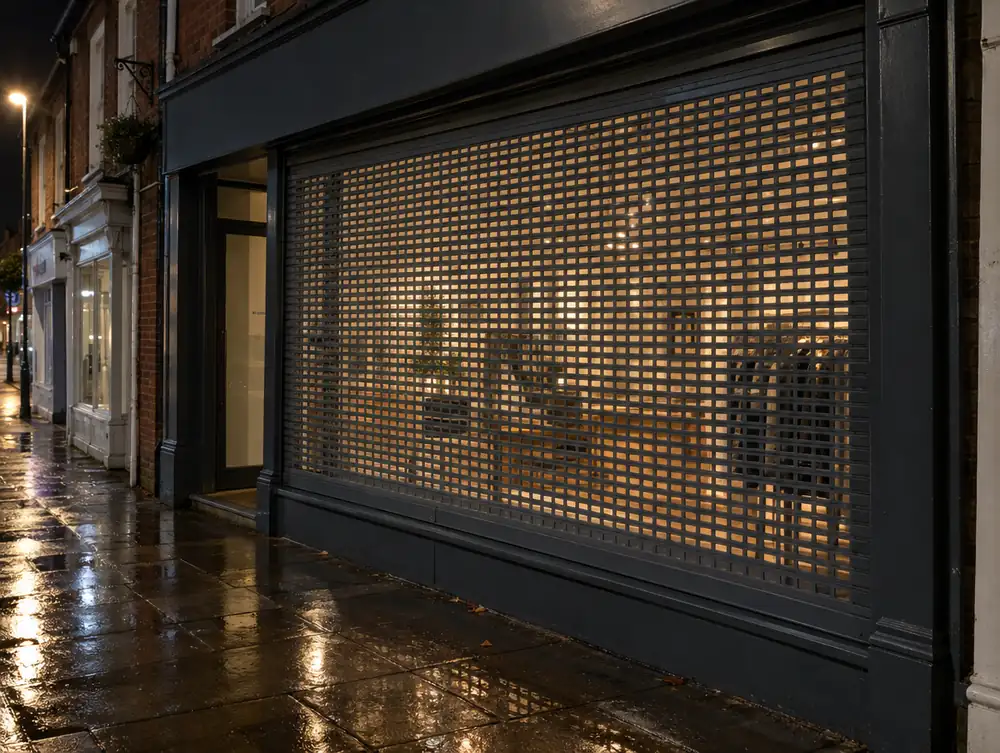
What goes into getting perforated roller shutters right in Chelsea?
If your Chelsea shopfront has a suspended ceiling behind it, an internal box can often hide above the tiles. Where the ceiling is solid or very low, we would look at a slim box in a painted bulkhead.
On premises with a recessed entrance, the shutter line needs careful thought. We usually bring it forward to the building line, or close the recess separately, so the doorway does not become a hiding place.
If your Chelsea unit is narrow, a central door can split a small window into two weak ones. Moving the door to one side gives you a single confident pane, provided the layout inside still works.
Which applications might perforated roller shutters in Chelsea involve?
A true like-for-like replacement usually needs no planning permission in England, because the external appearance isn't materially affected. New materials, a different glass line or altered proportions usually do count as material, so for perforated roller shutters at premises in the Chelsea area, an application is then likely. The council confirms which side of that line a job falls on.
At survey we check how things stand for your building, although applications for planning permission or advertisement consent here normally go to Royal Borough of Kensington and Chelsea.
How much could perforated roller shutters in Chelsea cost you?
Until the survey is done, plan on £1,695 to £4,495 plus VAT per shutter. Unusual sizes, fine detail and phased working push the figure up, while a simple brief and clear access keep it toward the lower end.
| Town | Chelsea |
|---|---|
| Area | Greater London |
| Postcode districts | SW10, SW3, SW5, SW7 |
| Planning authority | Royal Borough of Kensington and Chelsea |
| Building approval | Building Regulations (Approved Documents) |
| Distance from Great Barr | About 104 miles |
| Survey | Free for new work |
Does Royal Borough of Kensington and Chelsea publish shopfront guidance?
Yes, Shopfront Design Guidelines Supplementary Planning Document (2011). It tells applicants what the council expects from new and altered shopfronts. A few of the things it asks for:
- Stallriser height should not exceed the base of the pilasters, around 450mm, or the fascia depth, whichever is less.
- Box fascias are not to be used, and painted timber is treated as the most appropriate fascia on nineteenth-century buildings.
- External shutters are not acceptable across most of the borough, with internal open-link grilles preferred.
Questions about perforated roller shutters in Chelsea
Can I keep my window display lit behind a shutter in Chelsea?
Yes, and we recommend it. A low-level light on a timer costs very little and lets the display read through the perforations overnight.
Can one person open the shutter at my Chelsea shop?
Yes. Powered shutters run at the turn of a key or a button press, and a manual override is available if the power fails. We show your staff both at handover.
Do you remove old shutters in Chelsea?
Yes. Taking out the old curtain, box and guides, then making good the frontage, is shown as its own line in the itemised quotation.
Do I need planning permission to change a shopfront in the Chelsea area?
Usually yes, if the work materially affects the building's external appearance. England's shop permitted development rights exclude creating, altering or replacing a shopfront, so there is no shortcut. A true like-for-like replacement usually needs no application, and the council confirms the position.
Does the Equality Act apply to a shop entrance in the Chelsea area?
Yes. The Equality Act 2010 applies in England, as across Great Britain, and it requires reasonable steps to remove, alter or avoid physical features that disadvantage disabled people. The duty is anticipatory, so it looks at disabled people generally, and a new Services Code replaced the 2011 Code on 5 August 2026.