If you've admired a painted shopfront and wondered why yours can't look like that, it usually can. Send us the photo, and we'll draw a timber front for your Chelsea premises that captures what you liked.
Expect us to measure the opening, photograph the existing front and check how materials will reach it on the day, at a time you have agreed.
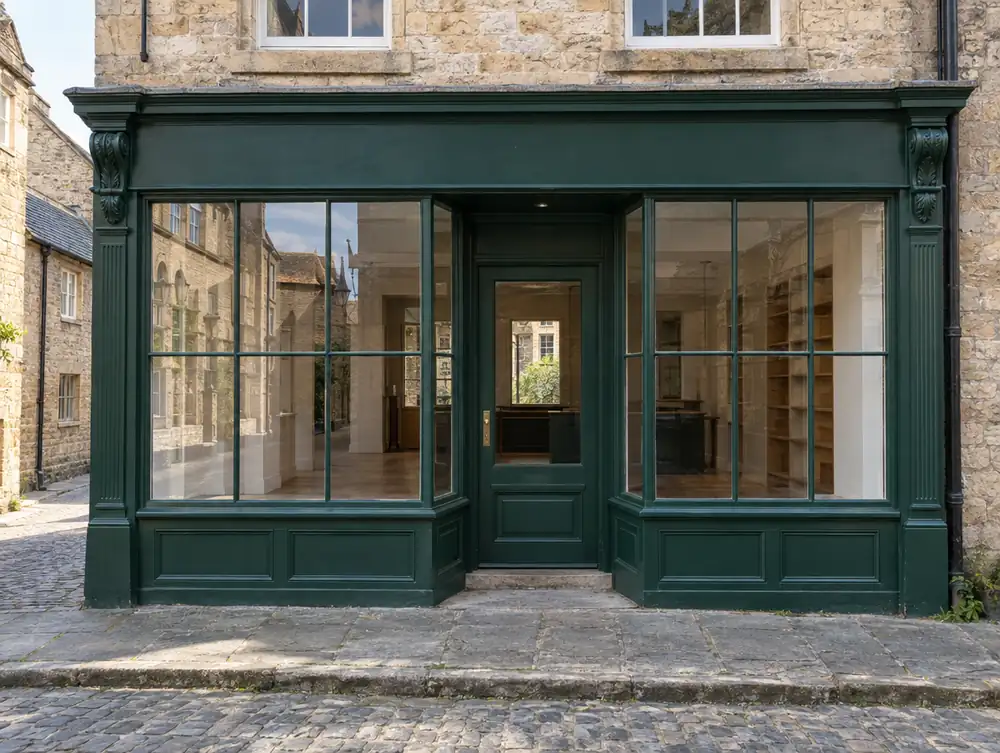
How do you design around the building when planning timber shopfronts in Chelsea?
Where a landlord in Chelsea has set rules for materials or colour, timber is usually an easy conversation. We'd prepare a drawing and paint reference for approval, and adjust the mouldings if the terms ask for something plainer.
In a parade of mixed fronts in Chelsea, painted timber can lift a unit without shouting. We'd take the height of the neighbouring cills and fascias, then let the depth of the mouldings and a considered colour do the talking.
Where the building has good brick or stone around the opening, set the frame back in the reveal so the masonry can be seen. On Chelsea premises with a flat elevation, that deep reveal throws a shadow line that adds real depth in low sun.
What might timber shopfronts cost in Chelsea?
We would budget £3,995 to £13,995 plus VAT for a typical frontage. Scope sets most of the figure, so a clear brief at the start does more for the budget than any later change of detail.
What permissions should you check for timber shopfronts in Chelsea?
Security grilles and shutters are named in England's rules: installing or replacing one on a shopfront sits outside the shop permitted development rights. The frontage itself is treated the same way, so for timber shopfronts at premises in the Chelsea area, building work that materially affects the appearance needs planning permission. Confirm the position with the council before anything is ordered.
Planning and advert applications for Chelsea premises normally go to Royal Borough of Kensington and Chelsea. We check the position for your address at survey.
| Town | Chelsea |
|---|---|
| Area | Greater London |
| Postcode districts | SW10, SW3, SW5, SW7 |
| Planning authority | Royal Borough of Kensington and Chelsea |
| Building approval | Building Regulations (Approved Documents) |
| Distance from Great Barr | About 104 miles |
| Survey | Free for new work |
Does Royal Borough of Kensington and Chelsea publish shopfront guidance?
Yes, Shopfront Design Guidelines Supplementary Planning Document (2011). It tells applicants what the council expects from new and altered shopfronts. A few of the things it asks for:
- Stallriser height should not exceed the base of the pilasters, around 450mm, or the fascia depth, whichever is less.
- Box fascias are not to be used, and painted timber is treated as the most appropriate fascia on nineteenth-century buildings.
- External shutters are not acceptable across most of the borough, with internal open-link grilles preferred.
Questions about timber shopfronts in Chelsea
Can you copy a timber shopfront I've seen in Greater London?
We can work from your photo and borrow what makes it succeed, including proportions, moulding sizes and colour. The front is then drawn to your own Chelsea opening.
Will timber suffer on my Chelsea frontage if it gets a lot of rain?
Not if the details are right. Sloped cills, sealed end grain and plinth blocks keep water moving, and the paint system then only has to deal with the weather, not trapped damp.
What should I budget for looking after a timber front in Chelsea?
A repaint every 5 to 7 years, plus a yearly wash and touch-up of the cills. Door gear needs checking too, since seasonal movement can throw a door out of line.
Does a new shopfront in the Chelsea area need Building Regulations approval?
Assume yes until building control says otherwise. England has no like-for-like exemption, though registered installers can self-certify replacement windows and doors in non-dwellings. That route doesn't cover structural glass, curtain walling or revolving doors.
Do I need planning permission to change a shopfront in the Chelsea area?
Usually yes, if the work materially affects the building's external appearance. England's shop permitted development rights exclude creating, altering or replacing a shopfront, so there is no shortcut. A true like-for-like replacement usually needs no application, and the council confirms the position.