Automatic sliding doors for Kensington premises start with how people reach your entrance. We look at the pavement, the footfall and the space either side of the opening before recommending a door.
Nothing gets ordered off the back of a survey in Kensington, because its job is to give us the numbers to draw and price from.
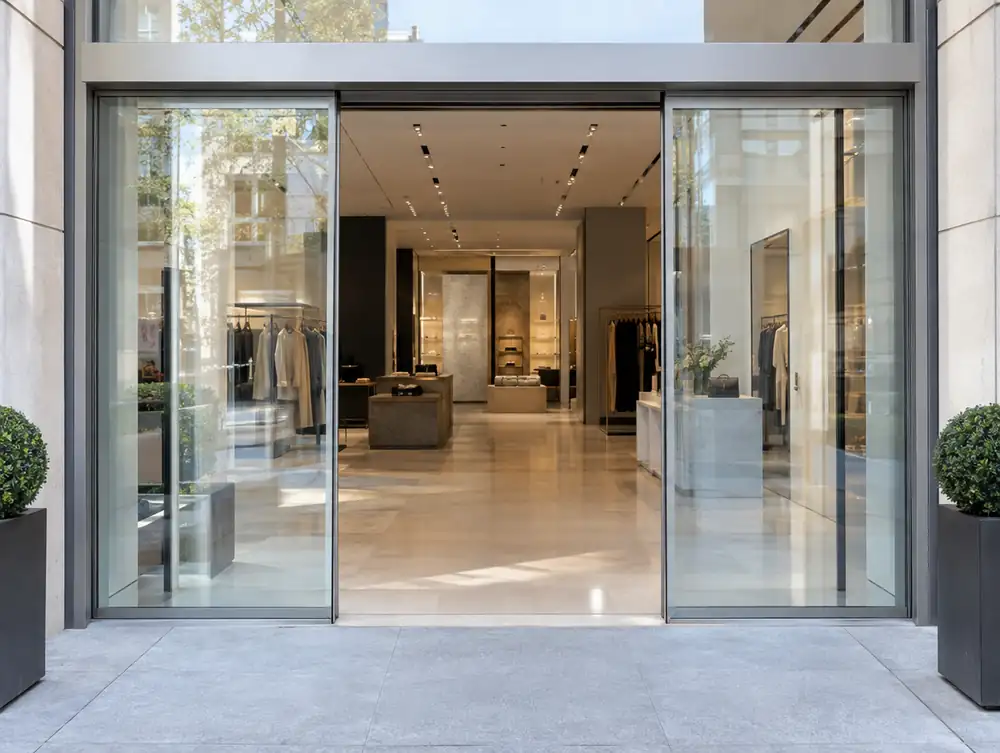
What goes into getting automatic sliding doors right in Kensington?
In a parade in Kensington with a narrow pavement, the sensor set-up is the first job. We'd angle the radar so people walking past don't trigger the door, and keep the leaves in line with the neighbouring frontage.
Automatic doors suit a night fit in Kensington, because most of the work is at the head and the opening stays usable in stages. We'd fit the track and leaves out of hours, then commission the door before you open.
If there are storeys above the shop, the frontage should feel like the base of the building and not a sign stuck on it. Lining up mullions with the windows overhead is a small move that settles the whole elevation at Kensington premises.
Which applications might automatic sliding doors in Kensington involve?
For automatic sliding doors at premises in the Kensington area, the deciding question in England is whether the building work materially affects the external appearance. If it does, planning permission is needed, while a true like-for-like replacement usually needs none. The council confirms the position for each site.
At survey we check how things stand for your building, although applications for planning permission or advertisement consent here normally go to Royal Borough of Kensington and Chelsea.
How much could automatic sliding doors in Kensington cost you?
The guide for automatic sliding doors is £3,895 to £11,995 plus VAT per entrance. Expect the lower end for simple work with clear access, and the upper end where detail, finish or awkward conditions add hours.
| Town | Kensington |
|---|---|
| Area | Greater London |
| Postcode districts | W8 |
| Planning authority | Royal Borough of Kensington and Chelsea |
| Building approval | Building Regulations (Approved Documents) |
| Distance from Great Barr | About 103 miles |
| Survey | Free for new work |
Does Royal Borough of Kensington and Chelsea publish shopfront guidance?
Yes, Shopfront Design Guidelines Supplementary Planning Document (2011). It tells applicants what the council expects from new and altered shopfronts. A few of the things it asks for:
- Stallriser height should not exceed the base of the pilasters, around 450mm, or the fascia depth, whichever is less.
- Box fascias are not to be used, and painted timber is treated as the most appropriate fascia on nineteenth-century buildings.
- External shutters are not acceptable across most of the borough, with internal open-link grilles preferred.
Questions about automatic sliding doors in Kensington
Can an automatic door work with my Kensington shop's alarm and locks?
Yes. The door can lock at closing, and it can link to your alarm or access control where the systems allow, with a manual key position as a fallback.
Will an automatic door fit my Kensington shop?
It depends on the width of the front and the depth at the head. A survey shows whether the parked leaves fit and where the operator can hide, and if a slider won't work we'd look at a powered swing door.
Will the door keep opening for passers-by in Kensington?
Not if it is set up properly. We narrow the sensor field on site and test it against real footfall, so only people heading for the door trigger it.
Does the Equality Act apply to a shop entrance in the Kensington area?
Yes. The Equality Act 2010 applies in England, as across Great Britain, and it requires reasonable steps to remove, alter or avoid physical features that disadvantage disabled people. The duty is anticipatory, so it looks at disabled people generally, and a new Services Code replaced the 2011 Code on 5 August 2026.
What rules apply to a fire exit door through a shopfront in the Kensington area?
It must open in the direction of escape and can't be locked against immediate use, and a dedicated fire exit can't be a sliding or revolving door. In England that comes from article 14(2) of the Regulatory Reform (Fire Safety) Order 2005, and the duty sits with the responsible person, normally the employer or whoever controls the premises for a business, otherwise the owner. An outward door can clash with section 153 of the Highways Act 1980 where it opens onto the footway, so raise it early.