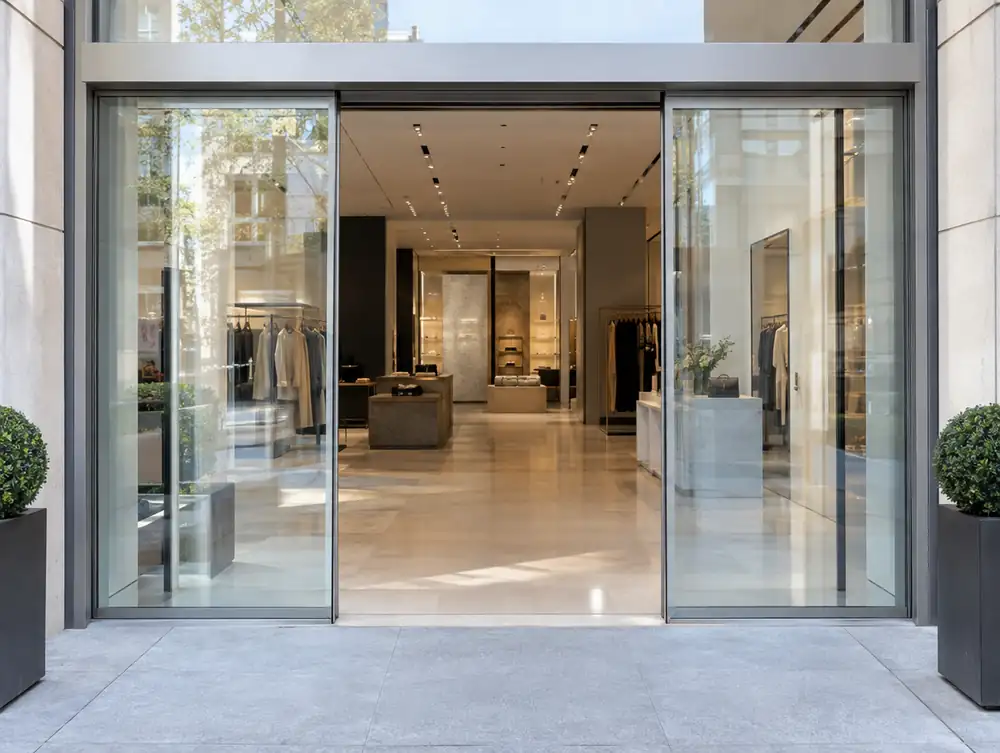
A slim framed slider can sit inside an existing Notting Hill frontage with little change to the outside. The drive hides behind the fascia, and the leaves line up with the screens either side.
Expect us to measure the opening, photograph the existing front and check how materials will reach it on the day, at a time you have agreed.
What makes automatic sliding doors work well on Notting Hill premises?
If your Notting Hill entrance catches low sun, infrared sensors can misread the light on the floor. We'd favour radar with a presence sensor set for those conditions, and consider solar control glass in the leaves.
Where a landlord in Notting Hill wants the frontage kept looking the same, a slim slider can sit behind the existing line. We'd draw the operator inside the fascia and give the landlord a clear elevation to approve.
On a north-facing frontage the glass stays free of glare, but the interior can look dim from the street, so lighting needs to sit closer to the window. If your Notting Hill premises face south, the problem flips to reflections by day and fading stock.
How much should you set aside for automatic sliding doors in Notting Hill?
Allow £3,895 to £11,995 plus VAT per entrance. Size and specification set most of that figure for automatic sliding doors, and the rest depends on what the survey finds on site.
Could automatic sliding doors in Notting Hill need planning permission?
England has no permitted development route for changing a shopfront. Part 7 Class A of the General Permitted Development Order 2015 excludes creating, altering or replacing one, and it allows no alterations at all on article 2(3) land. That leaves two outcomes for automatic sliding doors at premises in the Notting Hill area: a planning application, or work that doesn't materially affect the external appearance.
For Notting Hill, the usual route for planning and advert applications is through Royal Borough of Kensington and Chelsea, and we confirm that when we visit.
| Town | Notting Hill |
|---|---|
| Area | Greater London |
| Postcode districts | W10, W11, W12, W8 |
| Planning authority | Royal Borough of Kensington and Chelsea |
| Building approval | Building Regulations (Approved Documents) |
| Distance from Great Barr | About 102 miles |
| Survey | Free for new work |
Does Royal Borough of Kensington and Chelsea publish shopfront guidance?
Yes, Shopfront Design Guidelines Supplementary Planning Document (2011). It tells applicants what the council expects from new and altered shopfronts. A few of the things it asks for:
- Stallriser height should not exceed the base of the pilasters, around 450mm, or the fascia depth, whichever is less.
- Box fascias are not to be used, and painted timber is treated as the most appropriate fascia on nineteenth-century buildings.
- External shutters are not acceptable across most of the borough, with internal open-link grilles preferred.
Questions about automatic sliding doors in Notting Hill
Will an automatic door fit my Notting Hill shop?
It depends on the width of the front and the depth at the head. A survey shows whether the parked leaves fit and where the operator can hide, and if a slider won't work we'd look at a powered swing door.
What will people on the street see at my Notting Hill entrance?
Ideally, very little. The drive sits behind the fascia, the leaves line up with the screens beside them, and the frame colour matches the rest of your front.
Who installs automatic doors in Notting Hill?
Vetted door teams working under S&K Glazing handle the fit and set-up, travelling from Great Barr. Your agreement is with S&K Glazing Limited, and one person stays your point of call.
Does a new shopfront in the Notting Hill area need Building Regulations approval?
Assume yes until building control says otherwise. England has no like-for-like exemption, though registered installers can self-certify replacement windows and doors in non-dwellings. That route doesn't cover structural glass, curtain walling or revolving doors.
Do I need listed building consent for a shopfront in the Notting Hill area?
Usually yes, if the building is listed. In England the local planning authority decides, and Historic England is notified of Grade I and II* works and specified Grade II works. Like-for-like repair may not need consent, so ask the council before work starts.