Most shopfronts that look effortless took careful drawing. For Kensington premises we test proportion, material and lighting on paper, where changes cost very little.
We measure your Kensington opening in person, at a time agreed with you first, so the visit fits around your trading.
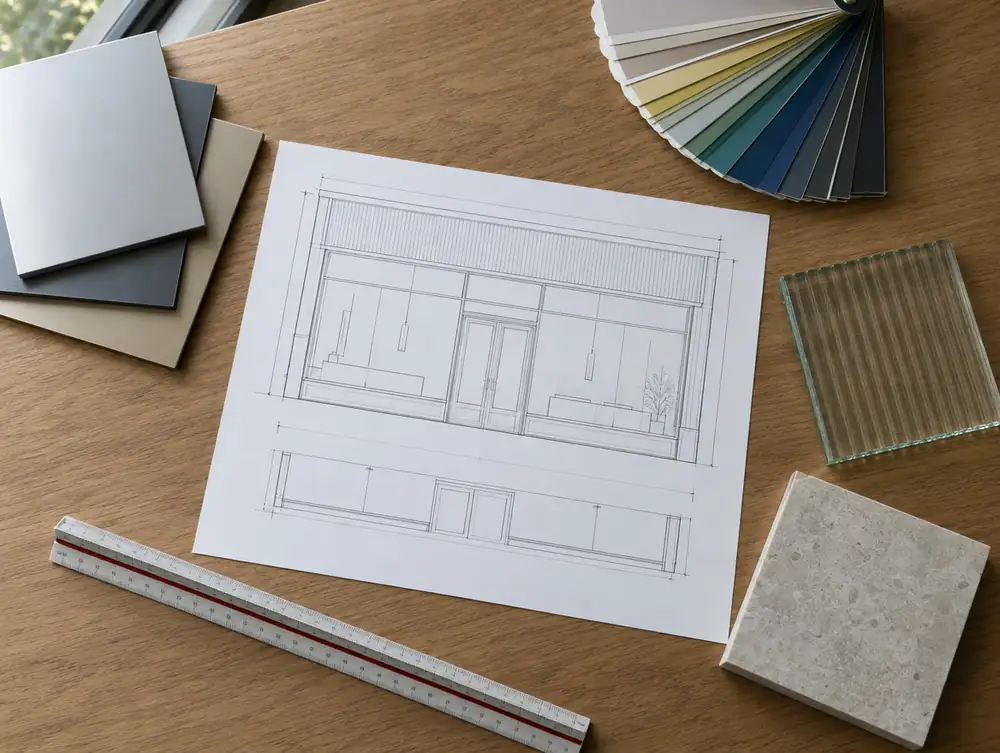
How do you design around the building when planning shopfront design in Kensington?
Should several trades be involved in your fit-out, we coordinate the frontage with the shopfitter's drawings. Ceiling lines, display depths and shutter boxes then agree with each other before work starts.
If your Kensington unit sits in a terrace, we draw the neighbouring frontages on the elevation too. Your design then has to work in context, which is how people will actually see it.
If the pavement falls across your frontage, let the stallriser take up the slope and keep the glass line dead level. The eye reads the long horizontal, so Kensington premises on a slope look settled once that line is true.
What might shopfront design cost in Kensington?
We would budget £495 to £2,495 plus VAT per frontage. Scope sets most of the figure, so a clear brief at the start does more for the budget than any later change of detail.
What permissions should you check for shopfront design in Kensington?
England has no permitted development route for changing a shopfront. Part 7 Class A of the General Permitted Development Order 2015 excludes creating, altering or replacing one, and it allows no alterations at all on article 2(3) land. That leaves two outcomes for shopfront work at premises in the Kensington area: a planning application, or work that doesn't materially affect the external appearance.
Expect planning and advert applications here to go to Royal Borough of Kensington and Chelsea in the normal way. We check what that means for your building when we survey it in Kensington.
| Town | Kensington |
|---|---|
| Area | Greater London |
| Postcode districts | W8 |
| Planning authority | Royal Borough of Kensington and Chelsea |
| Building approval | Building Regulations (Approved Documents) |
| Distance from Great Barr | About 103 miles |
| Survey | Free for new work |
Does Royal Borough of Kensington and Chelsea publish shopfront guidance?
Yes, Shopfront Design Guidelines Supplementary Planning Document (2011). It tells applicants what the council expects from new and altered shopfronts. A few of the things it asks for:
- Stallriser height should not exceed the base of the pilasters, around 450mm, or the fascia depth, whichever is less.
- Box fascias are not to be used, and painted timber is treated as the most appropriate fascia on nineteenth-century buildings.
- External shutters are not acceptable across most of the borough, with internal open-link grilles preferred.
Questions about shopfront design in Kensington
Can you design a frontage for Kensington premises I have not taken on yet?
Yes. A survey and concept drawing can show what the unit could become and what it might cost. That can be useful before you sign anything.
Can you show the design to my landlord in Greater London?
Yes. The drawings and visuals are prepared so a landlord or agent can review them easily. We can answer their questions directly if that helps.
How many options will I see for my Kensington premises?
Usually two or three directions at concept stage, then one developed design. If you already know what you want, we can go straight to the developed drawings.
Do I need planning permission to change a shopfront in the Kensington area?
Usually yes, if the work materially affects the building's external appearance. England's shop permitted development rights exclude creating, altering or replacing a shopfront, so there is no shortcut. A true like-for-like replacement usually needs no application, and the council confirms the position.
Does the Equality Act apply to a shop entrance in the Kensington area?
Yes. The Equality Act 2010 applies in England, as across Great Britain, and it requires reasonable steps to remove, alter or avoid physical features that disadvantage disabled people. The duty is anticipatory, so it looks at disabled people generally, and a new Services Code replaced the 2011 Code on 5 August 2026.