Seeing the frontage before it is built changes the conversation. You get scale drawings and a rendered view of your Earls Court premises, so you can judge it properly before committing.
Please have keys to any meter cupboards and shutter housings to hand when we survey in Earls Court, because what sits behind them can change the drawing.
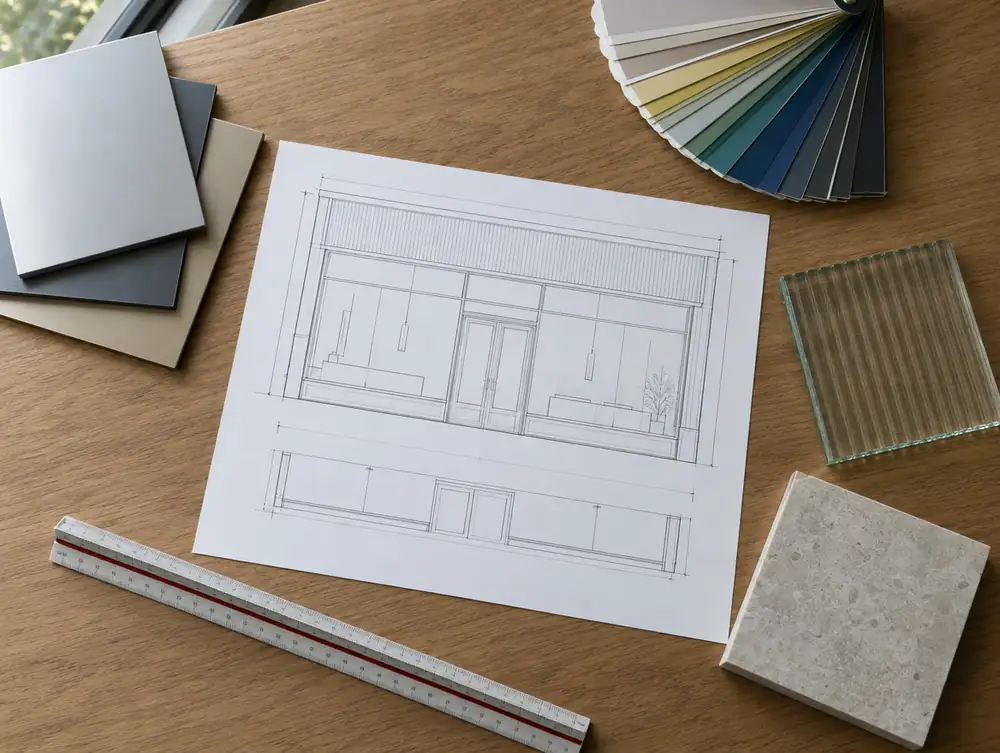
Where should you begin with shopfront design in Earls Court?
If the pavement falls along your frontage, we survey the levels before drawing a line. Door threshold, stallriser and sill are then set from the real ground, which is where designs drawn from photographs tend to fail.
If you trade after dark, we add an evening view to the drawings. Interior light, the sign and any shade change how the frontage reads, so we would sooner show you than describe it.
Where the footway outside your Earls Court premises is narrow, a recessed entrance earns its keep. It gives people a dry place to pause out of the walkway, and it adds a longer run of display glass either side of the door.
What sign-off might you need for shopfront design in Earls Court?
Security grilles and shutters are named in England's rules: installing or replacing one on a shopfront sits outside the shop permitted development rights. The frontage itself is treated the same way, so for shopfront work at premises in the Earls Court area, building work that materially affects the appearance needs planning permission. Confirm the position with the council before anything is ordered.
Expect planning and advert applications here to go to Royal Borough of Kensington and Chelsea in the normal way. We check what that means for your building when we survey it in Earls Court.
What price should you expect for shopfront design in Earls Court?
A sensible starting budget is £495 to £2,495 plus VAT per frontage. What shifts the figure is whatever can't be seen yet, such as the condition behind the old frontage or the services running through it.
| Town | Earls Court |
|---|---|
| Area | Greater London |
| Postcode districts | SW10, SW5, W14, W8 |
| Planning authority | Royal Borough of Kensington and Chelsea |
| Building approval | Building Regulations (Approved Documents) |
| Distance from Great Barr | About 103 miles |
| Survey | Free for new work |
Does Royal Borough of Kensington and Chelsea publish shopfront guidance?
Yes, Shopfront Design Guidelines Supplementary Planning Document (2011). It tells applicants what the council expects from new and altered shopfronts. A few of the things it asks for:
- Stallriser height should not exceed the base of the pilasters, around 450mm, or the fascia depth, whichever is less.
- Box fascias are not to be used, and painted timber is treated as the most appropriate fascia on nineteenth-century buildings.
- External shutters are not acceptable across most of the borough, with internal open-link grilles preferred.
Questions about shopfront design in Earls Court
Can you show the design to my landlord in Greater London?
Yes. The drawings and visuals are prepared so a landlord or agent can review them easily. We can answer their questions directly if that helps.
Can a design for Earls Court premises follow my brand guidelines?
Yes. Send them over with your logo files, and we apply them to your elevation. Where a rule does not fit the building, we explain why and suggest an adjustment.
Do I need a design service for a simple Earls Court shopfront?
Not always. Every job gets a measured survey and scale drawings anyway. The design service adds options, visuals and a full specification, which pay off when the look matters most.
Does the Equality Act apply to a shop entrance in the Earls Court area?
Yes. The Equality Act 2010 applies in England, as across Great Britain, and it requires reasonable steps to remove, alter or avoid physical features that disadvantage disabled people. The duty is anticipatory, so it looks at disabled people generally, and a new Services Code replaced the 2011 Code on 5 August 2026.
Does a new shopfront in the Earls Court area need Building Regulations approval?
Assume yes until building control says otherwise. England has no like-for-like exemption, though registered installers can self-certify replacement windows and doors in non-dwellings. That route doesn't cover structural glass, curtain walling or revolving doors.