Design, manufacture, wiring and fitting all sit under one contract for lit signs across Kensington and Greater London. Your named contact handles the job from measured survey to first switch-on.
Surveys for Kensington are booked with you directly. Tell us your quieter days and we'll work around them.
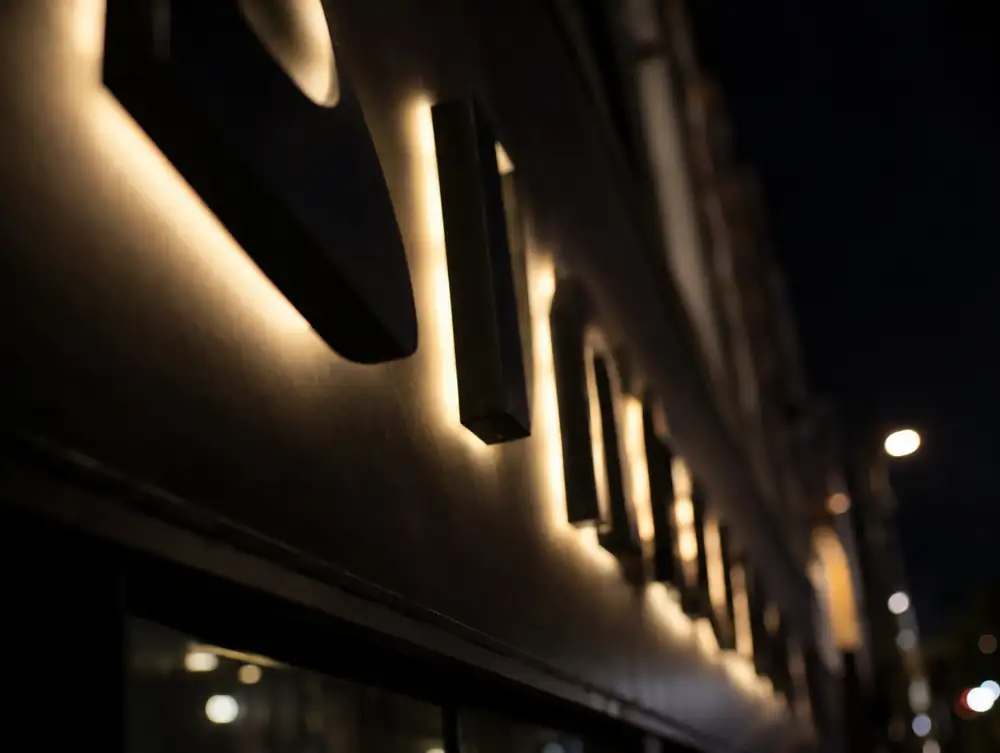
What makes illuminated signage work well on Kensington premises?
Where the interior is lit in warm tones, a cold white sign will look wrong from the street. We match the sign to the shop lighting behind the glass, so the two read as one scheme.
If your Kensington fascia is dark and glossy, halo light may disappear into it. We would test a sample or suggest a matt panel behind the letters, so the glow has something to land on.
A corner unit has two fronts to think about, and the return elevation often does as much selling as the main one. If that is your layout in Kensington, carry the fascia and glass line round the corner and treat both faces as one composition.
Could illuminated signage in Kensington need planning permission?
Security grilles and shutters are named in England's rules: installing or replacing one on a shopfront sits outside the shop permitted development rights. The frontage itself is treated the same way, so for illuminated signage at premises in the Kensington area, building work that materially affects the appearance needs planning permission. Confirm the position with the council before anything is ordered.
Class 4B, England's class for lit signs, isn't available in conservation areas, Areas of Outstanding Natural Beauty, National Parks or the Broads, so a lit sign there normally needs advertisement consent. In an area of special control it is unavailable too, and Class 5 drops to a 3.6m top height, 0.3m letters and one-tenth of the building face up to 3.6m. Ask the council which designations cover premises in the Kensington area.
At survey we check how things stand for your building, although applications for planning permission or advertisement consent here normally go to Royal Borough of Kensington and Chelsea.
How much should you set aside for illuminated signage in Kensington?
Our guide band is £895 to £3,995 plus VAT per sign. Scope is the biggest lever, so a tighter brief for illuminated signage brings the figure down faster than any change of detail.
| Town | Kensington |
|---|---|
| Area | Greater London |
| Postcode districts | W8 |
| Planning authority | Royal Borough of Kensington and Chelsea |
| Building approval | Building Regulations (Approved Documents) |
| Distance from Great Barr | About 103 miles |
| Survey | Free for new work |
Does Royal Borough of Kensington and Chelsea publish shopfront guidance?
Yes, Shopfront Design Guidelines Supplementary Planning Document (2011). It tells applicants what the council expects from new and altered shopfronts. A few of the things it asks for:
- Stallriser height should not exceed the base of the pilasters, around 450mm, or the fascia depth, whichever is less.
- Box fascias are not to be used, and painted timber is treated as the most appropriate fascia on nineteenth-century buildings.
- External shutters are not acceptable across most of the borough, with internal open-link grilles preferred.
Questions about illuminated signage in Kensington
Can an illuminated sign be fitted around trading in Kensington?
Yes. External fitting is usually done from a tower or platform with little effect on the shop, and internal cable work can be arranged out of hours.
Which illuminated sign suits a restaurant in Kensington?
Halo-lit letters in a warm white usually suit restaurants, as they feel calm and considered. A trough light over a painted sign is a good alternative for a more traditional room.
Can the sign in Kensington be switched off at night?
Yes. A timer, photocell or simple switch can be built in, and many premises set the sign to go off shortly after closing or late in the evening.
Does a shop sign in the Kensington area need advertisement consent?
Not always. In England, an unlit sign within Class 5 of the 2007 Advertisement Regulations generally needs no application, and neither does a lit sign within Class 4B. Anything outside those classes needs consent, and Class 4B isn't available in conservation areas, so check before ordering.
What rules apply to a fire exit door through a shopfront in the Kensington area?
It must open in the direction of escape and can't be locked against immediate use, and a dedicated fire exit can't be a sliding or revolving door. In England that comes from article 14(2) of the Regulatory Reform (Fire Safety) Order 2005, and the duty sits with the responsible person, normally the employer or whoever controls the premises for a business, otherwise the owner. An outward door can clash with section 153 of the Highways Act 1980 where it opens onto the footway, so raise it early.