On a warm evening, an open front does more for a cafe or bar in Kensington than any sign. We design the folding set around your seating, so the panels park where they don't cost you a table.
It helps if you can be there when we visit Kensington, since five minutes walking the frontage together answers more than a long email.
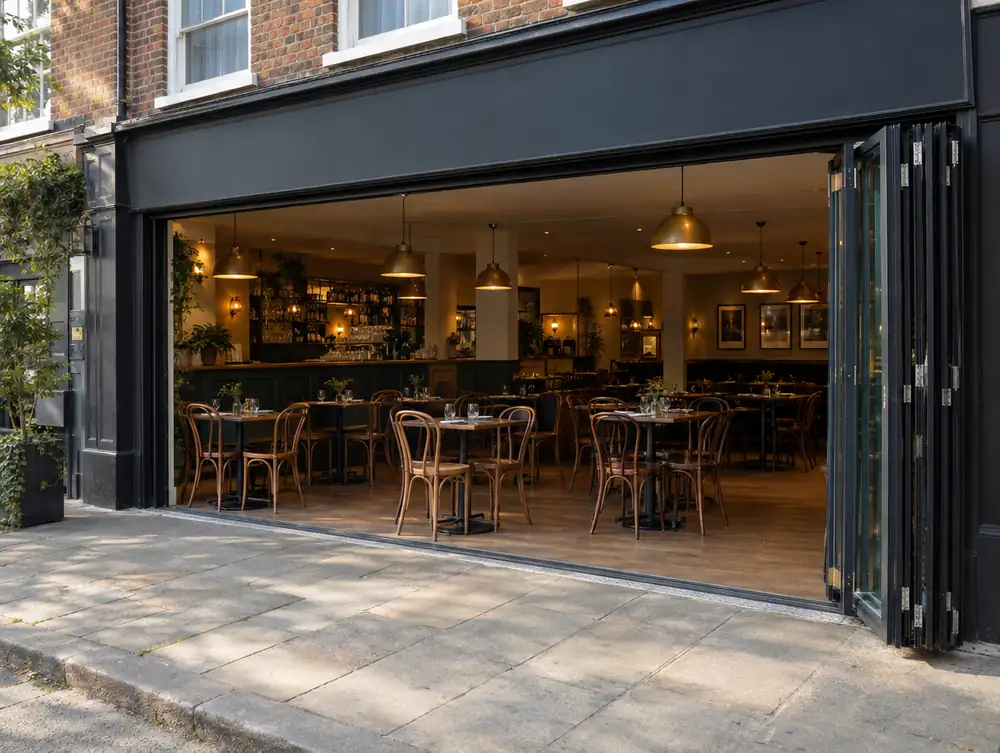
Where should you begin with bi-folding shopfronts in Kensington?
A corner plot offers something rare: a front that can open on two sides. For Kensington corner premises, we'd look at two sets meeting with no fixed post, provided the structure above can span it.
Landlords often worry about what a bi-fold does to the structure and the weather line. For a unit in Kensington we'd prepare a drawing of the head, threshold and reinstatement route, so the conversation is about detail rather than doubt.
If your premises were once two shops, decide early whether the front should read as one or as two. One continuous fascia with a repeated bay width usually settles the elevation better than two mismatched halves, which is worth testing on any Kensington unit of that kind.
What sign-off might you need for bi-folding shopfronts in Kensington?
England has no permitted development route for changing a shopfront. Part 7 Class A of the General Permitted Development Order 2015 excludes creating, altering or replacing one, and it allows no alterations at all on article 2(3) land. That leaves two outcomes for bi-folding shopfronts at premises in the Kensington area: a planning application, or work that doesn't materially affect the external appearance.
Planning and advert applications for Kensington premises normally go to Royal Borough of Kensington and Chelsea. We check the position for your address at survey.
What price should you expect for bi-folding shopfronts in Kensington?
A sensible starting budget is £5,195 to £13,995 plus VAT for a typical opening. What shifts the figure is whatever can't be seen yet, such as the condition behind the old frontage or the services running through it.
| Town | Kensington |
|---|---|
| Area | Greater London |
| Postcode districts | W8 |
| Planning authority | Royal Borough of Kensington and Chelsea |
| Building approval | Building Regulations (Approved Documents) |
| Distance from Great Barr | About 103 miles |
| Survey | Free for new work |
Does Royal Borough of Kensington and Chelsea publish shopfront guidance?
Yes, Shopfront Design Guidelines Supplementary Planning Document (2011). It tells applicants what the council expects from new and altered shopfronts. A few of the things it asks for:
- Stallriser height should not exceed the base of the pilasters, around 450mm, or the fascia depth, whichever is less.
- Box fascias are not to be used, and painted timber is treated as the most appropriate fascia on nineteenth-century buildings.
- External shutters are not acceptable across most of the borough, with internal open-link grilles preferred.
Questions about bi-folding shopfronts in Kensington
Will I lose a table to the stack in my Kensington restaurant?
Possibly one, but careful layout usually avoids it. We draw the folded panels on your floor plan, then look at moving the stack to a quieter corner or splitting the set in two.
Can I have a timber bi-fold on my Kensington frontage?
Yes. Painted hardwood sets suit older premises across Greater London, though the panels are heavier and need a stiffer head than aluminium.
How many panels would my Kensington opening need?
It depends on the width and how you want the set to open. Most openings divide into leaves under 1m wide, and an odd number gives you a daily door, so we draw the options after the measure-up.
Do I need planning permission to change a shopfront in the Kensington area?
Usually yes, if the work materially affects the building's external appearance. England's shop permitted development rights exclude creating, altering or replacing a shopfront, so there is no shortcut. A true like-for-like replacement usually needs no application, and the council confirms the position.
What rules apply to a fire exit door through a shopfront in the Kensington area?
It must open in the direction of escape and can't be locked against immediate use, and a dedicated fire exit can't be a sliding or revolving door. In England that comes from article 14(2) of the Regulatory Reform (Fire Safety) Order 2005, and the duty sits with the responsible person, normally the employer or whoever controls the premises for a business, otherwise the owner. An outward door can clash with section 153 of the Highways Act 1980 where it opens onto the footway, so raise it early.