From Inverness to the furthest corner of the Highlands and Moray, the sequence for revolving doors stays the same: survey, drawings, written price, then work on site. We travel from Great Barr in Birmingham and use vetted teams working under S&K Glazing.
Most frontages share something with someone, be that a door to the flats above, a meter cupboard or a pilaster on the boundary. We pick those up early on revolving doors in the Highlands and Moray, because they are far easier to design around than to discover on the day.
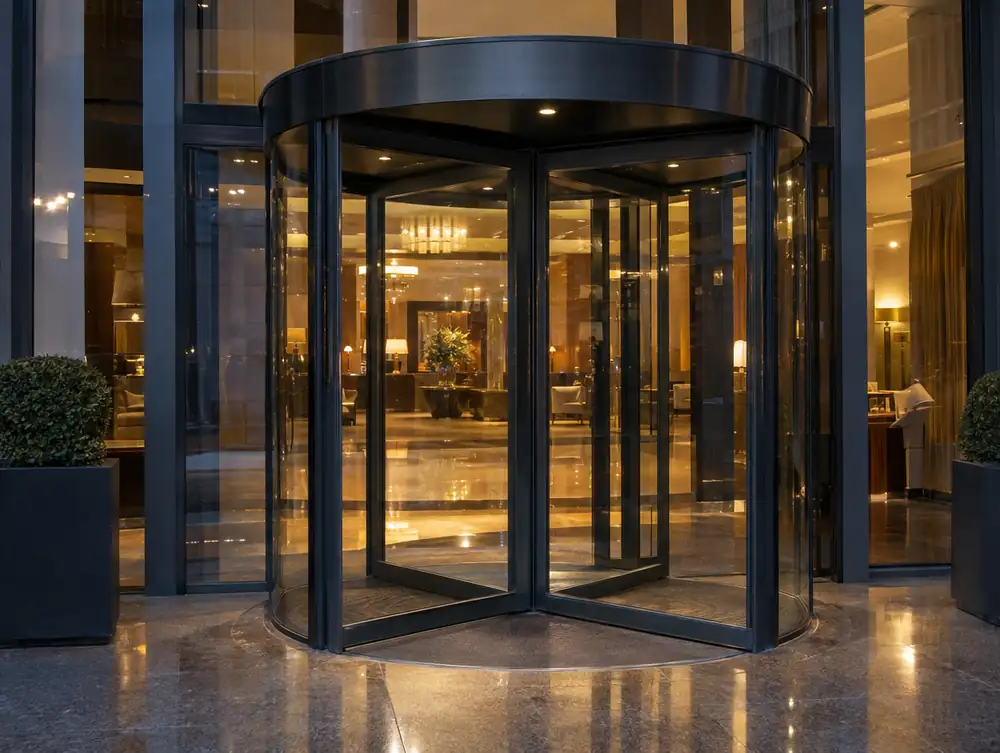
What should you look for from revolving doors in the Highlands and Moray?
Hotels, offices and flagship stores all use a drum differently. For a lobby in Inverness or elsewhere in the Highlands and Moray, we size the compartments for the people arriving, including their luggage, so the door never becomes the slowest part of the welcome.
Getting a drum into the building takes some thought. For addresses in the Highlands and Moray, we check how the curved panels and canopy reach the opening, since large pieces may need lifting gear or a delivery outside trading hours.
What consents apply to revolving doors in the Highlands and Moray?
Scottish guidance says like-for-like windows need no permission, and a true like-for-like frontage replacement usually follows the same logic. Class 7A covers altering or replacing an existing window, but it doesn't mention shopfronts, so ask before relying on it for a display window. For revolving doors at premises in the Highlands and Moray area, a material effect on the external appearance means planning permission, and the council confirms the position.
How much do revolving doors cost in the Highlands and Moray?
A sensible starting budget is £19,995 to £59,995 plus VAT per door. What shifts the figure is whatever can't be seen yet, such as the condition behind the old frontage or the services running through it.
| Area | Highlands and Moray |
|---|---|
| Nation | Scotland |
| Towns covered | 5 |
| Main town | Inverness |
| Planning regime | Scotland: 1997 Planning Act and the 1984 Advertisement Regulations |
| Building approval | Building warrant (Technical Handbook) |
| Survey | By arrangement |
Does The Highland Council publish shopfront guidance?
Yes, Shopfront Design Guide: Planning Guidance (2018). It tells applicants what the council expects from new and altered shopfronts. A few of the things it asks for:
- Stallrisers should be at least 400mm high, and glazing to ground level is generally not acceptable on traditional shopfronts.
- Fascias must not be internally lit or span more than one building, and lettering should fill no more than two-thirds of the fascia.
- Solid shutters are not supported, and external retractable shuttering is unlikely to be acceptable in conservation areas or on listed buildings.
Questions about revolving doors in the Highlands and Moray
Can you replace an old revolving door in Inverness?
Often, yes. We'd measure the existing drum and floor, then advise on refurbishing or replacing it, and a like-sized drum keeps the building work down.
Is my entrance in Inverness big enough for a revolving door?
It may be, if the frontage or lobby is generous. A 2.1m drum takes around 2.4m each way, and you'll need room for a side door as well.
Do you install revolving doors in the Highlands and Moray?
Yes. We travel from Great Barr to survey the entrance, and the floor, structure and door are coordinated under one contract.
Do roller shutters need planning permission in the Highlands and Moray area?
Usually yes, if they materially affect the external appearance. Class 9A doesn't name shutters, so in Scotland treat them as falling to the appearance test rather than assuming a permitted development route. Ask the council before ordering, as this is a reading of the rules and not an official statement.
Do I need a building warrant for a shopfront in the Highlands and Moray area?
Usually yes in Scotland, if the work alters a wall or structure. Schedule 3 of the Building (Scotland) Regulations 2004 lists some work that needs no warrant, such as replacing a door or window with its frame, but the standards still apply. Shopfronts aren't named there, so ask the council before relying on it.