Seen a frontage you admire? Bring the picture to our first talk about frameless glass shopfronts in the Highlands and Moray, and we will work out what makes it succeed, from fascia depth to glass line, and what that means for your building.
Finishes behave differently at full size. Any sample we show you for frameless glass shopfronts is better judged at the premises in daylight, since a colour that looks quiet on a desk can read much louder across a whole elevation.
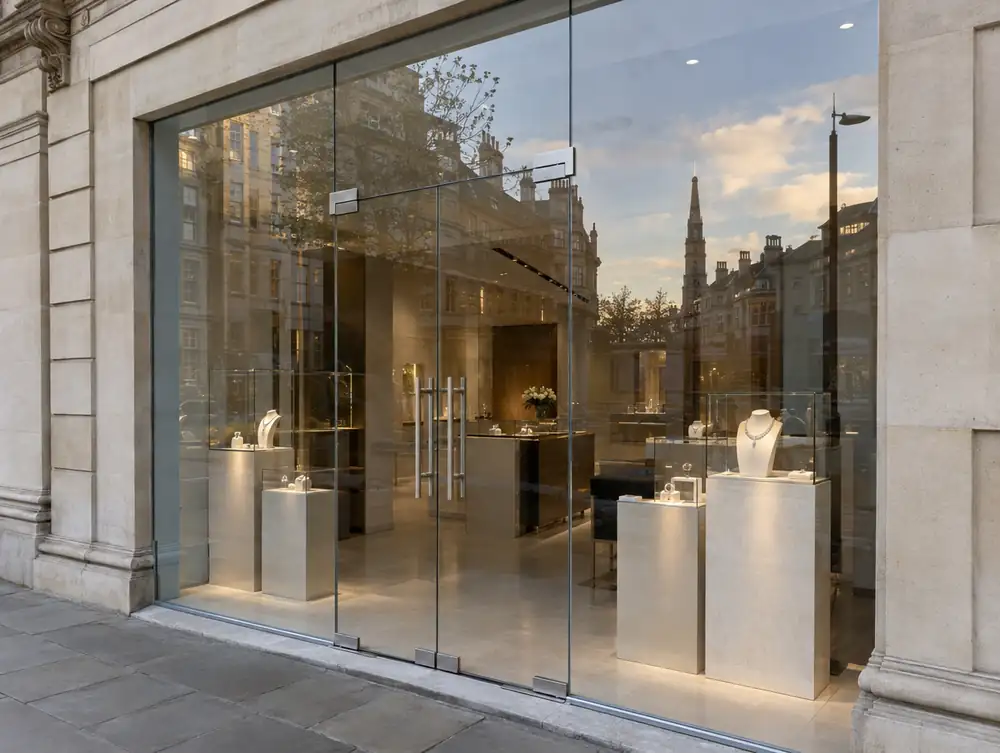
How do we handle frameless glass shopfronts for premises in the Highlands and Moray?
If your premises in the Highlands and Moray sit on a slope, a frameless front has nowhere to hide the fall. We'd step the floor channel behind a low plinth, or set the joints so each pane takes one level, rather than leaving a wedge of silicone at the pavement.
A frameless front leaves your interior on show all day. For restaurants, salons and boutiques across the Highlands and Moray, we look at the view from the pavement, including the backs of display units, till cables and ceiling services, and agree how to deal with them before the glass goes in.
What consents apply to frameless glass shopfronts in the Highlands and Moray?
Shutters aren't named in Class 9A, so in Scotland they usually fall to the appearance test. The same goes for frameless glass shopfronts at premises in the Highlands and Moray area: building work that materially affects the external appearance needs planning permission, and a true like-for-like usually doesn't. Ask the council to confirm the position for your site.
How much do frameless glass shopfronts cost in the Highlands and Moray?
Until the survey is done, plan on £4,995 to £15,995 plus VAT for a typical frontage. Unusual sizes, fine detail and phased working push the figure up, while a simple brief and clear access keep it toward the lower end.
| Area | Highlands and Moray |
|---|---|
| Nation | Scotland |
| Towns covered | 5 |
| Main town | Inverness |
| Planning regime | Scotland: 1997 Planning Act and the 1984 Advertisement Regulations |
| Building approval | Building warrant (Technical Handbook) |
| Survey | By arrangement |
Does The Highland Council publish shopfront guidance?
Yes, Shopfront Design Guide: Planning Guidance (2018). It tells applicants what the council expects from new and altered shopfronts. A few of the things it asks for:
- Stallrisers should be at least 400mm high, and glazing to ground level is generally not acceptable on traditional shopfronts.
- Fascias must not be internally lit or span more than one building, and lettering should fill no more than two-thirds of the fascia.
- Solid shutters are not supported, and external retractable shuttering is unlikely to be acceptable in conservation areas or on listed buildings.
Questions about frameless glass shopfronts in the Highlands and Moray
Do you need to close the shop to fit frameless glass in the Highlands and Moray?
Usually for part of the job. The old front has to come out before the new panes go in, so a closed day or an out-of-hours fit tends to be the tidiest answer.
Can you install frameless glass shopfronts across the Highlands and Moray?
Yes. The survey, check measure and fitting are all arranged from Great Barr, and the panes come to site when the opening is ready.
Can a frameless front in the Highlands and Moray still have a shutter?
Yes, and an internal shutter usually suits it better than an external one because the glass stays on show. We'd draw the box behind the fascia from the start.
Do roller shutters need planning permission in the Highlands and Moray area?
Usually yes, if they materially affect the external appearance. Class 9A doesn't name shutters, so in Scotland treat them as falling to the appearance test rather than assuming a permitted development route. Ask the council before ordering, as this is a reading of the rules and not an official statement.
Do I need planning permission to alter a shopfront in the Highlands and Moray area?
Usually yes, if the work materially affects the external appearance. Class 9A, Scotland's shop permitted development right, doesn't cover work that alters or extends beyond the existing front. A true like-for-like replacement usually needs no permission, and the council confirms the position.