For accessible entrances across the Highlands and Moray, we draw first and order later. You see a scale drawing with signed-off dimensions before anything is made, so the frontage on paper is the frontage you get.
If you're a tenant, your landlord will probably want to see what is proposed. The scale drawings we produce for accessible entrances are clear enough to send straight on, which saves a round of explaining.
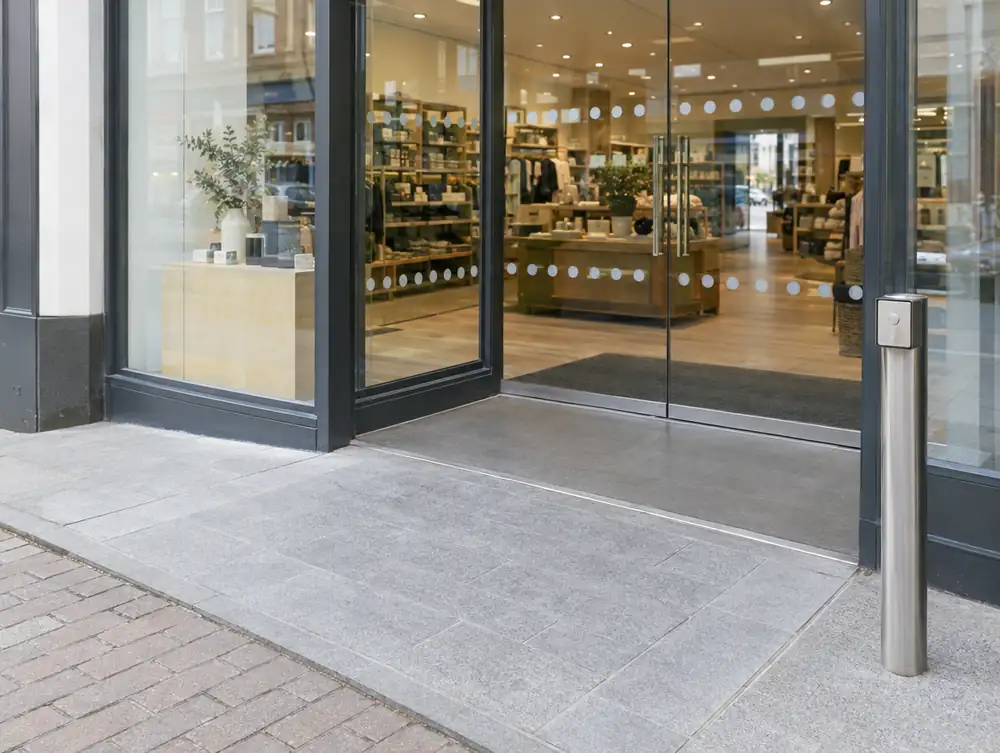
What makes accessible entrances work well for premises in the Highlands and Moray?
A stone step or old threshold can be worth keeping for its character. If your premises in the Highlands and Moray have one, we look at ways of working around it, such as a slim ramp within the recess or a second entrance to one side.
Pavements set the challenge. For premises across the Highlands and Moray, we take levels along the frontage and into the shop, because one end of a unit may sit almost level while the other is a full step above the street.
What consents apply to accessible entrances in the Highlands and Moray?
Class 9A, Scotland's shop permitted development right, gives no route for a shopfront change. It covers Class 1A premises, but not work that alters or extends beyond the existing front, and it doesn't apply in conservation areas, National Parks or World Heritage Sites. For accessible entrances at premises in the Highlands and Moray area, that generally means a planning application unless the external appearance isn't materially affected.
How much do accessible entrances cost in the Highlands and Moray?
The guide for accessible entrances is £995 to £6,995 plus VAT depending on the work. Expect the lower end for simple work with clear access, and the upper end where detail, finish or awkward conditions add hours.
| Area | Highlands and Moray |
|---|---|
| Nation | Scotland |
| Towns covered | 5 |
| Main town | Inverness |
| Planning regime | Scotland: 1997 Planning Act and the 1984 Advertisement Regulations |
| Building approval | Building warrant (Technical Handbook) |
| Survey | By arrangement |
Does The Highland Council publish shopfront guidance?
Yes, Shopfront Design Guide: Planning Guidance (2018). It tells applicants what the council expects from new and altered shopfronts. A few of the things it asks for:
- Stallrisers should be at least 400mm high, and glazing to ground level is generally not acceptable on traditional shopfronts.
- Fascias must not be internally lit or span more than one building, and lettering should fill no more than two-thirds of the fascia.
- Solid shutters are not supported, and external retractable shuttering is unlikely to be acceptable in conservation areas or on listed buildings.
Questions about accessible entrances in the Highlands and Moray
Will a powered door suit a small shop in the Highlands and Moray?
Often, yes. A low-energy swing operator suits small entrances and quieter footfall, and the door can still be used by hand.
Can work on my Highlands and Moray entrance be done around trading?
Usually. Most threshold and door work can happen out of hours, and we'd keep one route into the shop open wherever we can.
Can you help customers with mobility scooters at premises in Inverness?
We can look at the door width, the turning space inside and the threshold together, as scooters need more room than most wheelchairs.
Does a shop sign in the Highlands and Moray area need advertisement consent?
Not always. Scotland's 1984 Regulations let an unlit sign within Class IV(1) go up without an application, and Class VI does the same for a lit sign with each character lit from within. Class VI isn't available in conservation areas, and one council says lit signs always need express consent, so ask first.
Which way must a fire exit door open on a shop in the Highlands and Moray area?
In the direction of escape. Regulation 13(2) of the Fire Safety (Scotland) Regulations 2006 also rules out sliding and revolving doors on a dedicated fire exit and says fire exit doors can't be locked against immediate use. Duties sit with dutyholders under Part 3 of the Fire (Scotland) Act 2005, meaning the employer and any person with control of the premises.