For bronze and metal shopfronts across the Highlands and Moray, we draw first and order later. You see a scale drawing with signed-off dimensions before anything is made, so the frontage on paper is the frontage you get.
Most frontages share something with someone, be that a door to the flats above, a meter cupboard or a pilaster on the boundary. We pick those up early on bronze and metal shopfronts in the Highlands and Moray, because they are far easier to design around than to discover on the day.
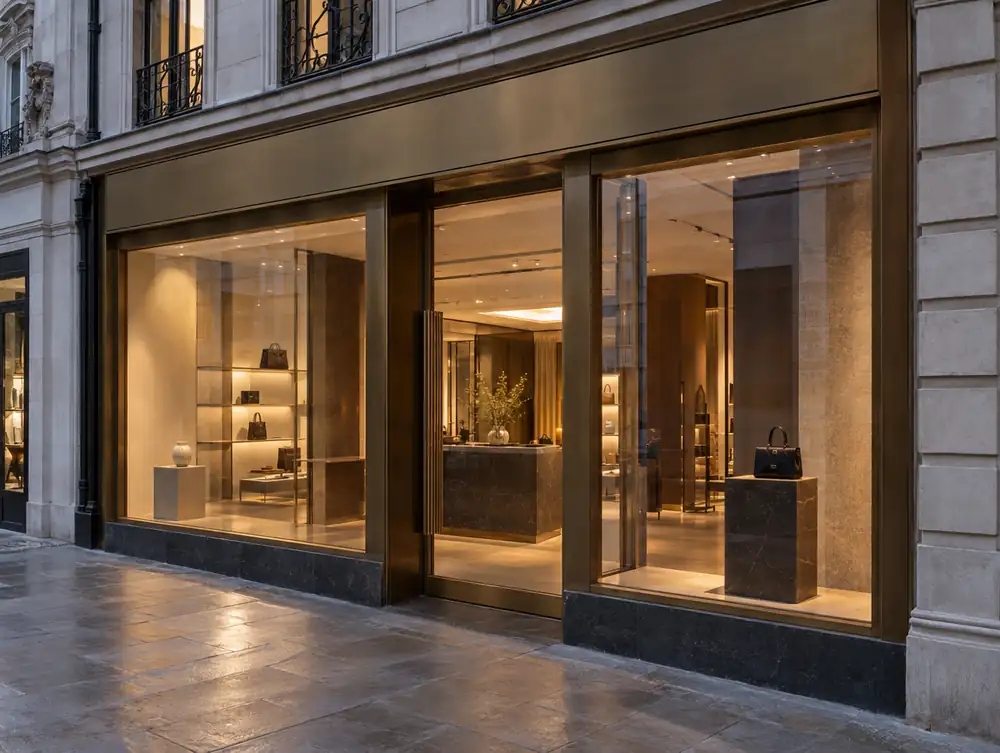
Where do you start with bronze and metal shopfronts in the Highlands and Moray?
Metal needs an owner once the job is finished. For any site in the Highlands and Moray, we'd agree who cleans it, with what and how often, so the finish still looks right several years on.
Two metals can share one front if the plan is clear. For premises in the Highlands and Moray we'd often pair a dark bronze frame with brass handles or lettering, keeping each metal to its own job so the eye reads one idea.
What consents apply to bronze and metal shopfronts in the Highlands and Moray?
Class 9A, Scotland's shop permitted development right, gives no route for a shopfront change. It covers Class 1A premises, but not work that alters or extends beyond the existing front, and it doesn't apply in conservation areas, National Parks or World Heritage Sites. For bronze and metal shopfronts at premises in the Highlands and Moray area, that generally means a planning application unless the external appearance isn't materially affected.
How much do bronze and metal shopfronts cost in the Highlands and Moray?
The guide for bronze and metal shopfronts is £7,995 to £24,995 plus VAT for a typical frontage. Expect the lower end for simple work with clear access, and the upper end where detail, finish or awkward conditions add hours.
| Area | Highlands and Moray |
|---|---|
| Nation | Scotland |
| Towns covered | 5 |
| Main town | Inverness |
| Planning regime | Scotland: 1997 Planning Act and the 1984 Advertisement Regulations |
| Building approval | Building warrant (Technical Handbook) |
| Survey | By arrangement |
Does The Highland Council publish shopfront guidance?
Yes, Shopfront Design Guide: Planning Guidance (2018). It tells applicants what the council expects from new and altered shopfronts. A few of the things it asks for:
- Stallrisers should be at least 400mm high, and glazing to ground level is generally not acceptable on traditional shopfronts.
- Fascias must not be internally lit or span more than one building, and lettering should fill no more than two-thirds of the fascia.
- Solid shutters are not supported, and external retractable shuttering is unlikely to be acceptable in conservation areas or on listed buildings.
Questions about bronze and metal shopfronts in the Highlands and Moray
Can you fit a metal front around trading in the Highlands and Moray?
Yes, closed-day or out-of-hours fitting can be arranged. Metal skins go on last, so the dusty work is finished before any visible finish arrives.
Can metal finishes match a brand's colours across the Highlands and Moray?
Often. PVD and anodised tones cover a useful range of warm and dark colours, and we can compare them against your brand reference at the survey.
Will a bronze front suit premises in Inverness?
It can, provided the colour works with the building and the light on your side of the street. We'd show samples on site instead of deciding from a photograph.
Do I need listed building consent for a shopfront in the Highlands and Moray area?
Almost certainly, if the building is listed and windows or doors are changing, according to Historic Environment Scotland. The planning authority decides, and Historic Environment Scotland is consulted on some applications. Scottish Ministers are notified if it objects.
Do I need a building warrant for a shopfront in the Highlands and Moray area?
Usually yes in Scotland, if the work alters a wall or structure. Schedule 3 of the Building (Scotland) Regulations 2004 lists some work that needs no warrant, such as replacing a door or window with its frame, but the standards still apply. Shopfronts aren't named there, so ask the council before relying on it.