Our quotation for shopfront refurbishment in the Highlands and Moray is written, itemised and valid for 90 days. Nothing is ordered until you accept it, which gives you time to take it to a landlord, a partner or a board.
Most frontages share something with someone, be that a door to the flats above, a meter cupboard or a pilaster on the boundary. We pick those up early on shopfront refurbishment in the Highlands and Moray, because they are far easier to design around than to discover on the day.
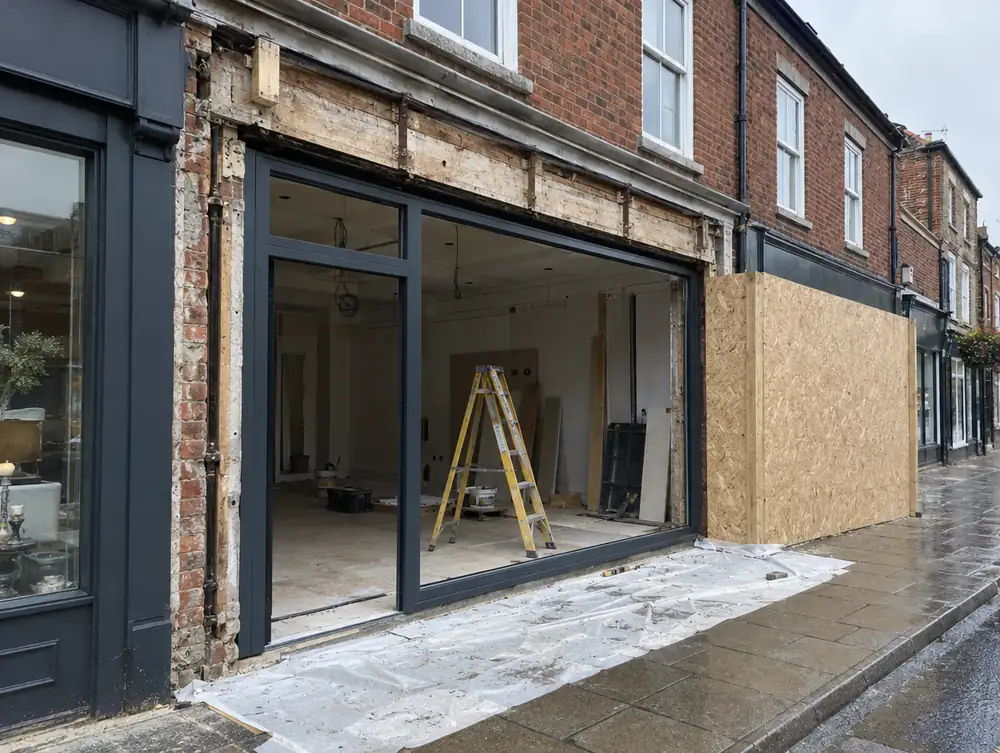
Where do you start with shopfront refurbishment in the Highlands and Moray?
A condition walk comes first. For a unit around Inverness we go over every frame, joint and seal with you, then separate what must be done from what would be nice to do.
Landlords with several units can refresh them in sequence. If you own premises across the Highlands and Moray, we would draw one palette and one sign zone, then carry them out as each unit falls vacant.
What consents apply to shopfront refurbishment in the Highlands and Moray?
Class 9A, Scotland's shop permitted development right, gives no route for a shopfront change. It covers Class 1A premises, but not work that alters or extends beyond the existing front, and it doesn't apply in conservation areas, National Parks or World Heritage Sites. For shopfront refurbishment at premises in the Highlands and Moray area, that generally means a planning application unless the external appearance isn't materially affected.
How much does shopfront refurbishment cost in the Highlands and Moray?
Guide price: £1,995 to £8,995 plus VAT depending on what is kept. Materials, finish and the amount of drawing and coordination involved all move it, and your itemised quotation shows where the money goes on shopfront refurbishment.
| Area | Highlands and Moray |
|---|---|
| Nation | Scotland |
| Towns covered | 5 |
| Main town | Inverness |
| Planning regime | Scotland: 1997 Planning Act and the 1984 Advertisement Regulations |
| Building approval | Building warrant (Technical Handbook) |
| Survey | By arrangement |
Does The Highland Council publish shopfront guidance?
Yes, Shopfront Design Guide: Planning Guidance (2018). It tells applicants what the council expects from new and altered shopfronts. A few of the things it asks for:
- Stallrisers should be at least 400mm high, and glazing to ground level is generally not acceptable on traditional shopfronts.
- Fascias must not be internally lit or span more than one building, and lettering should fill no more than two-thirds of the fascia.
- Solid shutters are not supported, and external retractable shuttering is unlikely to be acceptable in conservation areas or on listed buildings.
Questions about shopfront refurbishment in the Highlands and Moray
Can a refurbishment run alongside a new tenant's fit-out in the Highlands and Moray?
Yes, and that is often the ideal moment, as the frontage can be opened up without disturbing trade. We coordinate dates with your shopfitter through one named contact.
Can you budget a refurbishment in the Highlands and Moray from a photograph?
Only roughly, and we would not call it a price. Every figure comes from a measure-up, because the condition behind the paint is what sets the cost.
Do you repair original tile or joinery in the Highlands and Moray?
Yes, where it can be saved. Tile can be cleaned and repaired with matched pieces, and joinery can be spliced with new hardwood. We show you the options at survey.
Which way must a fire exit door open on a shop in the Highlands and Moray area?
In the direction of escape. Regulation 13(2) of the Fire Safety (Scotland) Regulations 2006 also rules out sliding and revolving doors on a dedicated fire exit and says fire exit doors can't be locked against immediate use. Duties sit with dutyholders under Part 3 of the Fire (Scotland) Act 2005, meaning the employer and any person with control of the premises.
Do I need planning permission to alter a shopfront in the Highlands and Moray area?
Usually yes, if the work materially affects the external appearance. Class 9A, Scotland's shop permitted development right, doesn't cover work that alters or extends beyond the existing front. A true like-for-like replacement usually needs no permission, and the council confirms the position.