Every enquiry for illuminated signage in the Highlands and Moray begins with a measured survey at the premises, because a price taken from a photograph is only a guess. That visit gives you real dimensions before anyone draws a line or orders a thing.
Finishes behave differently at full size. Any sample we show you for illuminated signage is better judged at the premises in daylight, since a colour that looks quiet on a desk can read much louder across a whole elevation.
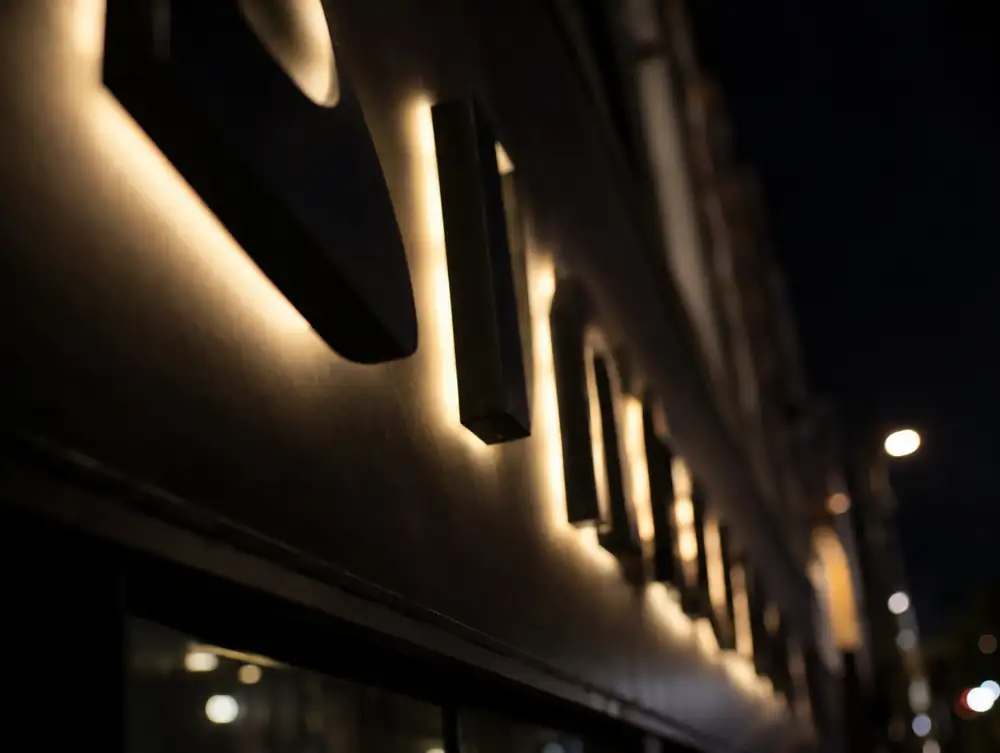
What should you settle before committing to illuminated signage in the Highlands and Moray?
Power often sets the layout. On a frontage near Inverness we trace where a supply can reach the sign without surface trunking, and we leave the drivers where they can be changed.
Flats or hotel rooms nearby change the brief. Where premises in the Highlands and Moray have neighbours close by at night, a warmer white, lower output and a late timer keep the sign welcome.
What consents apply to illuminated signage in the Highlands and Moray?
Section 26 of the Town and Country Planning (Scotland) Act 1997 sets the test: work that doesn't materially affect the external appearance isn't development. For illuminated signage at premises in the Highlands and Moray area, anything that does needs planning permission, and a true like-for-like replacement usually doesn't. The council confirms how that applies to each site.
Class VI isn't available in Scottish conservation areas, so a lit sign there normally needs advertisement consent. Special control areas are tighter again: no Class VI, and Class IV limited to a 3.6m top height, 0.3m letters and one-twelfth of the building face. The council can say which designations cover premises in the Highlands and Moray area.
How much does illuminated signage cost in the Highlands and Moray?
Allow £895 to £3,995 plus VAT per sign. Size and specification set most of that figure for illuminated signage, and the rest depends on what the survey finds on site.
| Area | Highlands and Moray |
|---|---|
| Nation | Scotland |
| Towns covered | 5 |
| Main town | Inverness |
| Planning regime | Scotland: 1997 Planning Act and the 1984 Advertisement Regulations |
| Building approval | Building warrant (Technical Handbook) |
| Survey | By arrangement |
Does The Highland Council publish shopfront guidance?
Yes, Shopfront Design Guide: Planning Guidance (2018). It tells applicants what the council expects from new and altered shopfronts. A few of the things it asks for:
- Stallrisers should be at least 400mm high, and glazing to ground level is generally not acceptable on traditional shopfronts.
- Fascias must not be internally lit or span more than one building, and lettering should fill no more than two-thirds of the fascia.
- Solid shutters are not supported, and external retractable shuttering is unlikely to be acceptable in conservation areas or on listed buildings.
Questions about illuminated signage in the Highlands and Moray
How disruptive is fitting a lit sign in the Highlands and Moray?
Very little, as a rule. Fitting usually takes one to two days from a tower or platform, and any cable work inside the shop can be done outside trading hours.
Can a lit sign in the Highlands and Moray be set on a timer?
Yes, and we would recommend it. A timer or photocell switches the sign to suit your trading hours, and it can dim or switch off late in the evening.
Do you arrange the electrics for signs around Inverness?
Yes. Low-voltage wiring and testing are part of the installation, with the final connection made by a qualified electrician. Any supply work needed is shown on the itemised quotation.
Do roller shutters need planning permission in the Highlands and Moray area?
Usually yes, if they materially affect the external appearance. Class 9A doesn't name shutters, so in Scotland treat them as falling to the appearance test rather than assuming a permitted development route. Ask the council before ordering, as this is a reading of the rules and not an official statement.
Does the Equality Act cover a shop entrance in the Highlands and Moray area?
Yes. The Equality Act 2010 applies in Scotland as part of Great Britain, and its anticipatory duty expects reasonable steps to remove, alter or avoid physical features that disadvantage disabled people generally. BS 8300-2:2018 is the current British Standard for accessible buildings.