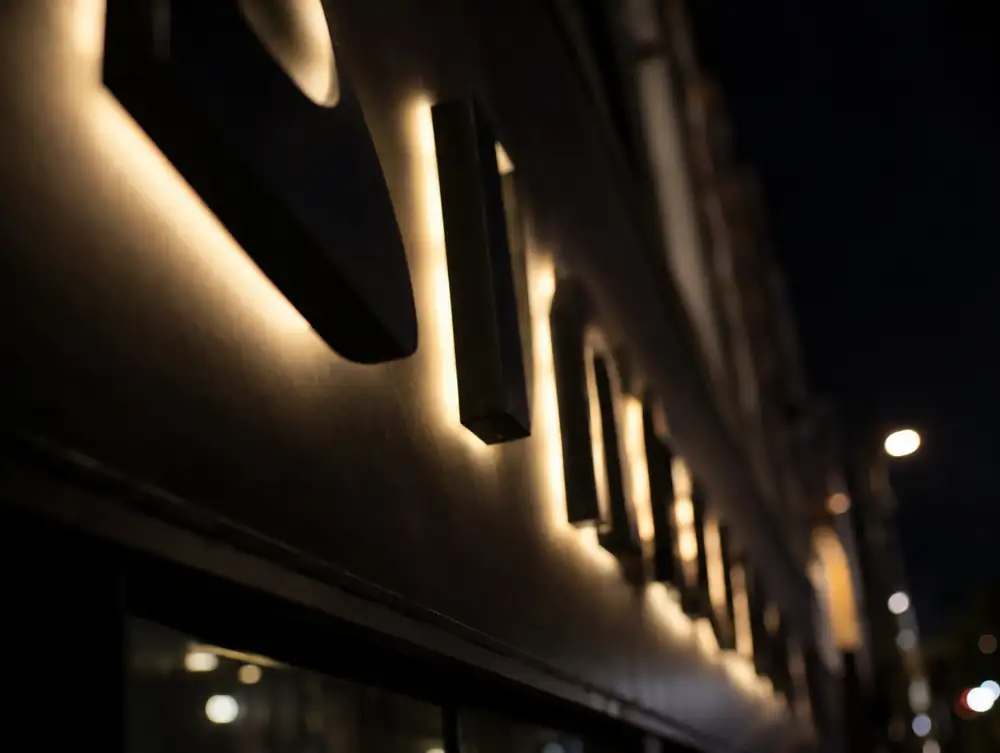
Halo-lit letters give Forres premises a soft glow on the panel behind, with the name itself in crisp silhouette. Face-lit and trough options suit other brands and buildings, and we show you the difference on a scale drawing.
We measure your Forres opening in person, at a time agreed with you first, so the visit fits around your trading.
What should you think about before commissioning illuminated signage in Forres?
If an old lightbox is coming down, we check the cable position and the wall behind it before designing the new sign. An existing supply can often be reused, which saves work on the inside.
On a timber frontage, a slim trough light usually keeps more of the daytime character than lit letters. We colour-match the bar to the fascia, so it almost disappears by day.
If your Forres unit is narrow, a central door can split a small window into two weak ones. Moving the door to one side gives you a single confident pane, provided the layout inside still works.
What is a realistic budget for illuminated signage in Forres?
We would budget £895 to £3,995 plus VAT per sign. Scope sets most of the figure, so a clear brief at the start does more for the budget than any later change of detail.
Who approves illuminated signage in Forres?
Scottish guidance says like-for-like windows need no permission, and a true like-for-like frontage replacement usually follows the same logic. Class 7A covers altering or replacing an existing window, but it doesn't mention shopfronts, so ask before relying on it for a display window. For illuminated signage at premises in the Forres area, a material effect on the external appearance means planning permission, and the council confirms the position.
Signs in Scotland come under the 1984 Advertisement Regulations, which have their own class numbers. At premises in the Forres area, an unlit fascia sign generally needs no application under Class IV(1) of Schedule 4 if it sits on a wall containing a shop window, tops out at 4.6m or first-floor level, and keeps letters to 0.75m high. Anything beyond that needs advertisement consent, and displaying a sign without consent is a criminal offence.
For Forres, the usual route for planning and advert applications is through The Moray Council, and we confirm that when we visit.
Do you cover Forres?
Yes, although Forres surveys are by arrangement and not part of a regular route. Travel and access are quoted separately, so you can see exactly what the location adds.
| Town | Forres |
|---|---|
| Area | Highlands and Moray |
| Postcode districts | IV36 |
| Planning authority | The Moray Council |
| Building approval | Building warrant (Technical Handbook) |
| Distance from Great Barr | About 356 miles |
| Survey | By arrangement |
Questions about illuminated signage in Forres
Will a lit sign in Forres cost much to run?
Very little. A typical LED sign uses about the same power as a few domestic lamps, and a timer trims that further. Occasional driver changes are the larger long-term cost.
Can an illuminated sign be fitted around trading in Forres?
Yes. External fitting is usually done from a tower or platform with little effect on the shop, and internal cable work can be arranged out of hours.
How will I know what my Forres sign looks like at night?
We draw it on your elevation and describe the lighting effect in the specification, and a sample letter can be tested on your fascia where that helps. Colour temperature and output are agreed before manufacture.
Does a shop sign in the Forres area need advertisement consent?
Not always. Scotland's 1984 Regulations let an unlit sign within Class IV(1) go up without an application, and Class VI does the same for a lit sign with each character lit from within. Class VI isn't available in conservation areas, and one council says lit signs always need express consent, so ask first.
Do I need planning permission to alter a shopfront in the Forres area?
Usually yes, if the work materially affects the external appearance. Class 9A, Scotland's shop permitted development right, doesn't cover work that alters or extends beyond the existing front. A true like-for-like replacement usually needs no permission, and the council confirms the position.