What should your premises say from across the road? We open every conversation about revolving doors in Cambridgeshire with that question, then treat sightlines and proportion as seriously as the budget.
Finishes behave differently at full size. Any sample we show you for revolving doors is better judged at the premises in daylight, since a colour that looks quiet on a desk can read much louder across a whole elevation.
How should you approach revolving doors in Cambridgeshire?
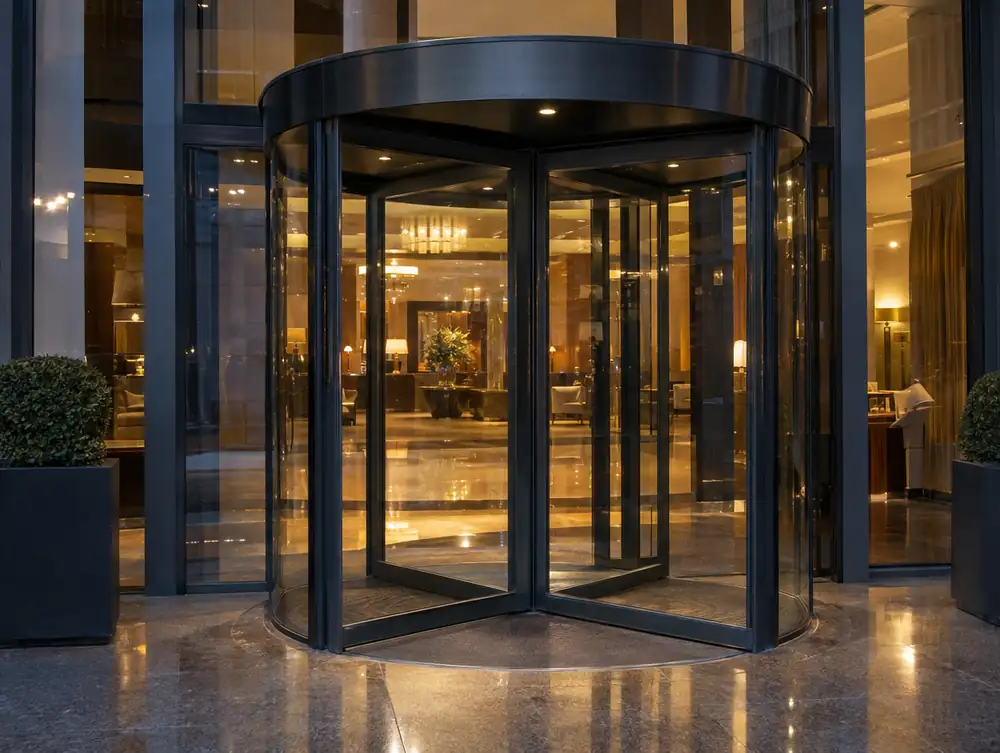
A glass drum is one of the few things on a frontage you can light from inside. For premises in Cambridgeshire that trade into the evening, we'd plan the canopy lighting early, because the drum then works as a lantern at the entrance.
Getting a drum into the building takes some thought. For addresses in Cambridgeshire, we check how the curved panels and canopy reach the opening, since large pieces may need lifting gear or a delivery outside trading hours.
What consents apply to revolving doors in Cambridgeshire?
A true like-for-like replacement usually needs no planning permission in England, because the external appearance isn't materially affected. New materials, a different glass line or altered proportions usually do count as material, so for revolving doors at premises in the Cambridgeshire area, an application is then likely. The council confirms which side of that line a job falls on.
How much do revolving doors cost in Cambridgeshire?
As a working budget, use £19,995 to £59,995 plus VAT per door. Your place inside that range for revolving doors depends mostly on how much of the existing frontage can stay and how much has to be put right first.
| Area | Cambridgeshire |
|---|---|
| Nation | England |
| Towns covered | 12 |
| Main town | Cambridge |
| Planning regime | England: TCPA 1990 and the 2007 Advertisement Regulations |
| Building approval | Building Regulations (Approved Documents) |
| Survey | Free for new work, from our Great Barr base |
Does Greater Cambridge publish shopfront guidance?
Yes, Appendix I: Shopfront guidance (Draft Greater Cambridge Local Plan). It tells applicants what the council expects from new and altered shopfronts. It is a draft, so check its status with the council before you rely on it. A few of the things it asks for:
- Original stallriser features should be kept and repaired unless beyond reasonable repair.
- Solid external roller shutters would only be approved if no other protection is adequate, and roller grilles need a case supported by police and insurer letters.
- Illuminated box fascias are not acceptable, and spotlights should be limited to two on most shopfronts or three on very wide ones.
Questions about revolving doors in Cambridgeshire
How much notice does a revolving door need for a site in Cambridgeshire?
Allow 10 to 16 weeks after sign-off as a typical range, plus about a week on site. Starting early also gives the floor work time to finish.
Is my entrance in Cambridge big enough for a revolving door?
It may be, if the frontage or lobby is generous. A 2.1m drum takes around 2.4m each way, and you'll need room for a side door as well.
Can a lobby in Cambridgeshire stay open during installation?
Usually, with the side door or another entrance in use while the drum goes in. We'd agree the sequence with you before the floor work starts.
Does the Equality Act apply to a shop entrance in the Cambridgeshire area?
Yes. The Equality Act 2010 applies in England, as across Great Britain, and it requires reasonable steps to remove, alter or avoid physical features that disadvantage disabled people. The duty is anticipatory, so it looks at disabled people generally, and a new Services Code replaced the 2011 Code on 5 August 2026.
Does a new shopfront in the Cambridgeshire area need Building Regulations approval?
Assume yes until building control says otherwise. England has no like-for-like exemption, though registered installers can self-certify replacement windows and doors in non-dwellings. That route doesn't cover structural glass, curtain walling or revolving doors.