From Cambridge to the furthest corner of Cambridgeshire, the sequence for curtain walling stays the same: survey, drawings, written price, then work on site. We travel from Great Barr in Birmingham and use vetted teams working under S&K Glazing.
Access gets as much attention as appearance at survey. Where a vehicle can stop, how long sections reach the opening and how the pavement stays safe for the public all shape the programme for curtain walling in Cambridgeshire.
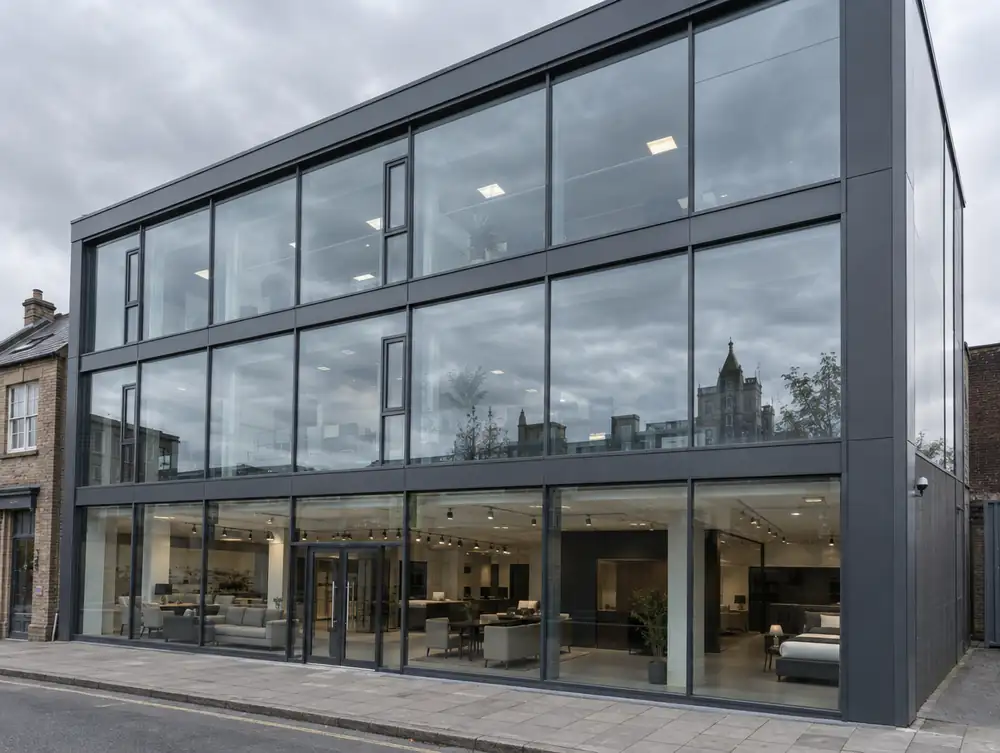
What should you settle before committing to curtain walling in Cambridgeshire?
Exposure changes from plot to plot across Cambridgeshire. A corner unit or a frontage facing open ground takes more wind than one sheltered in a terrace, so we size mullions for your elevation and leave the catalogue table aside.
A facade rarely stands alone. Where your elevation in Cambridgeshire butts up to a neighbour, we detail that junction early, as the flashing and the last mullion are what people see from the pavement.
What consents apply to curtain walling in Cambridgeshire?
A true like-for-like replacement usually needs no planning permission in England, because the external appearance isn't materially affected. New materials, a different glass line or altered proportions usually do count as material, so for curtain walling at premises in the Cambridgeshire area, an application is then likely. The council confirms which side of that line a job falls on.
How much does curtain walling cost in Cambridgeshire?
A sensible starting budget is £550 to £1,250 plus VAT per m². What shifts the figure is whatever can't be seen yet, such as the condition behind the old frontage or the services running through it.
| Area | Cambridgeshire |
|---|---|
| Nation | England |
| Towns covered | 12 |
| Main town | Cambridge |
| Planning regime | England: TCPA 1990 and the 2007 Advertisement Regulations |
| Building approval | Building Regulations (Approved Documents) |
| Survey | Free for new work, from our Great Barr base |
Does Greater Cambridge publish shopfront guidance?
Yes, Appendix I: Shopfront guidance (Draft Greater Cambridge Local Plan). It tells applicants what the council expects from new and altered shopfronts. It is a draft, so check its status with the council before you rely on it. A few of the things it asks for:
- Original stallriser features should be kept and repaired unless beyond reasonable repair.
- Solid external roller shutters would only be approved if no other protection is adequate, and roller grilles need a case supported by police and insurer letters.
- Illuminated box fascias are not acceptable, and spotlights should be limited to two on most shopfronts or three on very wide ones.
Questions about curtain walling in Cambridgeshire
Can you work from my architect's drawings for a building in Cambridgeshire?
Yes, and we check them against a measured survey before anything is ordered. Site dimensions overrule drawn ones, so any gap is raised with your architect and settled on revised scale drawings.
Can a building around Cambridge stay open during the work?
Usually, with some care over the sequence. Bays can be phased so one entrance stays in use, and closed-day or out-of-hours installation can be arranged for the parts that affect it. Your named contact agrees the sequence with you before work starts.
Do you replace old curtain walling in Cambridgeshire as well as fit new?
Yes. We check the existing brackets, seals and framing first, because a sound frame may only need new glass, gaskets and caps. If it has failed, we draw a full replacement and phase it around the building.
Does a shop sign in the Cambridgeshire area need advertisement consent?
Not always. In England, an unlit sign within Class 5 of the 2007 Advertisement Regulations generally needs no application, and neither does a lit sign within Class 4B. Anything outside those classes needs consent, and Class 4B isn't available in conservation areas, so check before ordering.
Do roller shutters need planning permission in the Cambridgeshire area?
Usually yes. Installing or replacing a security grill or shutter on a shopfront is expressly outside England's shop permitted development rights, so the only way to avoid an application is work that doesn't materially affect the appearance. Ask the council before ordering.