Our quotation for fascia signage in Cambridgeshire is written, itemised and valid for 90 days. Nothing is ordered until you accept it, which gives you time to take it to a landlord, a partner or a board.
Your frontage is read alongside its neighbours, so we note the fascia line, stallriser height and pilasters on either side before drawing fascia signage for Cambridgeshire premises. Matching those lines or breaking them on purpose can both work, whereas doing it by accident never does.
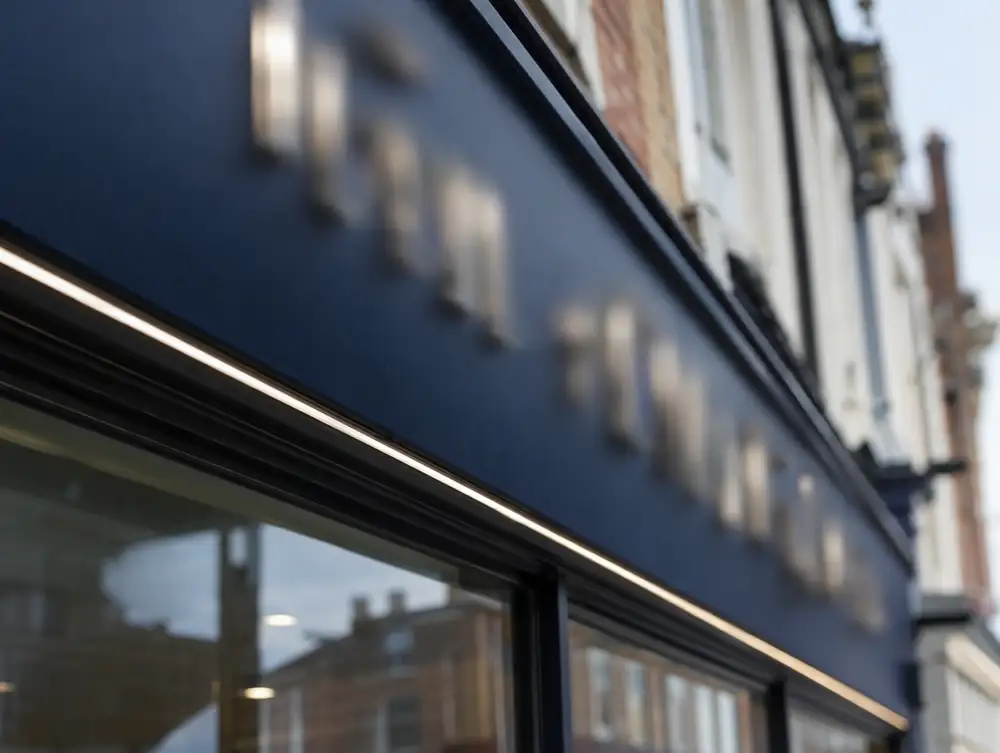
What makes fascia signage work well for premises in Cambridgeshire?
Access is often the hidden cost of a sign. For a frontage in Cambridgeshire we check canopies, pavement width and what sits below, then choose between a tower and a mobile platform.
Neighbouring signs set the visual noise your name has to sit against. If the units beside your premises in Cambridgeshire use bright panels, a quieter dark fascia with well-spaced letters will usually stand out more.
What consents apply to fascia signage in Cambridgeshire?
England has no permitted development route for changing a shopfront. Part 7 Class A of the General Permitted Development Order 2015 excludes creating, altering or replacing one, and it allows no alterations at all on article 2(3) land. That leaves two outcomes for fascia signage at premises in the Cambridgeshire area: a planning application, or work that doesn't materially affect the external appearance.
A lit projecting sign at premises in the Cambridgeshire area has firm limits under Class 4B in England: 0.75m² per surface and 1m high. It can project 1m, or two-thirds of the footway if that is less, and it can't sit over the carriageway. A larger sign needs advertisement consent, and so does a lit one in a conservation area.
How much does fascia signage cost in Cambridgeshire?
Guide price: £395 to £1,995 plus VAT per sign. Materials, finish and the amount of drawing and coordination involved all move it, and your itemised quotation shows where the money goes on fascia signage.
| Area | Cambridgeshire |
|---|---|
| Nation | England |
| Towns covered | 12 |
| Main town | Cambridge |
| Planning regime | England: TCPA 1990 and the 2007 Advertisement Regulations |
| Building approval | Building Regulations (Approved Documents) |
| Survey | Free for new work, from our Great Barr base |
Does Greater Cambridge publish shopfront guidance?
Yes, Appendix I: Shopfront guidance (Draft Greater Cambridge Local Plan). It tells applicants what the council expects from new and altered shopfronts. It is a draft, so check its status with the council before you rely on it. A few of the things it asks for:
- Original stallriser features should be kept and repaired unless beyond reasonable repair.
- Solid external roller shutters would only be approved if no other protection is adequate, and roller grilles need a case supported by police and insurer letters.
- Illuminated box fascias are not acceptable, and spotlights should be limited to two on most shopfronts or three on very wide ones.
Questions about fascia signage in Cambridgeshire
Will you take down an old sign in Cambridgeshire and repair what is behind it?
Yes. Removal and making good are itemised in the quotation. Hidden rot or failed flashing is reported with photographs before any extra work goes ahead.
Do I see a drawing before a sign for a unit in Cambridgeshire is made?
Always. You receive a scale drawing showing the sign on your elevation, with dimensions, materials and colours, and nothing is made until you sign it off.
Can you replace a fascia sign in Cambridgeshire without touching the shopfront?
Yes. Most signs can be changed on their own, and we check the subframe once the old panel is off. If the shopfront will be replaced within a few years, we would tell you, so the sign can be sized for it.
Does a new shopfront in the Cambridgeshire area need Building Regulations approval?
Assume yes until building control says otherwise. England has no like-for-like exemption, though registered installers can self-certify replacement windows and doors in non-dwellings. That route doesn't cover structural glass, curtain walling or revolving doors.
Does a shop sign in the Cambridgeshire area need advertisement consent?
Not always. In England, an unlit sign within Class 5 of the 2007 Advertisement Regulations generally needs no application, and neither does a lit sign within Class 4B. Anything outside those classes needs consent, and Class 4B isn't available in conservation areas, so check before ordering.