Every enquiry for frameless glass doors in Cambridgeshire begins with a measured survey at the premises, because a price taken from a photograph is only a guess. That visit gives you real dimensions before anyone draws a line or orders a thing.
Finishes behave differently at full size. Any sample we show you for frameless glass doors is better judged at the premises in daylight, since a colour that looks quiet on a desk can read much louder across a whole elevation.
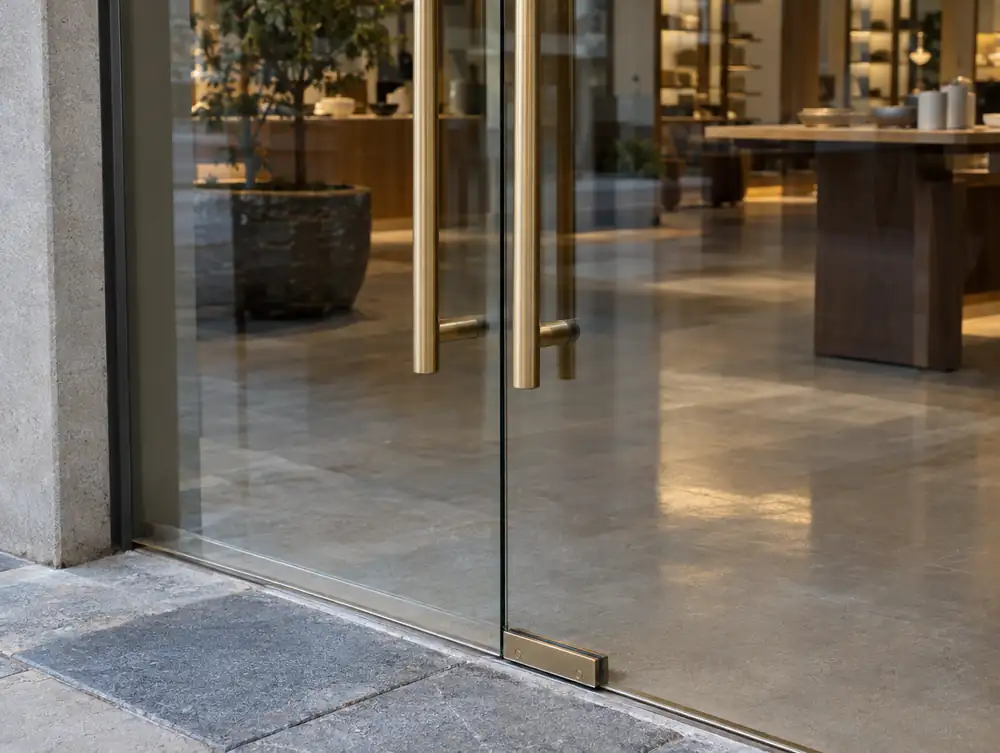
What should you look for from frameless glass doors in Cambridgeshire?
What's under the threshold decides the door. For premises across Cambridgeshire, we check for cellars, pipes and thin screeds at survey, because a floor spring needs depth and old shops don't always have it.
Security after hours shapes the hardware. For premises in Cambridgeshire that close early or sit on a quiet street, we'd look at the lock position, floor socket and any internal shutter together, so the door is secure without looking heavy.
What consents apply to frameless glass doors in Cambridgeshire?
For frameless glass doors at premises in the Cambridgeshire area, the deciding question in England is whether the building work materially affects the external appearance. If it does, planning permission is needed, while a true like-for-like replacement usually needs none. The council confirms the position for each site.
How much do frameless glass doors cost in Cambridgeshire?
Allow £1,495 to £4,495 plus VAT per door set. Size and specification set most of that figure for frameless glass doors, and the rest depends on what the survey finds on site.
| Area | Cambridgeshire |
|---|---|
| Nation | England |
| Towns covered | 12 |
| Main town | Cambridge |
| Planning regime | England: TCPA 1990 and the 2007 Advertisement Regulations |
| Building approval | Building Regulations (Approved Documents) |
| Survey | Free for new work, from our Great Barr base |
Does Greater Cambridge publish shopfront guidance?
Yes, Appendix I: Shopfront guidance (Draft Greater Cambridge Local Plan). It tells applicants what the council expects from new and altered shopfronts. It is a draft, so check its status with the council before you rely on it. A few of the things it asks for:
- Original stallriser features should be kept and repaired unless beyond reasonable repair.
- Solid external roller shutters would only be approved if no other protection is adequate, and roller grilles need a case supported by police and insurer letters.
- Illuminated box fascias are not acceptable, and spotlights should be limited to two on most shopfronts or three on very wide ones.
Questions about frameless glass doors in Cambridgeshire
Do you match door fittings to our other premises in Cambridgeshire?
Yes. Fittings come in several finishes, and we'd use your existing door as the reference so every entrance feels the same.
Do you fit frameless glass doors across Cambridgeshire?
Yes. We travel from Great Barr to survey, make a final check measure and fit each door set.
What if my floor in Cambridgeshire can't take a floor spring?
We'd use a concealed closer in a slim transom. It keeps the look almost the same, and suits floors over a cellar or with services beneath.
Does a shop sign in the Cambridgeshire area need advertisement consent?
Not always. In England, an unlit sign within Class 5 of the 2007 Advertisement Regulations generally needs no application, and neither does a lit sign within Class 4B. Anything outside those classes needs consent, and Class 4B isn't available in conservation areas, so check before ordering.
Does a new shopfront in the Cambridgeshire area need Building Regulations approval?
Assume yes until building control says otherwise. England has no like-for-like exemption, though registered installers can self-certify replacement windows and doors in non-dwellings. That route doesn't cover structural glass, curtain walling or revolving doors.