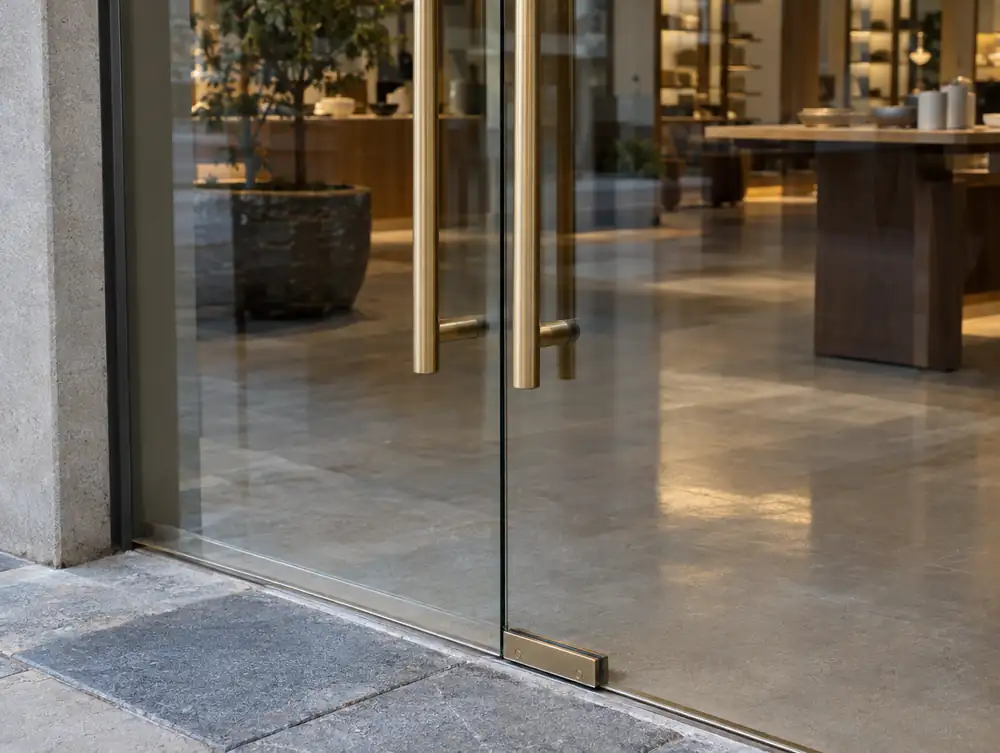
Want a clearer view into your Cambridge shop? A toughened glass door on a floor spring gives you that, with slim fittings and a soft, controlled close.
Bring whatever you have to the survey in Cambridge: brand guidelines, lease plans, old drawings or a photo of a frontage you admire.
Where should you begin with frameless glass doors in Cambridge?
A narrow Cambridge unit benefits from a door that takes up no visual width. We'd use a single glass leaf hung beside one clear pane, so the entrance and the display read as one view into the shop.
On a sunny Cambridge frontage, dark door handles can get uncomfortably hot and fingermarks on the glass show up more. We'd favour brushed finishes, and a full-height handle keeps hands on the metal and off the pane.
Where a fascia has crept down over the years, lifting it back to its original line can add real height to the glass. Check what sits behind it first at Cambridge premises, since a shutter box or old beam may set the limit.
What sign-off might you need for frameless glass doors in Cambridge?
England has no permitted development route for changing a shopfront. Part 7 Class A of the General Permitted Development Order 2015 excludes creating, altering or replacing one, and it allows no alterations at all on article 2(3) land. That leaves two outcomes for frameless glass doors at premises in the Cambridge area: a planning application, or work that doesn't materially affect the external appearance.
Cambridge applications for planning permission or advertisement consent are normally handled by Cambridge City Council. Our survey includes a check of the position for your address.
What price should you expect for frameless glass doors in Cambridge?
Guide price: £1,495 to £4,495 plus VAT per door set. Materials, finish and the amount of drawing and coordination involved all move it, and your itemised quotation shows where the money goes on frameless glass doors.
| Town | Cambridge |
|---|---|
| Area | Cambridgeshire |
| Postcode districts | CB1, CB2, CB4 |
| Planning authority | Cambridge City Council |
| Building approval | Building Regulations (Approved Documents) |
| Distance from Great Barr | About 89 miles |
| Survey | Free for new work |
Does Greater Cambridge publish shopfront guidance?
Yes, Appendix I: Shopfront guidance (Draft Greater Cambridge Local Plan). It tells applicants what the council expects from new and altered shopfronts. It is a draft, so check its status with the council before you rely on it. A few of the things it asks for:
- Original stallriser features should be kept and repaired unless beyond reasonable repair.
- Solid external roller shutters would only be approved if no other protection is adequate, and roller grilles need a case supported by police and insurer letters.
- Illuminated box fascias are not acceptable, and spotlights should be limited to two on most shopfronts or three on very wide ones.
Questions about frameless glass doors in Cambridge
Will a glass door be safe with children around in my Cambridge shop?
Toughened glass is strong and breaks into small pieces, so it is a good choice for a family-facing shop. The main risks are finger traps at the hinge side, which careful spring settings and guards can reduce.
Can you reuse my existing floor spring in Cambridge?
Sometimes, if it is sound and suits the new leaf. We'd test it at survey, because an old spring under a heavier door tends to fail early.
Who fits glass doors in Cambridge?
Vetted glazing teams working under S&K Glazing fit them, and you have a single named contact. They travel to Cambridge from Great Barr.
Does a new shopfront in the Cambridge area need Building Regulations approval?
Assume yes until building control says otherwise. England has no like-for-like exemption, though registered installers can self-certify replacement windows and doors in non-dwellings. That route doesn't cover structural glass, curtain walling or revolving doors.
Do I need listed building consent for a shopfront in the Cambridge area?
Usually yes, if the building is listed. In England the local planning authority decides, and Historic England is notified of Grade I and II* works and specified Grade II works. Like-for-like repair may not need consent, so ask the council before work starts.