Colour is the first thing anyone notices about an awning, and it changes the light underneath. For premises in Cambridge we choose fabric with the interior and the stock in mind.
Expect us to measure the opening, photograph the existing front and check how materials will reach it on the day, at a time you have agreed.
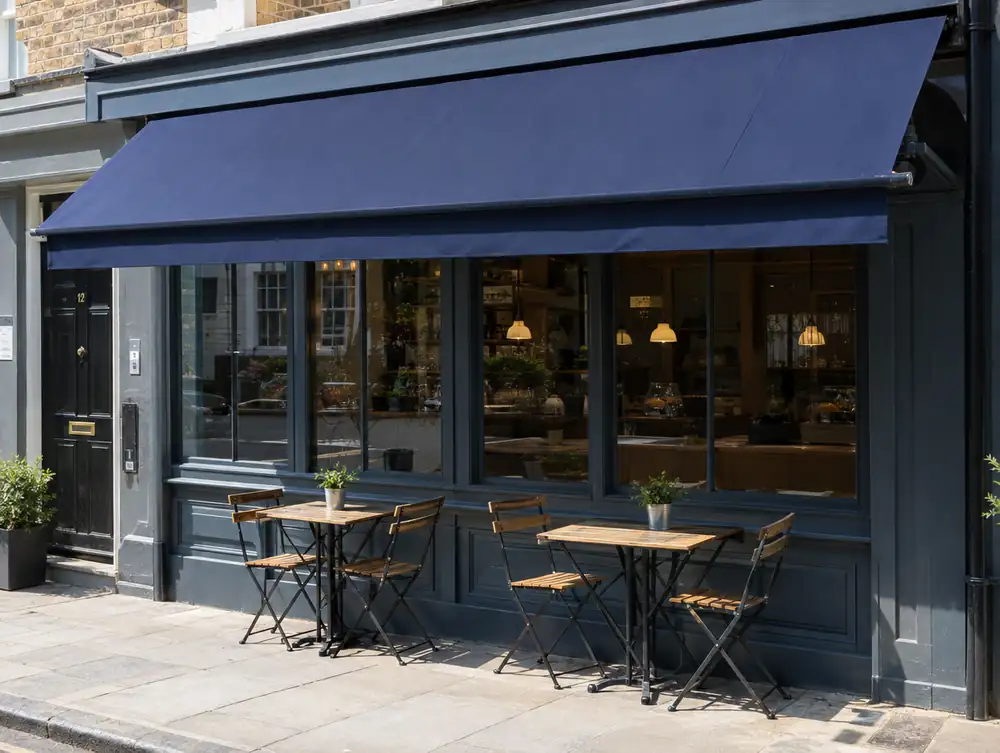
How do you design around the building when planning canopies and awnings in Cambridge?
If your Cambridge premises sell food from the front, we would avoid a strong fabric colour that tints the display. Neutral or striped canvas keeps produce looking natural.
Where the pavement is narrow, a long arm will reach too far, so we would look at a shorter projection or a drop-arm blind. Headroom and the kerb line are measured before we suggest a size.
Where a fascia has crept down over the years, lifting it back to its original line can add real height to the glass. Check what sits behind it first at Cambridge premises, since a shutter box or old beam may set the limit.
What permissions should you check for canopies and awnings in Cambridge?
England has no permitted development route for changing a shopfront. Part 7 Class A of the General Permitted Development Order 2015 excludes creating, altering or replacing one, and it allows no alterations at all on article 2(3) land. That leaves two outcomes for canopies and awnings at premises in the Cambridge area: a planning application, or work that doesn't materially affect the external appearance.
A lit projecting sign at premises in the Cambridge area has firm limits under Class 4B in England: 0.75m² per surface and 1m high. It can project 1m, or two-thirds of the footway if that is less, and it can't sit over the carriageway. A larger sign needs advertisement consent, and so does a lit one in a conservation area.
For Cambridge, the usual route for planning and advert applications is through Cambridge City Council, and we confirm that when we visit.
What might canopies and awnings cost in Cambridge?
As a working budget, use £1,495 to £9,995 plus VAT per canopy or awning. Your place inside that range for canopies and awnings depends mostly on how much of the existing frontage can stay and how much has to be put right first.
| Town | Cambridge |
|---|---|
| Area | Cambridgeshire |
| Postcode districts | CB1, CB2, CB4 |
| Planning authority | Cambridge City Council |
| Building approval | Building Regulations (Approved Documents) |
| Distance from Great Barr | About 89 miles |
| Survey | Free for new work |
Does Greater Cambridge publish shopfront guidance?
Yes, Appendix I: Shopfront guidance (Draft Greater Cambridge Local Plan). It tells applicants what the council expects from new and altered shopfronts. It is a draft, so check its status with the council before you rely on it. A few of the things it asks for:
- Original stallriser features should be kept and repaired unless beyond reasonable repair.
- Solid external roller shutters would only be approved if no other protection is adequate, and roller grilles need a case supported by police and insurer letters.
- Illuminated box fascias are not acceptable, and spotlights should be limited to two on most shopfronts or three on very wide ones.
Questions about canopies and awnings in Cambridge
Can the awning match other premises I run in Cambridgeshire?
Yes. Send a photograph and any fabric reference, and we match the cloth, valance and lettering as closely as current ranges allow. Fabric lines change over time, so we show you a sample first.
Will an awning or canopy be measured before I get a price in Cambridge?
Yes. Every price comes from a measure-up, because wall construction and pavement width affect the design. You then receive an itemised quotation, valid for 90 days.
Can an awning in Cambridge be motorised?
Yes, most can. A tubular motor sits inside the roller, with a remote or wall switch, and a wind sensor can be added. You will need a power supply near the box, which we check at survey.
Do I need listed building consent for a shopfront in the Cambridge area?
Usually yes, if the building is listed. In England the local planning authority decides, and Historic England is notified of Grade I and II* works and specified Grade II works. Like-for-like repair may not need consent, so ask the council before work starts.
Does the Equality Act apply to a shop entrance in the Cambridge area?
Yes. The Equality Act 2010 applies in England, as across Great Britain, and it requires reasonable steps to remove, alter or avoid physical features that disadvantage disabled people. The duty is anticipatory, so it looks at disabled people generally, and a new Services Code replaced the 2011 Code on 5 August 2026.