Thinking about opening up your Cambridge frontage? Start with where the stack will sit, because that one decision shapes the panel count, the track and the seating plan behind it.
It helps if you can be there when we visit Cambridge, since five minutes walking the frontage together answers more than a long email.
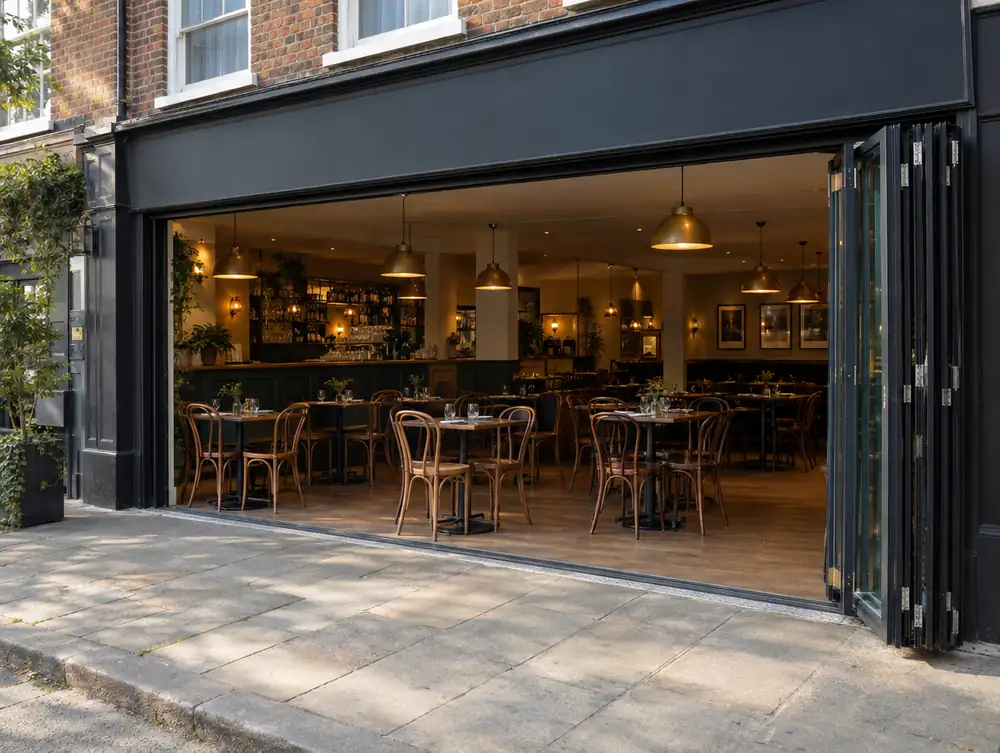
Where should you begin with bi-folding shopfronts in Cambridge?
In a parade in Cambridge, a bi-fold has to sit politely when closed. We'd match the fascia line and keep a short fixed return at one end, so the set reads as part of the row instead of a gap in it.
Bi-folds suit a two-stage fit at Cambridge premises that trade late. We'd take the old front out and fix the frame during closed hours, then hang and adjust the panels the following night, with temporary boarding in between.
If your premises were once two shops, decide early whether the front should read as one or as two. One continuous fascia with a repeated bay width usually settles the elevation better than two mismatched halves, which is worth testing on any Cambridge unit of that kind.
What price should you expect for bi-folding shopfronts in Cambridge?
A sensible starting budget is £5,195 to £13,995 plus VAT for a typical opening. What shifts the figure is whatever can't be seen yet, such as the condition behind the old frontage or the services running through it.
What sign-off might you need for bi-folding shopfronts in Cambridge?
Security grilles and shutters are named in England's rules: installing or replacing one on a shopfront sits outside the shop permitted development rights. The frontage itself is treated the same way, so for bi-folding shopfronts at premises in the Cambridge area, building work that materially affects the appearance needs planning permission. Confirm the position with the council before anything is ordered.
Planning and advert applications for Cambridge premises normally go to Cambridge City Council. We check the position for your address at survey.
| Town | Cambridge |
|---|---|
| Area | Cambridgeshire |
| Postcode districts | CB1, CB2, CB4 |
| Planning authority | Cambridge City Council |
| Building approval | Building Regulations (Approved Documents) |
| Distance from Great Barr | About 89 miles |
| Survey | Free for new work |
Does Greater Cambridge publish shopfront guidance?
Yes, Appendix I: Shopfront guidance (Draft Greater Cambridge Local Plan). It tells applicants what the council expects from new and altered shopfronts. It is a draft, so check its status with the council before you rely on it. A few of the things it asks for:
- Original stallriser features should be kept and repaired unless beyond reasonable repair.
- Solid external roller shutters would only be approved if no other protection is adequate, and roller grilles need a case supported by police and insurer letters.
- Illuminated box fascias are not acceptable, and spotlights should be limited to two on most shopfronts or three on very wide ones.
Questions about bi-folding shopfronts in Cambridge
How secure is a folding front in Cambridge overnight?
Very, if it is specified for the job. Each leaf locks top and bottom with concealed bolts, and laminated glass adds a second line of defence.
Who do I speak to about a bi-fold in Cambridge?
Your named contact stays the same from the first visit to the final adjustment. Fitting is carried out by vetted teams working under S&K Glazing, travelling from Great Barr.
Can the threshold be level at my Cambridge premises?
It can be close to level, depending on the floor and drainage. We'd check the levels at survey, because a track sitting flush with the pavement still needs somewhere for water to go.
Do I need listed building consent for a shopfront in the Cambridge area?
Usually yes, if the building is listed. In England the local planning authority decides, and Historic England is notified of Grade I and II* works and specified Grade II works. Like-for-like repair may not need consent, so ask the council before work starts.
Do I need planning permission to change a shopfront in the Cambridge area?
Usually yes, if the work materially affects the building's external appearance. England's shop permitted development rights exclude creating, altering or replacing a shopfront, so there is no shortcut. A true like-for-like replacement usually needs no application, and the council confirms the position.