Seen a frontage you admire? Bring the picture to our first talk about bi-folding shopfronts in Cambridgeshire, and we will work out what makes it succeed, from fascia depth to glass line, and what that means for your building.
Most frontages share something with someone, be that a door to the flats above, a meter cupboard or a pilaster on the boundary. We pick those up early on bi-folding shopfronts in Cambridgeshire, because they are far easier to design around than to discover on the day.
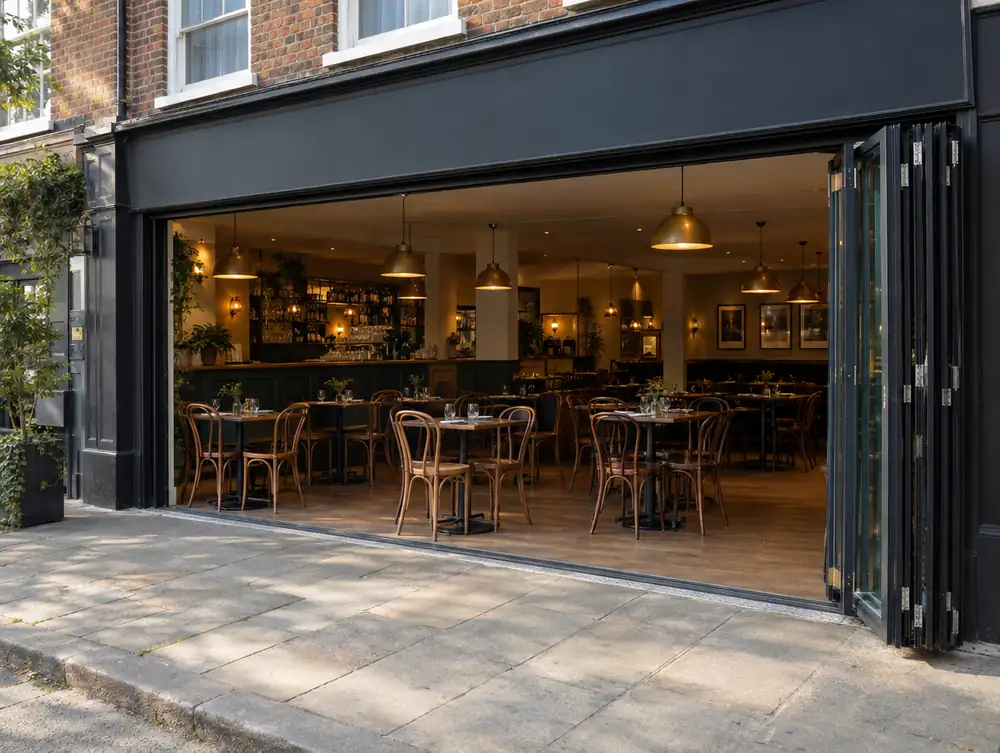
How do we handle bi-folding shopfronts for premises in Cambridgeshire?
Floors vary more than people expect. If your premises in Cambridgeshire are older, a level track can mean cutting into a slab, a stone threshold or a cellar head, so we find out what's under the floor before deciding between top-hung and bottom-rolling.
Late trade shapes a bi-fold's specification. For a bar or restaurant in Cambridgeshire that closes after dark, laminated panels and hidden bolts at every leaf give you a front that opens wide by day and shuts properly at night.
What consents apply to bi-folding shopfronts in Cambridgeshire?
Security grilles and shutters are named in England's rules: installing or replacing one on a shopfront sits outside the shop permitted development rights. The frontage itself is treated the same way, so for bi-folding shopfronts at premises in the Cambridgeshire area, building work that materially affects the appearance needs planning permission. Confirm the position with the council before anything is ordered.
How much do bi-folding shopfronts cost in Cambridgeshire?
Until the survey is done, plan on £5,195 to £13,995 plus VAT for a typical opening. Unusual sizes, fine detail and phased working push the figure up, while a simple brief and clear access keep it toward the lower end.
| Area | Cambridgeshire |
|---|---|
| Nation | England |
| Towns covered | 12 |
| Main town | Cambridge |
| Planning regime | England: TCPA 1990 and the 2007 Advertisement Regulations |
| Building approval | Building Regulations (Approved Documents) |
| Survey | Free for new work, from our Great Barr base |
Does Greater Cambridge publish shopfront guidance?
Yes, Appendix I: Shopfront guidance (Draft Greater Cambridge Local Plan). It tells applicants what the council expects from new and altered shopfronts. It is a draft, so check its status with the council before you rely on it. A few of the things it asks for:
- Original stallriser features should be kept and repaired unless beyond reasonable repair.
- Solid external roller shutters would only be approved if no other protection is adequate, and roller grilles need a case supported by police and insurer letters.
- Illuminated box fascias are not acceptable, and spotlights should be limited to two on most shopfronts or three on very wide ones.
Questions about bi-folding shopfronts in Cambridgeshire
Do bi-folds suit the weather in Cambridgeshire?
Yes, as long as the threshold, seals and panel sizes match the exposure. Sheltered streets get more open days, but closed performance is what counts through winter.
How soon could a bi-fold be ready for a site in Cambridgeshire?
Typically 4 to 7 weeks after drawings are signed off. Panels are made to order and delivered once the opening is prepared.
Do you install bi-folding shopfronts in Cambridgeshire?
Yes. We travel from Great Barr to survey the opening, check the head and floor, and fit the set with a vetted team.
What rules apply to a fire exit door through a shopfront in the Cambridgeshire area?
It must open in the direction of escape and can't be locked against immediate use, and a dedicated fire exit can't be a sliding or revolving door. In England that comes from article 14(2) of the Regulatory Reform (Fire Safety) Order 2005, and the duty sits with the responsible person, normally the employer or whoever controls the premises for a business, otherwise the owner. An outward door can clash with section 153 of the Highways Act 1980 where it opens onto the footway, so raise it early.
Do I need listed building consent for a shopfront in the Cambridgeshire area?
Usually yes, if the building is listed. In England the local planning authority decides, and Historic England is notified of Grade I and II* works and specified Grade II works. Like-for-like repair may not need consent, so ask the council before work starts.