Our quotation for structural glazing in Cambridgeshire is written, itemised and valid for 90 days. Nothing is ordered until you accept it, which gives you time to take it to a landlord, a partner or a board.
Finishes behave differently at full size. Any sample we show you for structural glazing is better judged at the premises in daylight, since a colour that looks quiet on a desk can read much louder across a whole elevation.
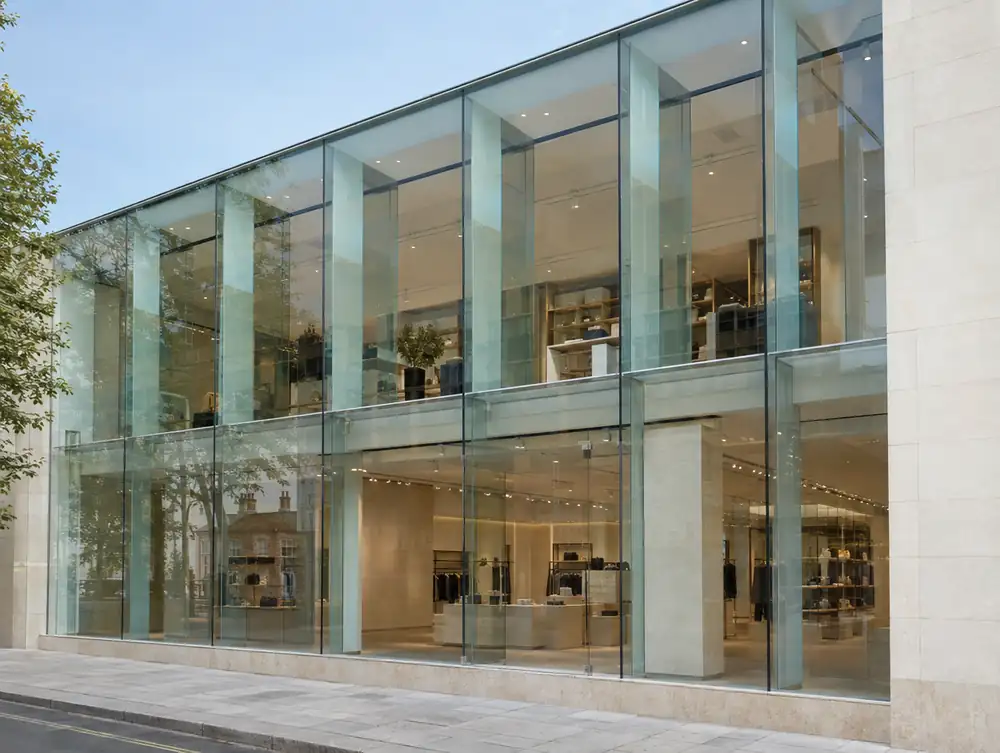
Where do you start with structural glazing in Cambridgeshire?
Floors are seldom level, and a frameless elevation gives that away. On premises in Cambridgeshire we survey the falls across the full width, then set packers and channels so the joints stay parallel from end to end.
Lifting decides what is possible on most structural glazing jobs. For premises across Cambridgeshire we walk the route from the delivery point to the opening at survey, looking for kerbs, cellar hatches and cables that would stop a glass lifter.
What consents apply to structural glazing in Cambridgeshire?
England has no permitted development route for changing a shopfront. Part 7 Class A of the General Permitted Development Order 2015 excludes creating, altering or replacing one, and it allows no alterations at all on article 2(3) land. That leaves two outcomes for structural glazing at premises in the Cambridgeshire area: a planning application, or work that doesn't materially affect the external appearance.
How much does structural glazing cost in Cambridgeshire?
Guide price: £950 to £1,850 plus VAT per m². Materials, finish and the amount of drawing and coordination involved all move it, and your itemised quotation shows where the money goes on structural glazing.
| Area | Cambridgeshire |
|---|---|
| Nation | England |
| Towns covered | 12 |
| Main town | Cambridge |
| Planning regime | England: TCPA 1990 and the 2007 Advertisement Regulations |
| Building approval | Building Regulations (Approved Documents) |
| Survey | Free for new work, from our Great Barr base |
Does Greater Cambridge publish shopfront guidance?
Yes, Appendix I: Shopfront guidance (Draft Greater Cambridge Local Plan). It tells applicants what the council expects from new and altered shopfronts. It is a draft, so check its status with the council before you rely on it. A few of the things it asks for:
- Original stallriser features should be kept and repaired unless beyond reasonable repair.
- Solid external roller shutters would only be approved if no other protection is adequate, and roller grilles need a case supported by police and insurer letters.
- Illuminated box fascias are not acceptable, and spotlights should be limited to two on most shopfronts or three on very wide ones.
Questions about structural glazing in Cambridgeshire
Can structural glazing be fitted while a business around Cambridge stays open?
Often, with a carefully agreed sequence. Lifts usually happen when the street is quiet, and closed-day or out-of-hours installation can be arranged. A temporary screen keeps the interior secure and dry until the glass is in.
What happens if a large pane breaks on premises in Cambridgeshire?
A laminated pane normally stays in place until it can be replaced. We would make the opening safe, then schedule the new pane and the lift, which typically takes some weeks because large glass is made to order.
Do you work with structural engineers on jobs around Cambridge?
Yes, an engineer's calculations form part of this work. If your project already has one, we supply glass and fixing data for their review, and if it does not, the engineering can be included in the quotation.
Do I need planning permission to change a shopfront in the Cambridgeshire area?
Usually yes, if the work materially affects the building's external appearance. England's shop permitted development rights exclude creating, altering or replacing a shopfront, so there is no shortcut. A true like-for-like replacement usually needs no application, and the council confirms the position.
What rules apply to a fire exit door through a shopfront in the Cambridgeshire area?
It must open in the direction of escape and can't be locked against immediate use, and a dedicated fire exit can't be a sliding or revolving door. In England that comes from article 14(2) of the Regulatory Reform (Fire Safety) Order 2005, and the duty sits with the responsible person, normally the employer or whoever controls the premises for a business, otherwise the owner. An outward door can clash with section 153 of the Highways Act 1980 where it opens onto the footway, so raise it early.