From Cambridge to the furthest corner of Cambridgeshire, the sequence for automatic sliding doors stays the same: survey, drawings, written price, then work on site. We travel from Great Barr in Birmingham and use vetted teams working under S&K Glazing.
What sits behind the existing fascia often decides the job. Old beams, abandoned cable runs and earlier frames are common finds, which is why our visit to Cambridgeshire premises looks past the surface before anything is drawn or priced for automatic sliding doors.
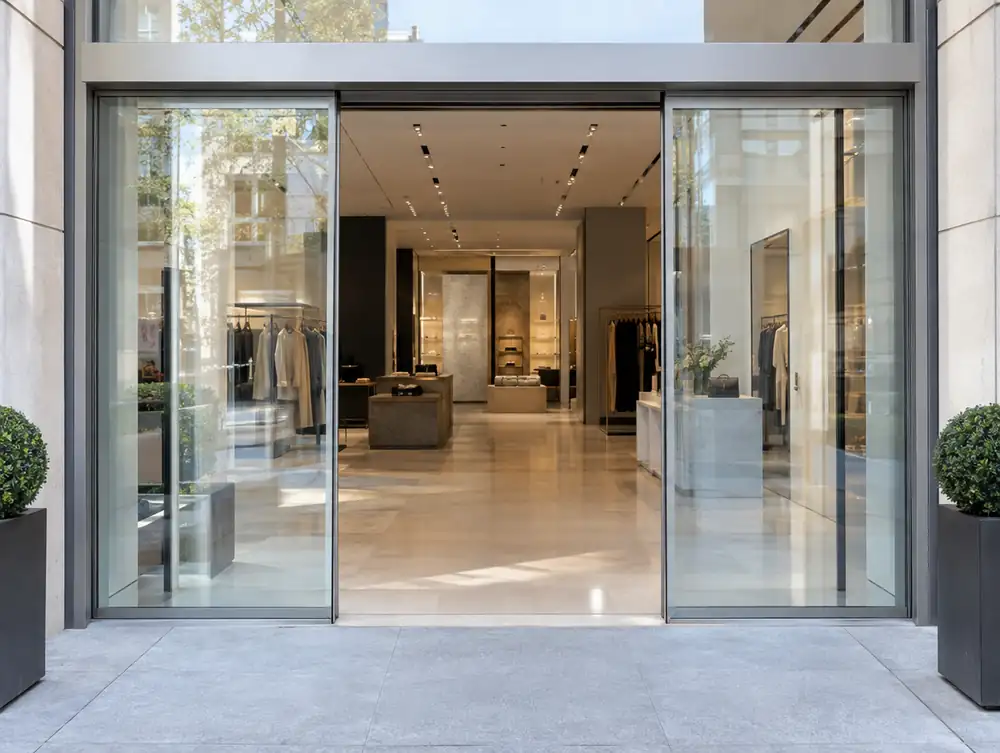
What should you look for from automatic sliding doors in Cambridgeshire?
If your premises in Cambridgeshire lose heat each time the door opens, the answer may be in the settings. Shorter hold-open times, a tighter sensor field and a night mode often cost less than new hardware, with an air curtain as the next step.
Narrow fronts are the hard part. Across Cambridgeshire, we check first whether the parked leaves fit, then whether a telescopic set would give a wider opening on the same width.
What consents apply to automatic sliding doors in Cambridgeshire?
A true like-for-like replacement usually needs no planning permission in England, because the external appearance isn't materially affected. New materials, a different glass line or altered proportions usually do count as material, so for automatic sliding doors at premises in the Cambridgeshire area, an application is then likely. The council confirms which side of that line a job falls on.
How much do automatic sliding doors cost in Cambridgeshire?
A sensible starting budget is £3,895 to £11,995 plus VAT per entrance. What shifts the figure is whatever can't be seen yet, such as the condition behind the old frontage or the services running through it.
| Area | Cambridgeshire |
|---|---|
| Nation | England |
| Towns covered | 12 |
| Main town | Cambridge |
| Planning regime | England: TCPA 1990 and the 2007 Advertisement Regulations |
| Building approval | Building Regulations (Approved Documents) |
| Survey | Free for new work, from our Great Barr base |
Does Greater Cambridge publish shopfront guidance?
Yes, Appendix I: Shopfront guidance (Draft Greater Cambridge Local Plan). It tells applicants what the council expects from new and altered shopfronts. It is a draft, so check its status with the council before you rely on it. A few of the things it asks for:
- Original stallriser features should be kept and repaired unless beyond reasonable repair.
- Solid external roller shutters would only be approved if no other protection is adequate, and roller grilles need a case supported by police and insurer letters.
- Illuminated box fascias are not acceptable, and spotlights should be limited to two on most shopfronts or three on very wide ones.
Questions about automatic sliding doors in Cambridgeshire
Do you fit automatic sliding doors across Cambridgeshire?
Yes. We travel from Great Barr to survey the entrance, then fit and set up the door with a vetted team.
Can a door in Cambridgeshire be set up to ignore people walking past?
Yes, in most cases. The sensor field can be narrowed and angled so it reads direction, which cuts false openings on a street-facing door.
Can premises in Cambridge keep trading during installation?
Often, yes. A side entrance or a closed period outside trading hours usually covers the main stage, and the door can be set up soon after.
Does a new shopfront in the Cambridgeshire area need Building Regulations approval?
Assume yes until building control says otherwise. England has no like-for-like exemption, though registered installers can self-certify replacement windows and doors in non-dwellings. That route doesn't cover structural glass, curtain walling or revolving doors.
Do I need planning permission to change a shopfront in the Cambridgeshire area?
Usually yes, if the work materially affects the building's external appearance. England's shop permitted development rights exclude creating, altering or replacing a shopfront, so there is no shortcut. A true like-for-like replacement usually needs no application, and the council confirms the position.