Every enquiry for curved glass shopfronts in Cambridgeshire begins with a measured survey at the premises, because a price taken from a photograph is only a guess. That visit gives you real dimensions before anyone draws a line or orders a thing.
Openings are rarely square or level, so the survey for curved glass shopfronts records diagonals, pavement fall and head height at several points. Those few millimetres decide whether the finished front sits true against the building.
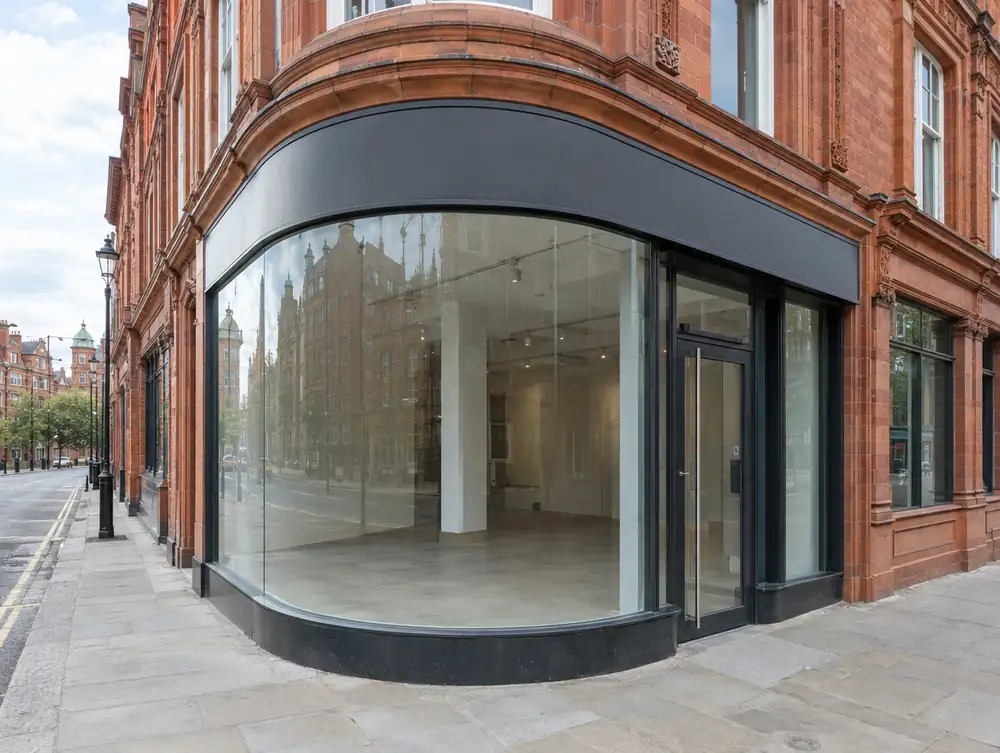
How should you approach curved glass shopfronts in Cambridgeshire?
Corners catch the weather from two directions. If your unit in Cambridgeshire stands on an exposed junction, we'd look harder at head fixings, cill drainage and the seal where the curve meets the straight run.
If your building in Cambridgeshire already has an old curved pane, we'd look at keeping it first. Older bent glass is hard to replicate, and a careful repair of the frame may save the piece that gives the front its character.
What consents apply to curved glass shopfronts in Cambridgeshire?
For curved glass shopfronts at premises in the Cambridgeshire area, the deciding question in England is whether the building work materially affects the external appearance. If it does, planning permission is needed, while a true like-for-like replacement usually needs none. The council confirms the position for each site.
How much do curved glass shopfronts cost in Cambridgeshire?
Allow £6,995 to £19,995 plus VAT for a typical frontage. Size and specification set most of that figure for curved glass shopfronts, and the rest depends on what the survey finds on site.
| Area | Cambridgeshire |
|---|---|
| Nation | England |
| Towns covered | 12 |
| Main town | Cambridge |
| Planning regime | England: TCPA 1990 and the 2007 Advertisement Regulations |
| Building approval | Building Regulations (Approved Documents) |
| Survey | Free for new work, from our Great Barr base |
Does Greater Cambridge publish shopfront guidance?
Yes, Appendix I: Shopfront guidance (Draft Greater Cambridge Local Plan). It tells applicants what the council expects from new and altered shopfronts. It is a draft, so check its status with the council before you rely on it. A few of the things it asks for:
- Original stallriser features should be kept and repaired unless beyond reasonable repair.
- Solid external roller shutters would only be approved if no other protection is adequate, and roller grilles need a case supported by police and insurer letters.
- Illuminated box fascias are not acceptable, and spotlights should be limited to two on most shopfronts or three on very wide ones.
Questions about curved glass shopfronts in Cambridgeshire
How do you measure a curve at premises in Cambridge?
At three heights, using a plywood template or a laser survey. That shows whether the corner is a true arc, and tells us where any difference has to be taken up.
What if my corner in Cambridgeshire is not a true curve?
Most aren't. We set the glass to the closest arc and absorb the rest in the head and floor channels, or build out the surround where the building drifts too far.
How long does curved glass take for a site in Cambridgeshire?
Typically 8 to 14 weeks for the panes after the template is approved. The time on site is short by comparison, typically 2 to 5 days.
Do I need planning permission to change a shopfront in the Cambridgeshire area?
Usually yes, if the work materially affects the building's external appearance. England's shop permitted development rights exclude creating, altering or replacing a shopfront, so there is no shortcut. A true like-for-like replacement usually needs no application, and the council confirms the position.
Does a new shopfront in the Cambridgeshire area need Building Regulations approval?
Assume yes until building control says otherwise. England has no like-for-like exemption, though registered installers can self-certify replacement windows and doors in non-dwellings. That route doesn't cover structural glass, curtain walling or revolving doors.