We measure, draw and fit aluminium fronts for Cambridge premises under one contract. You deal with one named contact from the first survey to handover.
Expect us to measure the opening, photograph the existing front and check how materials will reach it on the day, at a time you have agreed.
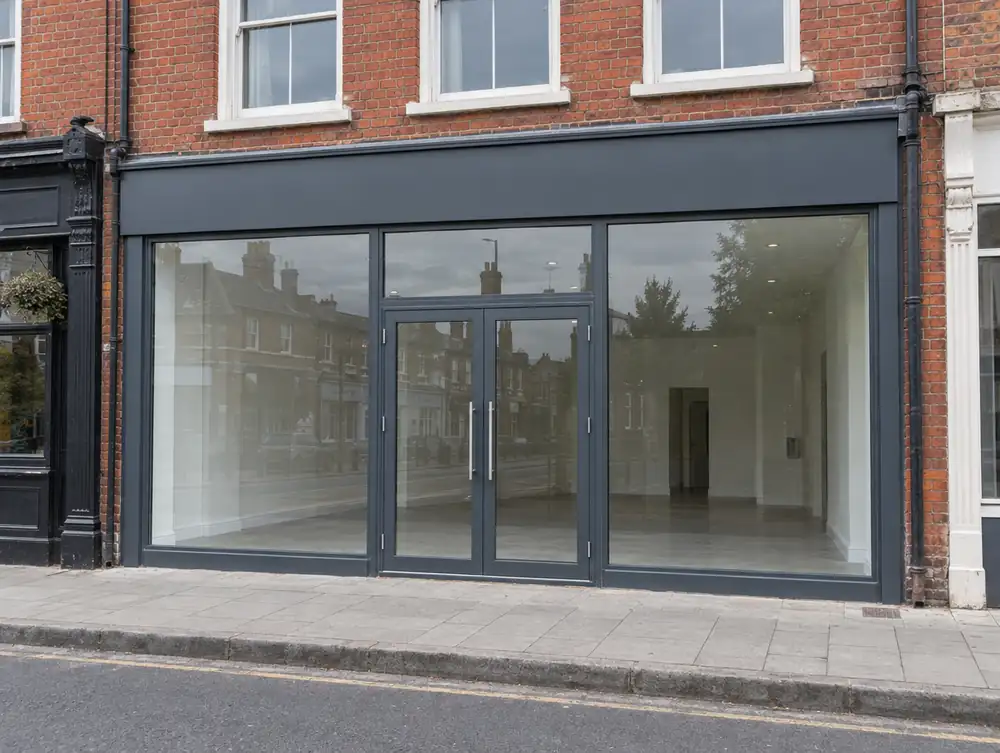
What should you think about before commissioning aluminium shopfronts in Cambridge?
If your Cambridge frontage faces south or west, the colour choice has a physical effect. Dark frames run hot in full sun and long runs of aluminium move, so we'd leave room for expansion at the fascia and look at solar control glass to protect stock.
If your unit sits in a parade in Cambridge, we'd start with the neighbours: the fascia line, cill height and pier rhythm of the row. Holding those lines lets a slimmer section stand out for the right reasons, rather than fighting everything beside it.
If you trade after dark in Cambridge, the view in matters more than the sign. A warm, evenly lit interior with light on the back wall will usually do more than a brighter fascia, because it gives the eye somewhere to go.
What is a realistic budget for aluminium shopfronts in Cambridge?
Allow £2,495 to £11,995 plus VAT for a typical 3 to 7 m frontage. Size and specification set most of that figure for aluminium shopfronts, and the rest depends on what the survey finds on site.
Who approves aluminium shopfronts in Cambridge?
For aluminium shopfronts at premises in the Cambridge area, the deciding question in England is whether the building work materially affects the external appearance. If it does, planning permission is needed, while a true like-for-like replacement usually needs none. The council confirms the position for each site.
For Cambridge, the usual route for planning and advert applications is through Cambridge City Council, and we confirm that when we visit.
| Town | Cambridge |
|---|---|
| Area | Cambridgeshire |
| Postcode districts | CB1, CB2, CB4 |
| Planning authority | Cambridge City Council |
| Building approval | Building Regulations (Approved Documents) |
| Distance from Great Barr | About 89 miles |
| Survey | Free for new work |
Does Greater Cambridge publish shopfront guidance?
Yes, Appendix I: Shopfront guidance (Draft Greater Cambridge Local Plan). It tells applicants what the council expects from new and altered shopfronts. It is a draft, so check its status with the council before you rely on it. A few of the things it asks for:
- Original stallriser features should be kept and repaired unless beyond reasonable repair.
- Solid external roller shutters would only be approved if no other protection is adequate, and roller grilles need a case supported by police and insurer letters.
- Illuminated box fascias are not acceptable, and spotlights should be limited to two on most shopfronts or three on very wide ones.
Questions about aluminium shopfronts in Cambridge
Can a sign and shutter be fitted with the frame in Cambridge?
Yes, and it's usually the neater way to do it. One contract covers the frontage, so the shutter box, fascia and sign fixings are drawn together and nobody is left waiting for another trade.
How does pricing work for Cambridge premises?
Every price comes from a measure-up, never a photograph. You get an itemised written quotation that holds for 90 days, and nothing is ordered until you accept it.
Who carries out the work in Cambridge?
Vetted teams working under S&K Glazing carry it out, with one named contact from survey to handover. The contract is with S&K Glazing Limited, and we travel to Cambridge from Great Barr.
Do I need planning permission to change a shopfront in the Cambridge area?
Usually yes, if the work materially affects the building's external appearance. England's shop permitted development rights exclude creating, altering or replacing a shopfront, so there is no shortcut. A true like-for-like replacement usually needs no application, and the council confirms the position.
Does the Equality Act apply to a shop entrance in the Cambridge area?
Yes. The Equality Act 2010 applies in England, as across Great Britain, and it requires reasonable steps to remove, alter or avoid physical features that disadvantage disabled people. The duty is anticipatory, so it looks at disabled people generally, and a new Services Code replaced the 2011 Code on 5 August 2026.