Drawn well, a frontage in Cambridge can be priced accurately and built without guesswork. The design pack covers elevation, section and specification.
Surveys for Cambridge are booked with you directly. Tell us your quieter days and we'll work around them.
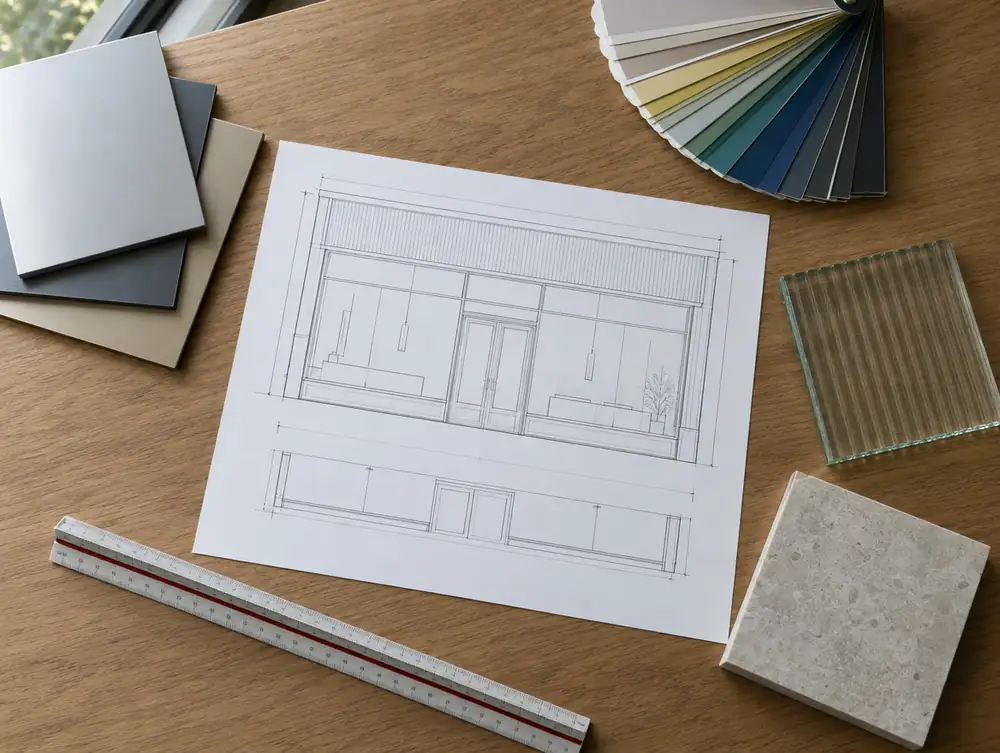
How would we approach shopfront design for your Cambridge premises?
Should several trades be involved in your fit-out, we coordinate the frontage with the shopfitter's drawings. Ceiling lines, display depths and shutter boxes then agree with each other before work starts.
If the pavement falls along your frontage, we survey the levels before drawing a line. Door threshold, stallriser and sill are then set from the real ground, which is where designs drawn from photographs tend to fail.
If you trade after dark in Cambridge, the view in matters more than the sign. A warm, evenly lit interior with light on the back wall will usually do more than a brighter fascia, because it gives the eye somewhere to go.
What consents could affect shopfront design in Cambridge?
For shopfront work at premises in the Cambridge area, the deciding question in England is whether the building work materially affects the external appearance. If it does, planning permission is needed, while a true like-for-like replacement usually needs none. The council confirms the position for each site.
At survey we check how things stand for your building, although applications for planning permission or advertisement consent here normally go to Cambridge City Council.
What should you budget for shopfront design in Cambridge?
Guide price: £495 to £2,495 plus VAT per frontage. Materials, finish and the amount of drawing and coordination involved all move it, and your itemised quotation shows where the money goes on shopfront design.
| Town | Cambridge |
|---|---|
| Area | Cambridgeshire |
| Postcode districts | CB1, CB2, CB4 |
| Planning authority | Cambridge City Council |
| Building approval | Building Regulations (Approved Documents) |
| Distance from Great Barr | About 89 miles |
| Survey | Free for new work |
Does Greater Cambridge publish shopfront guidance?
Yes, Appendix I: Shopfront guidance (Draft Greater Cambridge Local Plan). It tells applicants what the council expects from new and altered shopfronts. It is a draft, so check its status with the council before you rely on it. A few of the things it asks for:
- Original stallriser features should be kept and repaired unless beyond reasonable repair.
- Solid external roller shutters would only be approved if no other protection is adequate, and roller grilles need a case supported by police and insurer letters.
- Illuminated box fascias are not acceptable, and spotlights should be limited to two on most shopfronts or three on very wide ones.
Questions about shopfront design in Cambridge
Can you show the design to my landlord in Cambridgeshire?
Yes. The drawings and visuals are prepared so a landlord or agent can review them easily. We can answer their questions directly if that helps.
Can you design a frontage for Cambridge premises I have not taken on yet?
Yes. A survey and concept drawing can show what the unit could become and what it might cost. That can be useful before you sign anything.
What do you need from me before designing for my Cambridge premises?
The address, brand files and a few frontages you admire are a good start. Tell us your rough budget too, because it helps us focus on what can be built.
Does a shop sign in the Cambridge area need advertisement consent?
Not always. In England, an unlit sign within Class 5 of the 2007 Advertisement Regulations generally needs no application, and neither does a lit sign within Class 4B. Anything outside those classes needs consent, and Class 4B isn't available in conservation areas, so check before ordering.
Does a new shopfront in the Cambridge area need Building Regulations approval?
Assume yes until building control says otherwise. England has no like-for-like exemption, though registered installers can self-certify replacement windows and doors in non-dwellings. That route doesn't cover structural glass, curtain walling or revolving doors.