For accessible entrances across Cambridgeshire, we draw first and order later. You see a scale drawing with signed-off dimensions before anything is made, so the frontage on paper is the frontage you get.
Your frontage is read alongside its neighbours, so we note the fascia line, stallriser height and pilasters on either side before drawing accessible entrances for Cambridgeshire premises. Matching those lines or breaking them on purpose can both work, whereas doing it by accident never does.
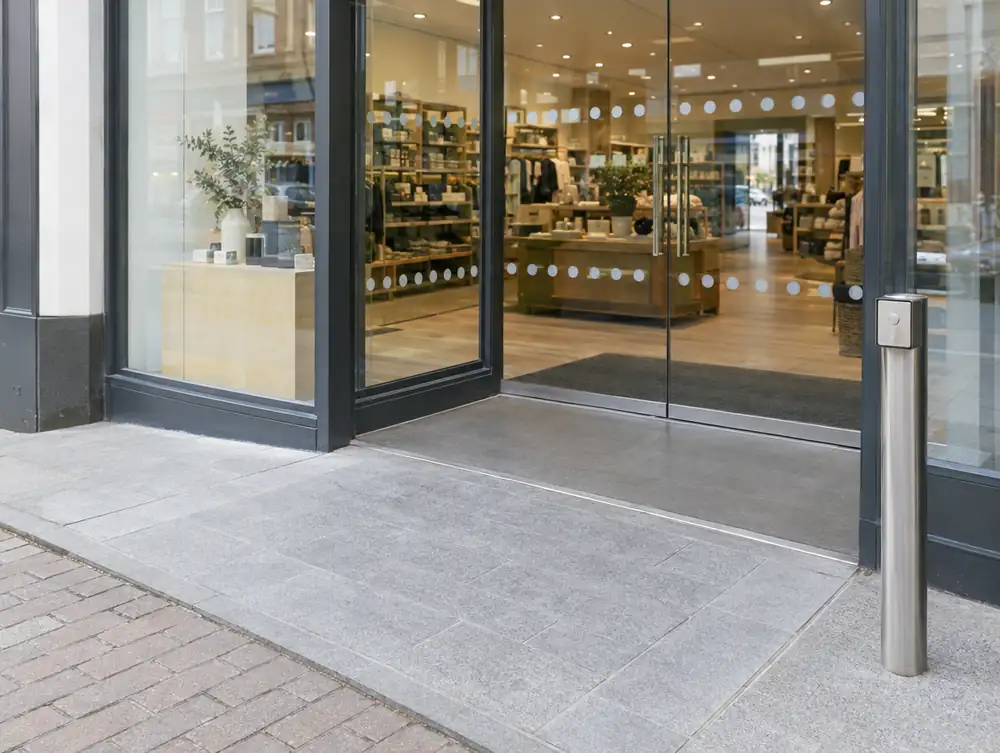
What makes accessible entrances work well for premises in Cambridgeshire?
Not every improvement is large. For premises across Cambridgeshire, a lighter closer, a contrasting handle and clear markings on the glass can often be done in a day, and they help people straight away.
A stone step or old threshold can be worth keeping for its character. If your premises in Cambridgeshire have one, we look at ways of working around it, such as a slim ramp within the recess or a second entrance to one side.
What consents apply to accessible entrances in Cambridgeshire?
England has no permitted development route for changing a shopfront. Part 7 Class A of the General Permitted Development Order 2015 excludes creating, altering or replacing one, and it allows no alterations at all on article 2(3) land. That leaves two outcomes for accessible entrances at premises in the Cambridgeshire area: a planning application, or work that doesn't materially affect the external appearance.
How much do accessible entrances cost in Cambridgeshire?
The guide for accessible entrances is £995 to £6,995 plus VAT depending on the work. Expect the lower end for simple work with clear access, and the upper end where detail, finish or awkward conditions add hours.
| Area | Cambridgeshire |
|---|---|
| Nation | England |
| Towns covered | 12 |
| Main town | Cambridge |
| Planning regime | England: TCPA 1990 and the 2007 Advertisement Regulations |
| Building approval | Building Regulations (Approved Documents) |
| Survey | Free for new work, from our Great Barr base |
Does Greater Cambridge publish shopfront guidance?
Yes, Appendix I: Shopfront guidance (Draft Greater Cambridge Local Plan). It tells applicants what the council expects from new and altered shopfronts. It is a draft, so check its status with the council before you rely on it. A few of the things it asks for:
- Original stallriser features should be kept and repaired unless beyond reasonable repair.
- Solid external roller shutters would only be approved if no other protection is adequate, and roller grilles need a case supported by police and insurer letters.
- Illuminated box fascias are not acceptable, and spotlights should be limited to two on most shopfronts or three on very wide ones.
Questions about accessible entrances in Cambridgeshire
Can work on my Cambridgeshire entrance be done around trading?
Usually. Most threshold and door work can happen out of hours, and we'd keep one route into the shop open wherever we can.
Will a powered door suit a small shop in Cambridgeshire?
Often, yes. A low-energy swing operator suits small entrances and quieter footfall, and the door can still be used by hand.
Can you improve shop entrances across Cambridgeshire?
Yes. We travel from Great Barr to survey the entrance, take levels and draw the options, and vetted teams carry out the work.
What rules apply to a fire exit door through a shopfront in the Cambridgeshire area?
It must open in the direction of escape and can't be locked against immediate use, and a dedicated fire exit can't be a sliding or revolving door. In England that comes from article 14(2) of the Regulatory Reform (Fire Safety) Order 2005, and the duty sits with the responsible person, normally the employer or whoever controls the premises for a business, otherwise the owner. An outward door can clash with section 153 of the Highways Act 1980 where it opens onto the footway, so raise it early.
Do I need planning permission to change a shopfront in the Cambridgeshire area?
Usually yes, if the work materially affects the building's external appearance. England's shop permitted development rights exclude creating, altering or replacing a shopfront, so there is no shortcut. A true like-for-like replacement usually needs no application, and the council confirms the position.