One contract covers the frontage when you come to us for revolving doors in Edinburgh and the Lothians, so glass, frame, sign and shutter aren't separate trades to chase. You also keep one named contact from first visit to handover.
Finishes behave differently at full size. Any sample we show you for revolving doors is better judged at the premises in daylight, since a colour that looks quiet on a desk can read much louder across a whole elevation.
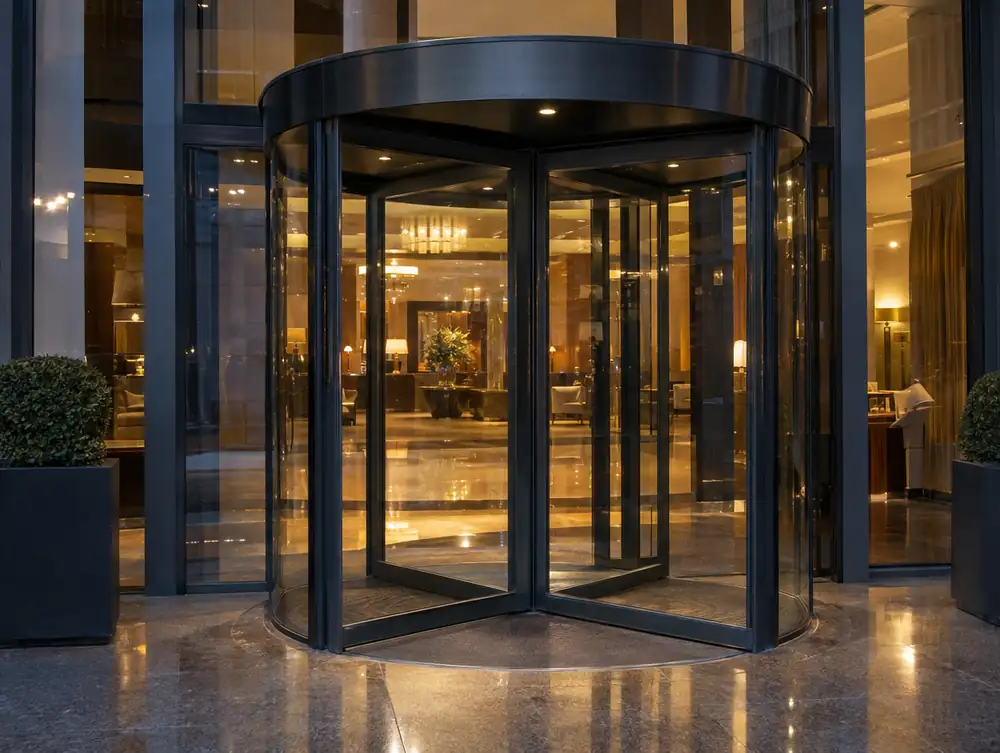
How do we handle revolving doors for premises in Edinburgh and the Lothians?
A side door is part of the design. Across Edinburgh and the Lothians, we treat the door beside the drum as an equal, with matching finishes and the same clear approach, so nobody feels sent round the back.
Hotels, offices and flagship stores all use a drum differently. For a lobby in Edinburgh or elsewhere in Edinburgh and the Lothians, we size the compartments for the people arriving, including their luggage, so the door never becomes the slowest part of the welcome.
What consents apply to revolving doors in Edinburgh and the Lothians?
Shutters aren't named in Class 9A, so in Scotland they usually fall to the appearance test. The same goes for revolving doors at premises in the Edinburgh and the Lothians area: building work that materially affects the external appearance needs planning permission, and a true like-for-like usually doesn't. Ask the council to confirm the position for your site.
How much do revolving doors cost in Edinburgh and the Lothians?
Our guide band is £19,995 to £59,995 plus VAT per door. Scope is the biggest lever, so a tighter brief for revolving doors brings the figure down faster than any change of detail.
| Area | Edinburgh and the Lothians |
|---|---|
| Nation | Scotland |
| Towns covered | 16 |
| Main town | Edinburgh |
| Planning regime | Scotland: 1997 Planning Act and the 1984 Advertisement Regulations |
| Building approval | Building warrant (Technical Handbook) |
| Survey | Free for new work, from our Great Barr base |
Does The City of Edinburgh Council publish shopfront guidance?
Yes, Guidance for Businesses (2024). It tells applicants what the council expects from new and altered shopfronts. A few of the things it asks for:
- Fascias should not exceed one-fifth of the overall frontage height, and applied fascia boards are normally unacceptable.
- Individual lettering should not exceed two-thirds of the fascia depth, up to a maximum of 450mm.
- Solid roller shutters are unacceptable, externally mounted shutters will not be considered acceptable, and toughened glass is the most appropriate security method.
Questions about revolving doors in Edinburgh and the Lothians
How much notice does a revolving door need for a site in Edinburgh and the Lothians?
Allow 10 to 16 weeks after sign-off as a typical range, plus about a week on site. Starting early also gives the floor work time to finish.
Will a revolving door cut heating bills at premises in Edinburgh and the Lothians?
It can, especially on an exposed entrance, because the wings stop through-draughts. The saving depends on footfall and on how the drum compares with the door you have now.
Can you replace an old revolving door in Edinburgh?
Often, yes. We'd measure the existing drum and floor, then advise on refurbishing or replacing it, and a like-sized drum keeps the building work down.
Does the Equality Act cover a shop entrance in the Edinburgh and the Lothians area?
Yes. The Equality Act 2010 applies in Scotland as part of Great Britain, and its anticipatory duty expects reasonable steps to remove, alter or avoid physical features that disadvantage disabled people generally. BS 8300-2:2018 is the current British Standard for accessible buildings.
Which way must a fire exit door open on a shop in the Edinburgh and the Lothians area?
In the direction of escape. Regulation 13(2) of the Fire Safety (Scotland) Regulations 2006 also rules out sliding and revolving doors on a dedicated fire exit and says fire exit doors can't be locked against immediate use. Duties sit with dutyholders under Part 3 of the Fire (Scotland) Act 2005, meaning the employer and any person with control of the premises.