Few businesses can shut for a week, so any time on site for structural glazing in Edinburgh and the Lothians is planned around the hours you trade. Closed-day or out-of-hours installation can be arranged.
What sits behind the existing fascia often decides the job. Old beams, abandoned cable runs and earlier frames are common finds, which is why our visit to Edinburgh and the Lothians premises looks past the surface before anything is drawn or priced for structural glazing.
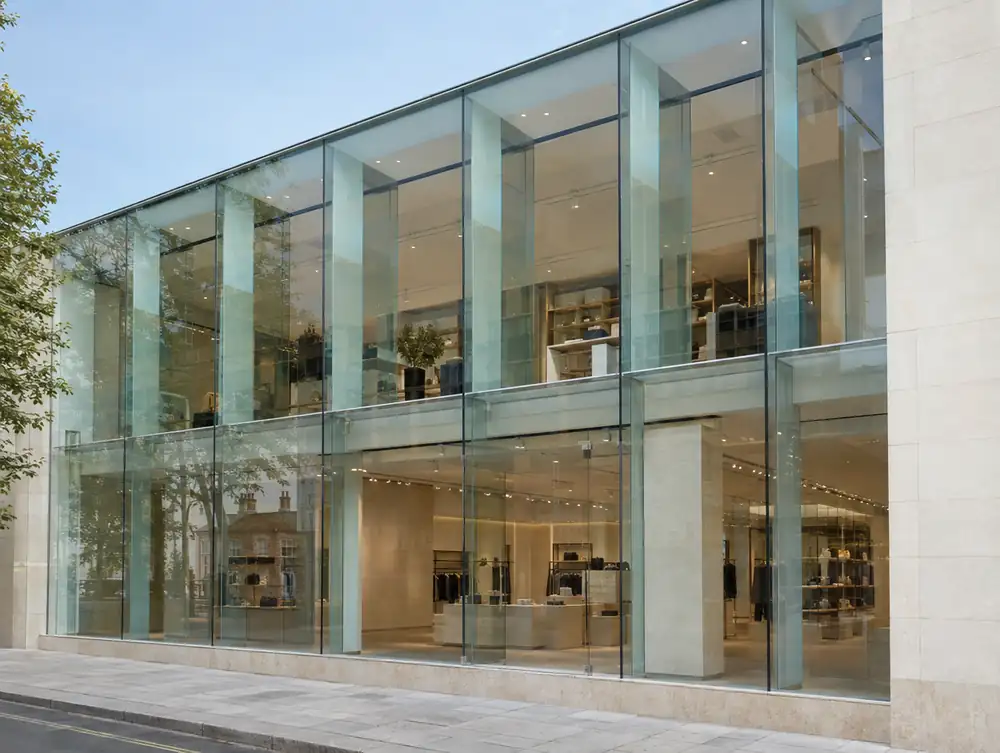
What should you look for from structural glazing in Edinburgh and the Lothians?
Narrow streets call for a different grid. Where premises around Edinburgh open onto a tight street, one big pane can become two smaller ones with a fin on the joint, trading a little purity for a lift that can happen safely.
A flagship entrance often has a fixed opening date. Where a new unit in Edinburgh and the Lothians is working to one, we plan back from it and leave room for a windy lifting day or a damaged pane.
What consents apply to structural glazing in Edinburgh and the Lothians?
Section 26 of the Town and Country Planning (Scotland) Act 1997 sets the test: work that doesn't materially affect the external appearance isn't development. For structural glazing at premises in the Edinburgh and the Lothians area, anything that does needs planning permission, and a true like-for-like replacement usually doesn't. The council confirms how that applies to each site.
How much does structural glazing cost in Edinburgh and the Lothians?
We would budget £950 to £1,850 plus VAT per m². Scope sets most of the figure, so a clear brief at the start does more for the budget than any later change of detail.
| Area | Edinburgh and the Lothians |
|---|---|
| Nation | Scotland |
| Towns covered | 16 |
| Main town | Edinburgh |
| Planning regime | Scotland: 1997 Planning Act and the 1984 Advertisement Regulations |
| Building approval | Building warrant (Technical Handbook) |
| Survey | Free for new work, from our Great Barr base |
Does The City of Edinburgh Council publish shopfront guidance?
Yes, Guidance for Businesses (2024). It tells applicants what the council expects from new and altered shopfronts. A few of the things it asks for:
- Fascias should not exceed one-fifth of the overall frontage height, and applied fascia boards are normally unacceptable.
- Individual lettering should not exceed two-thirds of the fascia depth, up to a maximum of 450mm.
- Solid roller shutters are unacceptable, externally mounted shutters will not be considered acceptable, and toughened glass is the most appropriate security method.
Questions about structural glazing in Edinburgh and the Lothians
Will my existing floor in Edinburgh and the Lothians take a concealed channel?
That depends on the depth of the floor build-up. Where it is too shallow, the channel can sit on the slab with the finish cut around it, or a raised detail can be drawn. We open up a small area at survey to find out.
Can I get a price for premises in Edinburgh and the Lothians from photographs?
No, every price comes from a measure-up. Structural glazing depends on the exact opening, floor and head, so a figure from a photograph would mislead you.
Do you work with structural engineers on jobs around Edinburgh?
Yes, an engineer's calculations form part of this work. If your project already has one, we supply glass and fixing data for their review, and if it does not, the engineering can be included in the quotation.
Does a shop sign in the Edinburgh and the Lothians area need advertisement consent?
Not always. Scotland's 1984 Regulations let an unlit sign within Class IV(1) go up without an application, and Class VI does the same for a lit sign with each character lit from within. Class VI isn't available in conservation areas, and one council says lit signs always need express consent, so ask first.
Which way must a fire exit door open on a shop in the Edinburgh and the Lothians area?
In the direction of escape. Regulation 13(2) of the Fire Safety (Scotland) Regulations 2006 also rules out sliding and revolving doors on a dedicated fire exit and says fire exit doors can't be locked against immediate use. Duties sit with dutyholders under Part 3 of the Fire (Scotland) Act 2005, meaning the employer and any person with control of the premises.