Every enquiry for bronze and metal shopfronts in Edinburgh and the Lothians begins with a measured survey at the premises, because a price taken from a photograph is only a guess. That visit gives you real dimensions before anyone draws a line or orders a thing.
Access gets as much attention as appearance at survey. Where a vehicle can stop, how long sections reach the opening and how the pavement stays safe for the public all shape the programme for bronze and metal shopfronts in Edinburgh and the Lothians.
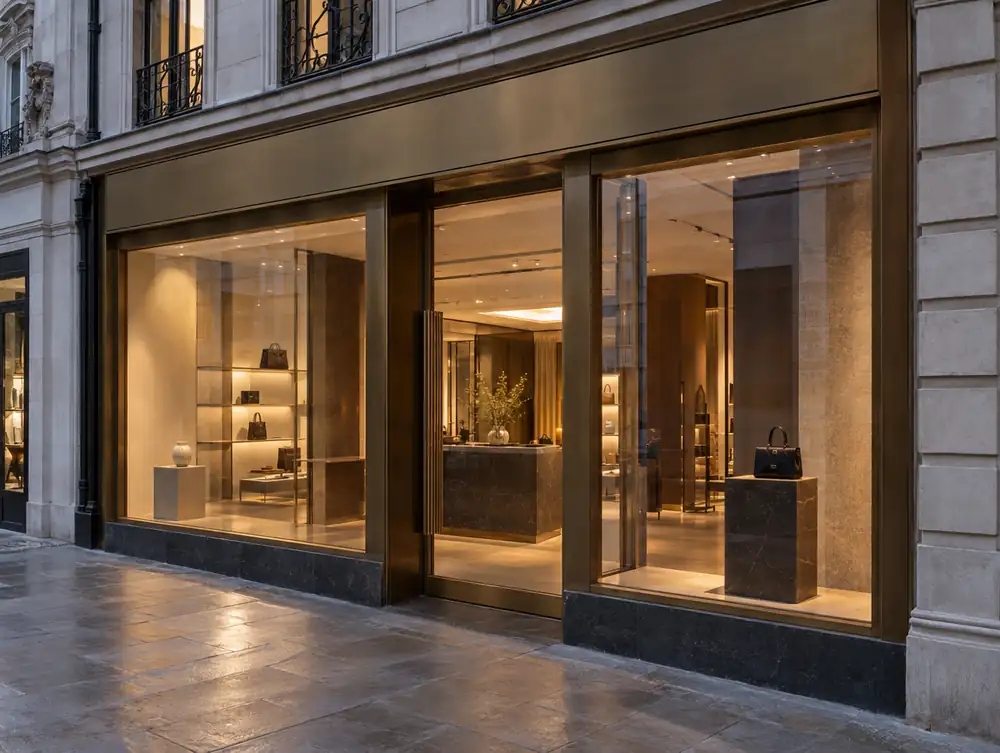
What should you settle before committing to bronze and metal shopfronts in Edinburgh and the Lothians?
Salt air changes the specification. If your premises in Edinburgh and the Lothians sit near the coast, we'd look at grade 316 stainless fixings, tighter isolation between metals and a shorter care cycle for any live finish.
A metal front is judged up close, so for premises across Edinburgh and the Lothians we bring samples to site and look at them in daylight against your stone or brick. Bronze that reads warm on a desk can turn muddy beside red brickwork.
What consents apply to bronze and metal shopfronts in Edinburgh and the Lothians?
Section 26 of the Town and Country Planning (Scotland) Act 1997 sets the test: work that doesn't materially affect the external appearance isn't development. For bronze and metal shopfronts at premises in the Edinburgh and the Lothians area, anything that does needs planning permission, and a true like-for-like replacement usually doesn't. The council confirms how that applies to each site.
How much do bronze and metal shopfronts cost in Edinburgh and the Lothians?
Allow £7,995 to £24,995 plus VAT for a typical frontage. Size and specification set most of that figure for bronze and metal shopfronts, and the rest depends on what the survey finds on site.
| Area | Edinburgh and the Lothians |
|---|---|
| Nation | Scotland |
| Towns covered | 16 |
| Main town | Edinburgh |
| Planning regime | Scotland: 1997 Planning Act and the 1984 Advertisement Regulations |
| Building approval | Building warrant (Technical Handbook) |
| Survey | Free for new work, from our Great Barr base |
Does The City of Edinburgh Council publish shopfront guidance?
Yes, Guidance for Businesses (2024). It tells applicants what the council expects from new and altered shopfronts. A few of the things it asks for:
- Fascias should not exceed one-fifth of the overall frontage height, and applied fascia boards are normally unacceptable.
- Individual lettering should not exceed two-thirds of the fascia depth, up to a maximum of 450mm.
- Solid roller shutters are unacceptable, externally mounted shutters will not be considered acceptable, and toughened glass is the most appropriate security method.
Questions about bronze and metal shopfronts in Edinburgh and the Lothians
How long does a metal front take for sites in Edinburgh and the Lothians?
Making typically takes 8 to 14 weeks from approval, and fitting 3 to 7 days. Finish approval tends to be the stage that sets the pace.
Do you fit bronze and metal shopfronts in Edinburgh and the Lothians?
Yes. We travel from Great Barr to survey and fit them, and every finish is agreed with you on a sample before anything is made.
Will a bronze front suit premises in Edinburgh?
It can, provided the colour works with the building and the light on your side of the street. We'd show samples on site instead of deciding from a photograph.
Which way must a fire exit door open on a shop in the Edinburgh and the Lothians area?
In the direction of escape. Regulation 13(2) of the Fire Safety (Scotland) Regulations 2006 also rules out sliding and revolving doors on a dedicated fire exit and says fire exit doors can't be locked against immediate use. Duties sit with dutyholders under Part 3 of the Fire (Scotland) Act 2005, meaning the employer and any person with control of the premises.
Does a shop sign in the Edinburgh and the Lothians area need advertisement consent?
Not always. Scotland's 1984 Regulations let an unlit sign within Class IV(1) go up without an application, and Class VI does the same for a lit sign with each character lit from within. Class VI isn't available in conservation areas, and one council says lit signs always need express consent, so ask first.