Few businesses can shut for a week, so any time on site for stallrisers and cladding in Edinburgh and the Lothians is planned around the hours you trade. Closed-day or out-of-hours installation can be arranged.
Daylight is only half the brief for stallrisers and cladding, because a frontage keeps working after dark. Think about how the glass, the sign and the view inside will read to someone walking past at six o'clock on a winter evening.
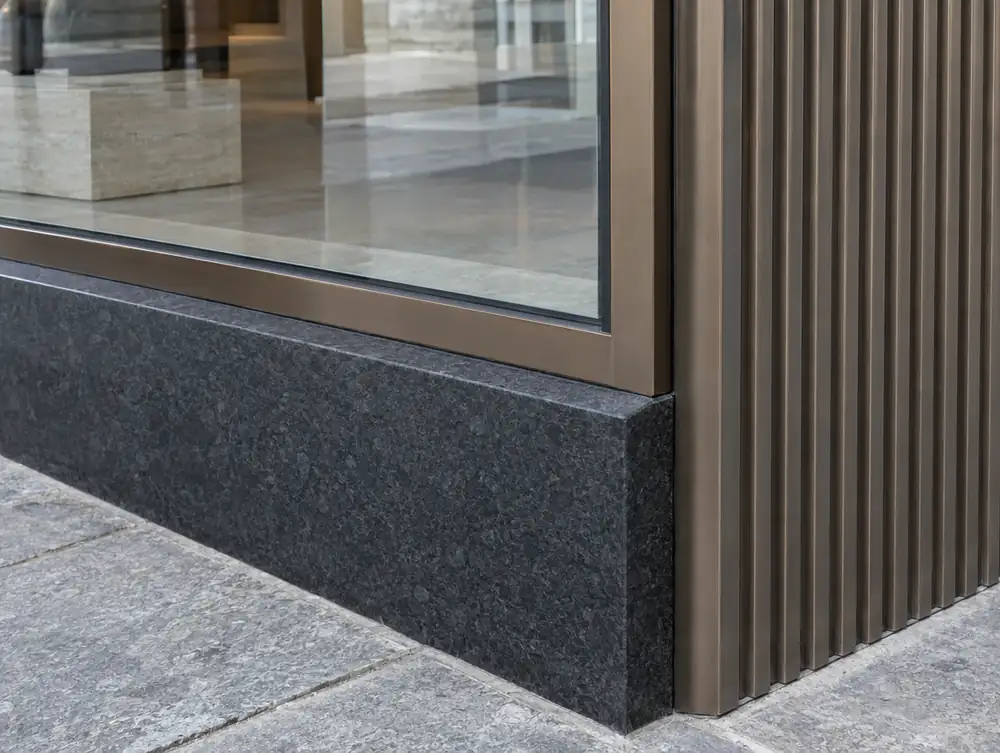
What should you settle before committing to stallrisers and cladding in Edinburgh and the Lothians?
Stripping an old facing can reveal what the building had first. If original tile or timber turns up on your premises in Edinburgh and the Lothians, we stop and talk to you, since repairing it may cost less than cladding over it.
Road grit does the most damage at this level. On premises across Edinburgh and the Lothians that take winter salt or regular pavement washing, we fit a replaceable plinth so the lowest edge can be changed without disturbing the facing.
What consents apply to stallrisers and cladding in Edinburgh and the Lothians?
Section 26 of the Town and Country Planning (Scotland) Act 1997 sets the test: work that doesn't materially affect the external appearance isn't development. For stallrisers and cladding at premises in the Edinburgh and the Lothians area, anything that does needs planning permission, and a true like-for-like replacement usually doesn't. The council confirms how that applies to each site.
How much do stallrisers and cladding cost in Edinburgh and the Lothians?
We would budget £195 to £495 plus VAT per m². Scope sets most of the figure, so a clear brief at the start does more for the budget than any later change of detail.
| Area | Edinburgh and the Lothians |
|---|---|
| Nation | Scotland |
| Towns covered | 16 |
| Main town | Edinburgh |
| Planning regime | Scotland: 1997 Planning Act and the 1984 Advertisement Regulations |
| Building approval | Building warrant (Technical Handbook) |
| Survey | Free for new work, from our Great Barr base |
Does The City of Edinburgh Council publish shopfront guidance?
Yes, Guidance for Businesses (2024). It tells applicants what the council expects from new and altered shopfronts. A few of the things it asks for:
- Fascias should not exceed one-fifth of the overall frontage height, and applied fascia boards are normally unacceptable.
- Individual lettering should not exceed two-thirds of the fascia depth, up to a maximum of 450mm.
- Solid roller shutters are unacceptable, externally mounted shutters will not be considered acceptable, and toughened glass is the most appropriate security method.
Questions about stallrisers and cladding in Edinburgh and the Lothians
Can stallriser work on premises around Edinburgh be done in a day?
A straightforward composite or painted panel often can, and fitting can be arranged on a closed day. Stone and tile take longer because of fixing and setting time, so we would agree a short phased plan.
Will road salt damage a metal stallriser in Edinburgh and the Lothians?
It will, if cut edges are left exposed. We use folded sheet with hidden edges, keep the base clear of the pavement and fit a replaceable plinth where salt is heavy.
Can you reclad only the stallriser on my premises in Edinburgh and the Lothians?
Yes. It is one of the simplest ways to lift a tired frontage, provided the frame above is sound. We check the sill detail first, because a new facing must not trap water beneath it.
Do roller shutters need planning permission in the Edinburgh and the Lothians area?
Usually yes, if they materially affect the external appearance. Class 9A doesn't name shutters, so in Scotland treat them as falling to the appearance test rather than assuming a permitted development route. Ask the council before ordering, as this is a reading of the rules and not an official statement.
Which way must a fire exit door open on a shop in the Edinburgh and the Lothians area?
In the direction of escape. Regulation 13(2) of the Fire Safety (Scotland) Regulations 2006 also rules out sliding and revolving doors on a dedicated fire exit and says fire exit doors can't be locked against immediate use. Duties sit with dutyholders under Part 3 of the Fire (Scotland) Act 2005, meaning the employer and any person with control of the premises.