What should your premises say from across the road? We open every conversation about planning and consent support in Edinburgh and the Lothians with that question, then treat proportion as seriously as the budget.
Access gets as much attention as appearance at survey. Where a vehicle can stop, how long sections reach the opening and how the pavement stays safe for the public all shape the programme for planning and consent support in Edinburgh and the Lothians.
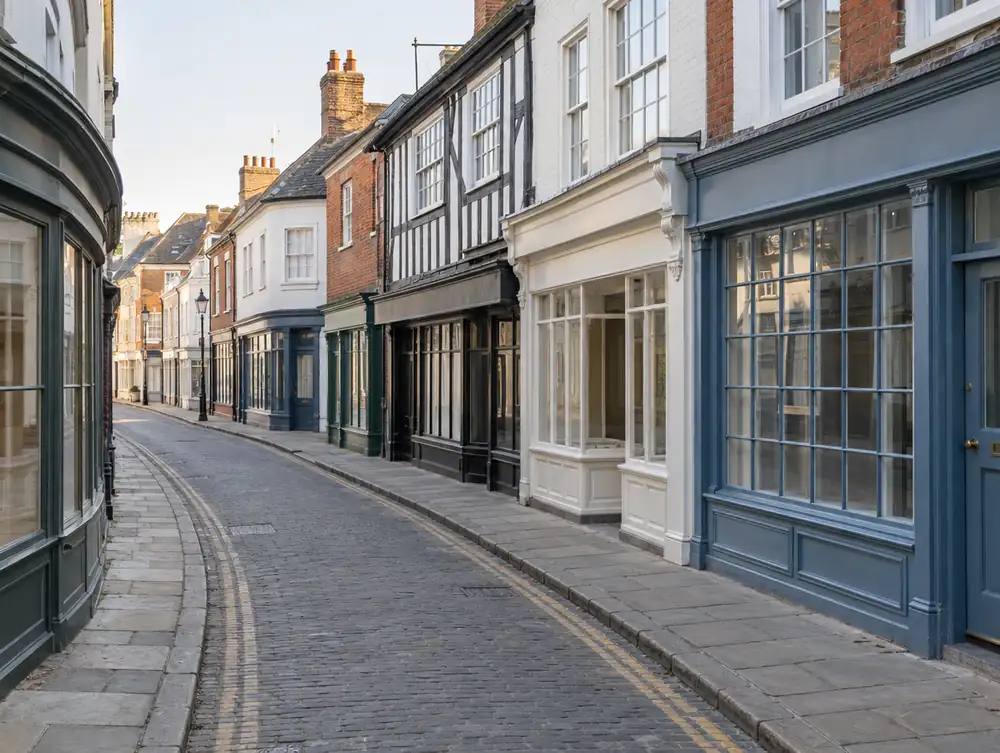
What should you look for from planning and consent support in Edinburgh and the Lothians?
Neighbouring frontages are part of the case. On a unit in Edinburgh and the Lothians we note sign heights, colours and materials nearby, so the design can show why it belongs.
Timing matters as much as paperwork. If your premises around Edinburgh have an opening date, we work back from it and leave room for questions from the case officer before anything is ordered.
What consents apply to shopfront work in Edinburgh and the Lothians?
Scottish guidance says like-for-like windows need no permission, and a true like-for-like frontage replacement usually follows the same logic. Class 7A covers altering or replacing an existing window, but it doesn't mention shopfronts, so ask before relying on it for a display window. For shopfront work at premises in the Edinburgh and the Lothians area, a material effect on the external appearance means planning permission, and the council confirms the position.
How much does planning and consent support cost in Edinburgh and the Lothians?
A sensible starting budget is £395 to £1,295 plus VAT per application, plus the council's fee. What shifts the figure is whatever can't be seen yet, such as the condition behind the old frontage or the services running through it.
| Area | Edinburgh and the Lothians |
|---|---|
| Nation | Scotland |
| Towns covered | 16 |
| Main town | Edinburgh |
| Planning regime | Scotland: 1997 Planning Act and the 1984 Advertisement Regulations |
| Building approval | Building warrant (Technical Handbook) |
| Survey | Free for new work, from our Great Barr base |
Does The City of Edinburgh Council publish shopfront guidance?
Yes, Guidance for Businesses (2024). It tells applicants what the council expects from new and altered shopfronts. A few of the things it asks for:
- Fascias should not exceed one-fifth of the overall frontage height, and applied fascia boards are normally unacceptable.
- Individual lettering should not exceed two-thirds of the fascia depth, up to a maximum of 450mm.
- Solid roller shutters are unacceptable, externally mounted shutters will not be considered acceptable, and toughened glass is the most appropriate security method.
Questions about planning and consent support in Edinburgh and the Lothians
Do you prepare applications for premises across Edinburgh and the Lothians?
Yes. We measure, draw and prepare the application, then submit it and answer the officer's questions. The decision itself is never ours to make, and we will always be plain about that.
Will you answer the officer's questions on premises in Edinburgh and the Lothians?
Yes, your named contact handles queries about the drawings and the design. We let you know what was asked and what we replied, so you stay informed.
What photographs help with an application near Edinburgh?
Straight-on views of the frontage, views along the street in both directions and close-ups of any older details. We take photographs at survey, and yours can add useful history.
Do I need listed building consent for a shopfront in the Edinburgh and the Lothians area?
Almost certainly, if the building is listed and windows or doors are changing, according to Historic Environment Scotland. The planning authority decides, and Historic Environment Scotland is consulted on some applications. Scottish Ministers are notified if it objects.
Do roller shutters need planning permission in the Edinburgh and the Lothians area?
Usually yes, if they materially affect the external appearance. Class 9A doesn't name shutters, so in Scotland treat them as falling to the appearance test rather than assuming a permitted development route. Ask the council before ordering, as this is a reading of the rules and not an official statement.