Seen a frontage you admire? Bring the picture to our first talk about revolving doors in Bristol, and we will work out what makes it succeed, from fascia depth to glass line, and what that means for your building.
Most frontages share something with someone, be that a door to the flats above, a meter cupboard or a pilaster on the boundary. We pick those up early on revolving doors in Bristol, because they are far easier to design around than to discover on the day.
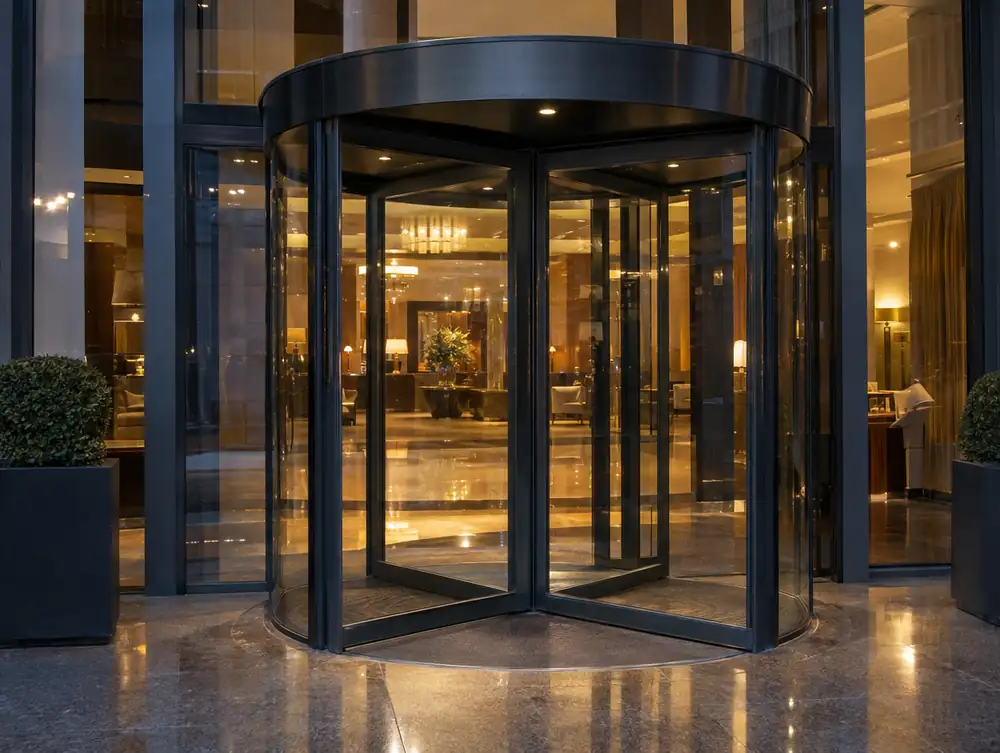
How do we handle revolving doors for premises in Bristol?
Hotels, offices and flagship stores all use a drum differently. For a lobby in Bristol or elsewhere in Bristol, we size the compartments for the people arriving, including their luggage, so the door never becomes the slowest part of the welcome.
A side door is part of the design. Across Bristol, we treat the door beside the drum as an equal, with matching finishes and the same clear approach, so nobody feels sent round the back.
What consents apply to revolving doors in Bristol?
Security grilles and shutters are named in England's rules: installing or replacing one on a shopfront sits outside the shop permitted development rights. The frontage itself is treated the same way, so for revolving doors at premises in the Bristol area, building work that materially affects the appearance needs planning permission. Confirm the position with the council before anything is ordered.
How much do revolving doors cost in Bristol?
Until the survey is done, plan on £19,995 to £59,995 plus VAT per door. Unusual sizes, fine detail and phased working push the figure up, while a simple brief and clear access keep it toward the lower end.
| Area | Bristol |
|---|---|
| Nation | England |
| Towns covered | 2 |
| Main town | Bristol |
| Planning regime | England: TCPA 1990 and the 2007 Advertisement Regulations |
| Building approval | Building Regulations (Approved Documents) |
| Survey | Free for new work, from our Great Barr base |
Does Bristol City Council publish shopfront guidance?
Yes, Shopfront Guidelines (Policy Advice Note No. 8). It tells applicants what the council expects from new and altered shopfronts. A few of the things it asks for:
- Stallrisers are strongly recommended for security, and can be reinforced with masonry or steel behind a panelled front.
- As a rule of thumb fascia depth is one-fifth of shopfront height, and a fascia should not span more than one property.
- External shutters are not suitable for listed buildings, shutters should preferably be internal in conservation areas, and housings should not project beyond fascias.
Questions about revolving doors in Bristol
Do you install revolving doors in Bristol?
Yes. We travel from Great Barr to survey the entrance, and the floor, structure and door are coordinated under one contract.
Can a lobby in Bristol stay open during installation?
Usually, with the side door or another entrance in use while the drum goes in. We'd agree the sequence with you before the floor work starts.
Can you replace an old revolving door in Bristol?
Often, yes. We'd measure the existing drum and floor, then advise on refurbishing or replacing it, and a like-sized drum keeps the building work down.
Do roller shutters need planning permission in the Bristol area?
Usually yes. Installing or replacing a security grill or shutter on a shopfront is expressly outside England's shop permitted development rights, so the only way to avoid an application is work that doesn't materially affect the appearance. Ask the council before ordering.
Do I need listed building consent for a shopfront in the Bristol area?
Usually yes, if the building is listed. In England the local planning authority decides, and Historic England is notified of Grade I and II* works and specified Grade II works. Like-for-like repair may not need consent, so ask the council before work starts.