Few businesses can shut for a week, so any time on site for curved glass shopfronts in Bristol is planned around the hours you trade. Closed-day or out-of-hours installation can be arranged.
Finishes behave differently at full size. Any sample we show you for curved glass shopfronts is better judged at the premises in daylight, since a colour that looks quiet on a desk can read much louder across a whole elevation.
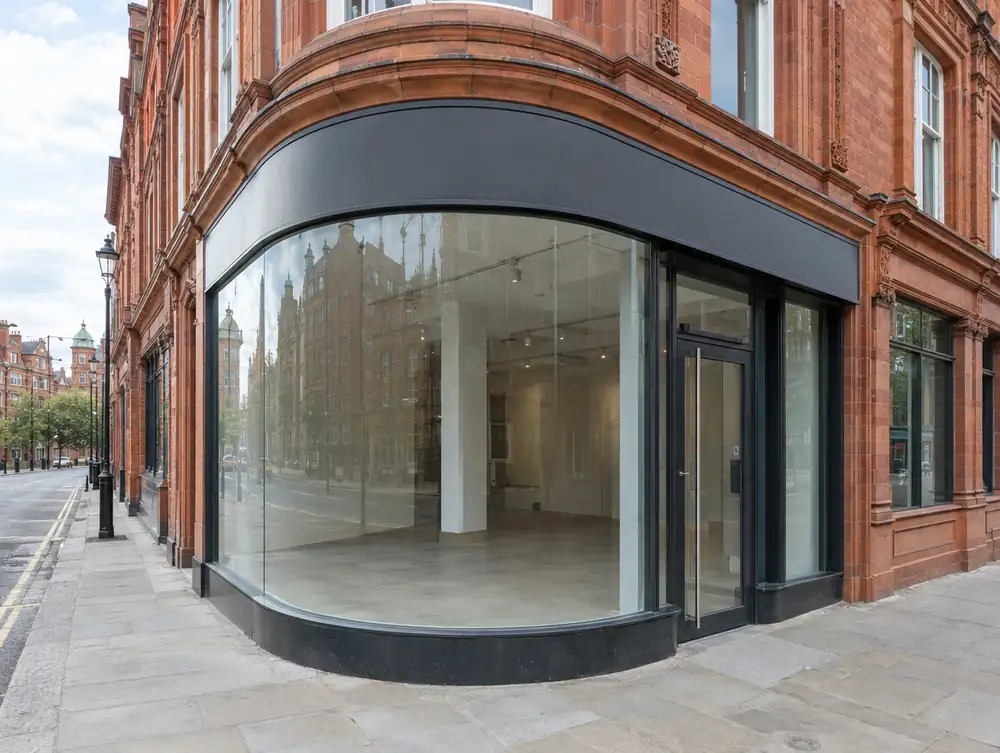
What should you look for from curved glass shopfronts in Bristol?
A curved pane follows the building instead of a catalogue. For premises across Bristol we template the real corner at floor, waist and head height, because old brickwork often drifts from one radius to another.
Corners catch the weather from two directions. If your unit in Bristol stands on an exposed junction, we'd look harder at head fixings, cill drainage and the seal where the curve meets the straight run.
What consents apply to curved glass shopfronts in Bristol?
For curved glass shopfronts at premises in the Bristol area, the deciding question in England is whether the building work materially affects the external appearance. If it does, planning permission is needed, while a true like-for-like replacement usually needs none. The council confirms the position for each site.
How much do curved glass shopfronts cost in Bristol?
We would budget £6,995 to £19,995 plus VAT for a typical frontage. Scope sets most of the figure, so a clear brief at the start does more for the budget than any later change of detail.
| Area | Bristol |
|---|---|
| Nation | England |
| Towns covered | 2 |
| Main town | Bristol |
| Planning regime | England: TCPA 1990 and the 2007 Advertisement Regulations |
| Building approval | Building Regulations (Approved Documents) |
| Survey | Free for new work, from our Great Barr base |
Does Bristol City Council publish shopfront guidance?
Yes, Shopfront Guidelines (Policy Advice Note No. 8). It tells applicants what the council expects from new and altered shopfronts. A few of the things it asks for:
- Stallrisers are strongly recommended for security, and can be reinforced with masonry or steel behind a panelled front.
- As a rule of thumb fascia depth is one-fifth of shopfront height, and a fascia should not span more than one property.
- External shutters are not suitable for listed buildings, shutters should preferably be internal in conservation areas, and housings should not project beyond fascias.
Questions about curved glass shopfronts in Bristol
How do you measure a curve at premises in Bristol?
At three heights, using a plywood template or a laser survey. That shows whether the corner is a true arc, and tells us where any difference has to be taken up.
Do you supply curved glass shopfronts across Bristol?
Yes. We travel from Great Barr to template the curve and fit the glass, with the panes made to that template.
Is a faceted front a sensible alternative in Bristol?
Often, yes, especially on a wide radius. Narrow flat panes give a soft curve from a distance, cost less and are far simpler to replace.
What rules apply to a fire exit door through a shopfront in the Bristol area?
It must open in the direction of escape and can't be locked against immediate use, and a dedicated fire exit can't be a sliding or revolving door. In England that comes from article 14(2) of the Regulatory Reform (Fire Safety) Order 2005, and the duty sits with the responsible person, normally the employer or whoever controls the premises for a business, otherwise the owner. An outward door can clash with section 153 of the Highways Act 1980 where it opens onto the footway, so raise it early.
Do I need planning permission to change a shopfront in the Bristol area?
Usually yes, if the work materially affects the building's external appearance. England's shop permitted development rights exclude creating, altering or replacing a shopfront, so there is no shortcut. A true like-for-like replacement usually needs no application, and the council confirms the position.