Our quotation for structural glazing in Bristol is written, itemised and valid for 90 days. Nothing is ordered until you accept it, which gives you time to take it to a landlord, a partner or a board.
Access gets as much attention as appearance at survey. Where a vehicle can stop, how long sections reach the opening and how the pavement stays safe for the public all shape the programme for structural glazing in Bristol.
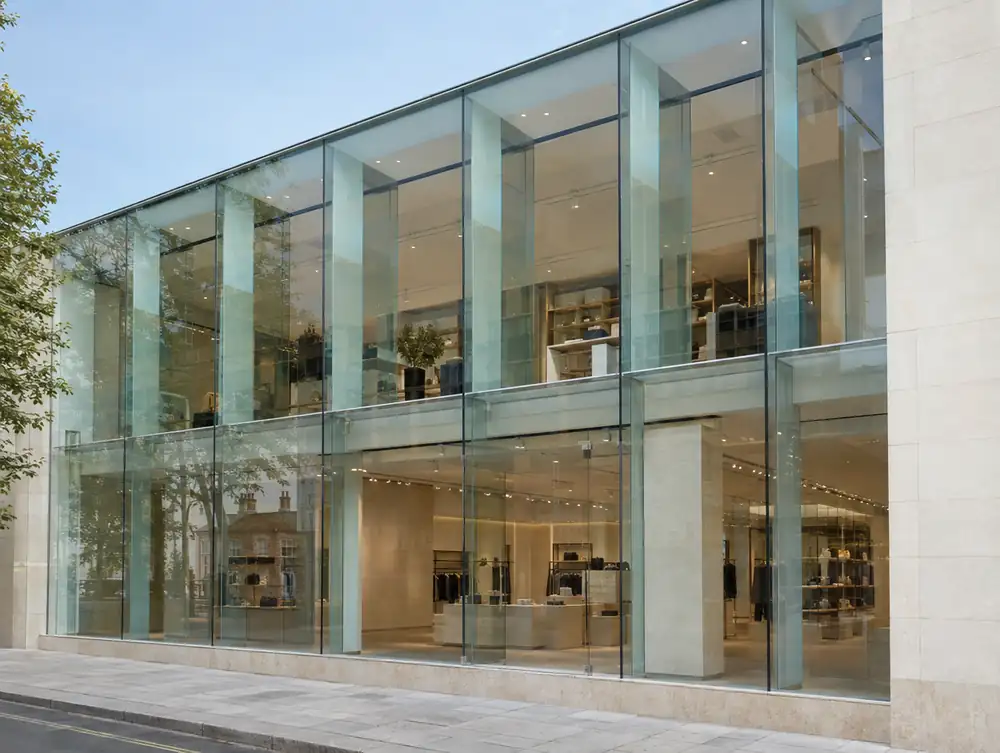
Where do you start with structural glazing in Bristol?
Lifting decides what is possible on most structural glazing jobs. For premises across Bristol we walk the route from the delivery point to the opening at survey, looking for kerbs, cellar hatches and cables that would stop a glass lifter.
Deflection matters as much as strength if your frontage in Bristol sits beneath a steel or timber head. We check how that head behaves before glass goes under it, since a pane with no frame cannot absorb movement.
What consents apply to structural glazing in Bristol?
England has no permitted development route for changing a shopfront. Part 7 Class A of the General Permitted Development Order 2015 excludes creating, altering or replacing one, and it allows no alterations at all on article 2(3) land. That leaves two outcomes for structural glazing at premises in the Bristol area: a planning application, or work that doesn't materially affect the external appearance.
How much does structural glazing cost in Bristol?
Guide price: £950 to £1,850 plus VAT per m². Materials, finish and the amount of drawing and coordination involved all move it, and your itemised quotation shows where the money goes on structural glazing.
| Area | Bristol |
|---|---|
| Nation | England |
| Towns covered | 2 |
| Main town | Bristol |
| Planning regime | England: TCPA 1990 and the 2007 Advertisement Regulations |
| Building approval | Building Regulations (Approved Documents) |
| Survey | Free for new work, from our Great Barr base |
Does Bristol City Council publish shopfront guidance?
Yes, Shopfront Guidelines (Policy Advice Note No. 8). It tells applicants what the council expects from new and altered shopfronts. A few of the things it asks for:
- Stallrisers are strongly recommended for security, and can be reinforced with masonry or steel behind a panelled front.
- As a rule of thumb fascia depth is one-fifth of shopfront height, and a fascia should not span more than one property.
- External shutters are not suitable for listed buildings, shutters should preferably be internal in conservation areas, and housings should not project beyond fascias.
Questions about structural glazing in Bristol
Will my existing floor in Bristol take a concealed channel?
That depends on the depth of the floor build-up. Where it is too shallow, the channel can sit on the slab with the finish cut around it, or a raised detail can be drawn. We open up a small area at survey to find out.
Do you work with structural engineers on jobs around Bristol?
Yes, an engineer's calculations form part of this work. If your project already has one, we supply glass and fixing data for their review, and if it does not, the engineering can be included in the quotation.
Can large glass reach premises on a narrow street in Bristol?
Often, yes, though pane size may need to change. We measure the street, the kerb and any overhead obstructions at survey, then size the glass around what a lifter can reach.
Does the Equality Act apply to a shop entrance in the Bristol area?
Yes. The Equality Act 2010 applies in England, as across Great Britain, and it requires reasonable steps to remove, alter or avoid physical features that disadvantage disabled people. The duty is anticipatory, so it looks at disabled people generally, and a new Services Code replaced the 2011 Code on 5 August 2026.
Does a new shopfront in the Bristol area need Building Regulations approval?
Assume yes until building control says otherwise. England has no like-for-like exemption, though registered installers can self-certify replacement windows and doors in non-dwellings. That route doesn't cover structural glass, curtain walling or revolving doors.