For automatic sliding doors across Bristol, we draw first and order later. You see a scale drawing with signed-off dimensions before anything is made, so the frontage on paper is the frontage you get.
Most frontages share something with someone, be that a door to the flats above, a meter cupboard or a pilaster on the boundary. We pick those up early on automatic sliding doors in Bristol, because they are far easier to design around than to discover on the day.
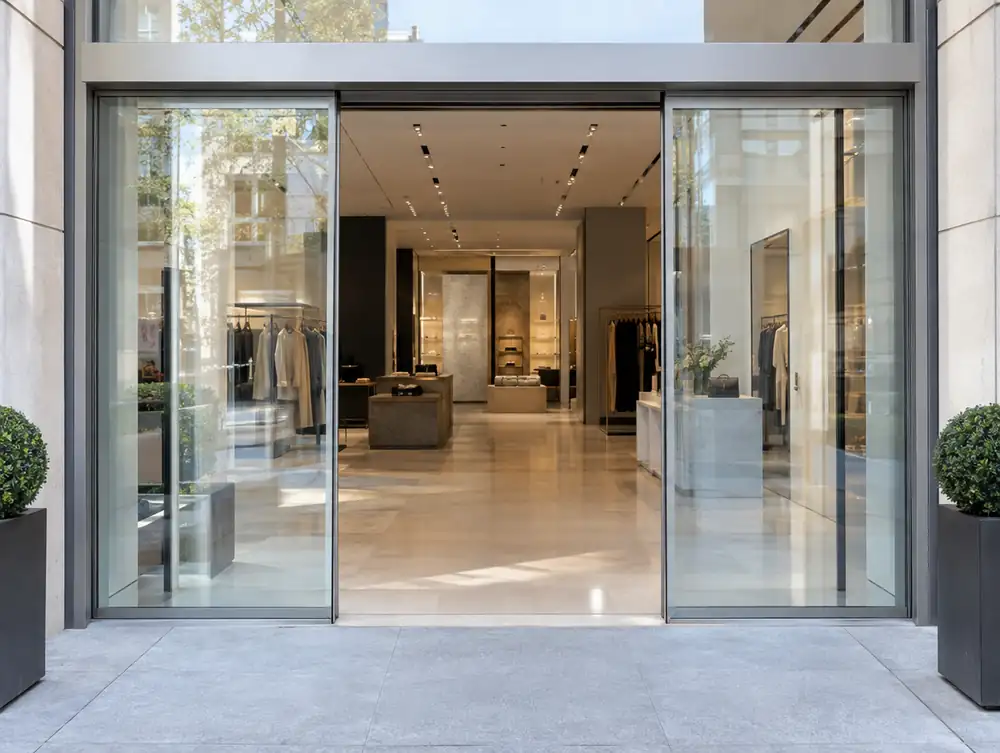
How do we handle automatic sliding doors for premises in Bristol?
Narrow fronts are the hard part. Across Bristol, we check first whether the parked leaves fit, then whether a telescopic set would give a wider opening on the same width.
A unit in Bristol may trade into the evening while a clinic elsewhere in Bristol keeps office hours. We set the door's modes to match, including one-way, exit-only and locked settings, so nobody has to think about it daily.
What consents apply to automatic sliding doors in Bristol?
England has no permitted development route for changing a shopfront. Part 7 Class A of the General Permitted Development Order 2015 excludes creating, altering or replacing one, and it allows no alterations at all on article 2(3) land. That leaves two outcomes for automatic sliding doors at premises in the Bristol area: a planning application, or work that doesn't materially affect the external appearance.
How much do automatic sliding doors cost in Bristol?
The guide for automatic sliding doors is £3,895 to £11,995 plus VAT per entrance. Expect the lower end for simple work with clear access, and the upper end where detail, finish or awkward conditions add hours.
| Area | Bristol |
|---|---|
| Nation | England |
| Towns covered | 2 |
| Main town | Bristol |
| Planning regime | England: TCPA 1990 and the 2007 Advertisement Regulations |
| Building approval | Building Regulations (Approved Documents) |
| Survey | Free for new work, from our Great Barr base |
Does Bristol City Council publish shopfront guidance?
Yes, Shopfront Guidelines (Policy Advice Note No. 8). It tells applicants what the council expects from new and altered shopfronts. A few of the things it asks for:
- Stallrisers are strongly recommended for security, and can be reinforced with masonry or steel behind a panelled front.
- As a rule of thumb fascia depth is one-fifth of shopfront height, and a fascia should not span more than one property.
- External shutters are not suitable for listed buildings, shutters should preferably be internal in conservation areas, and housings should not project beyond fascias.
Questions about automatic sliding doors in Bristol
Who services automatic doors once they are fitted in Bristol?
Any competent door engineer can, and we'd recommend two visits a year. We'll talk you through the options at handover, so it doesn't get forgotten.
Can premises in Bristol keep trading during installation?
Often, yes. A side entrance or a closed period outside trading hours usually covers the main stage, and the door can be set up soon after.
Can a door in Bristol be set up to ignore people walking past?
Yes, in most cases. The sensor field can be narrowed and angled so it reads direction, which cuts false openings on a street-facing door.
Does a new shopfront in the Bristol area need Building Regulations approval?
Assume yes until building control says otherwise. England has no like-for-like exemption, though registered installers can self-certify replacement windows and doors in non-dwellings. That route doesn't cover structural glass, curtain walling or revolving doors.
Does the Equality Act apply to a shop entrance in the Bristol area?
Yes. The Equality Act 2010 applies in England, as across Great Britain, and it requires reasonable steps to remove, alter or avoid physical features that disadvantage disabled people. The duty is anticipatory, so it looks at disabled people generally, and a new Services Code replaced the 2011 Code on 5 August 2026.