Aluminium suits slim sightlines, wide glass and low upkeep, while timber suits period buildings, conservation settings and deep mouldings. Entry budgets are close: from £2,495 plus VAT for aluminium and from £3,995 plus VAT for timber. The building usually decides, and timber is often what the council hopes to see on a protected frontage.
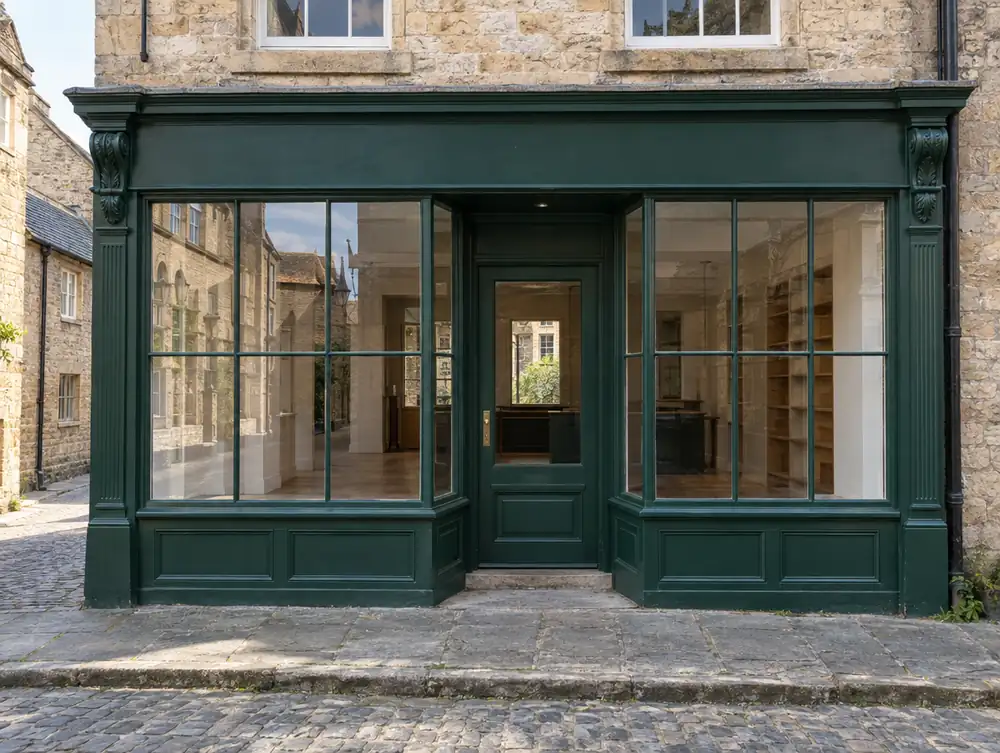
What is the difference between aluminium and timber shopfronts?
Aluminium is a slim extruded frame with a coating applied before it reaches site, while timber is deeper joinery, painted or oiled, that can be cut, patched and repainted where it stands. That single difference drives almost everything else.
A typical aluminium section shows around 50mm of face to the street, where a timber jamb or mullion is often 75mm to 100mm before any moulding. The metal gives you more glass. Timber gives you shadow, depth and a line the eye reads as traditional.
| Factor | Aluminium | Timber |
|---|---|---|
| Sightline | Slim, around 50mm typical | Deeper, often 75 to 100mm |
| Finish | Powder coat or anodised | Paint or oil, renewed on site |
| Upkeep | Washing and seal checks | Washing plus a repaint cycle |
| Damage | Scratches are hard to hide | Filled, spliced and repainted |
| Natural setting | Modern units, wide glass | Period and protected buildings |
| Guide price | £2,495 to £11,995 plus VAT for a typical 3 to 7 m frontage | £3,995 to £13,995 plus VAT for a typical frontage |
When is aluminium the right choice?
Aluminium is right when you want wide glass, thin lines and low upkeep on a modern or neutral building. A retail park unit, a new-build ground floor or a plain 1960s parade rarely gains anything from moulded joinery, and a clean metal frame sits more honestly on those elevations.
Colour is the other strong argument. A powder-coated section can follow a brand palette by reference, and every door, frame and capping arrives matching. Long frontages also favour metal, since sections stay straight and stable over a run that timber would need to joint and reinforce.
It tends to suit a shorter lease as well. Nobody has to budget for a repaint in year six, and thermally broken sections are available where double glazing makes sense. Door frames take trolleys and knocks without the bottom corners softening, which matters at a busy food unit.
When is aluminium the wrong choice?
Aluminium is usually the wrong choice on a listed building, in a sensitive conservation area, or wherever the character of the building depends on moulded joinery. A flat section reads thin against heavy brick piers and a painted cornice, and it can leave the upper floors looking as if they are floating on nothing.
Applied mouldings can pass from across the road and fail at the door, where a customer's eye is 300mm from the frame. Planning officers tend to spot the difference too. If the honest answer is that the building wants timber, a metal imitation will cost you an argument and look like a compromise.
Metal also has habits worth knowing. Scratches in a powder coat can be touched up but rarely vanish, so a damaged dark frame stays visible. Long dark runs on a sunny elevation get hot and move, and the joints need to be designed to take that movement or the sealant will tear within a few summers.
When is timber the right choice?
Timber is right on a period building, in most conservation settings, and anywhere the frontage depends on mouldings, panelling and a painted finish. It can be repaired in place, a damaged section can be spliced out, and a new colour is a weekend's work with a brush. Joinery also suits a recessed door, a panelled stallriser and a deep cornice, because each can be drawn and run to suit the building instead of being picked from a catalogue of sections.
When is timber the wrong choice?
Timber is usually the wrong choice when nobody will maintain it, or when the frontage takes constant abuse. A frame that misses two repaint cycles starts to fail at the cill and the bottom of the beads, and the repair bill arrives long before anyone notices from the pavement.
Heavy traffic is the next problem. Pallets, cages and pushchairs at a food store will chew through a softwood door frame, and a timber door under hard use wants more attention than most operators will give it. Wide spans can also be a stretch, since a timber transom over a long opening may need a concealed steel to stay straight.
Exposure matters as well. Dark paint on a south-facing elevation blisters sooner, and a damp, shaded street keeps end grain wet for much of the year. If you are on a short lease with a full repairing covenant, ask yourself who will be paying for that paint.
How much upkeep does each material need?
Aluminium needs washing and a yearly look at its seals, and timber needs the same plus repainting, typically every five to seven years on an exposed frontage. Coastal air and road salt shorten both cycles, so a seafront unit deserves a shorter routine than a sheltered arcade.
For metal, use mild detergent and keep the drainage slots at the bottom of each frame clear. Gaskets shrink with age, and a corner that has pulled open is an easy fix if you catch it early.
On joinery, check the cill, the foot of each pilaster and the joints every spring. A hairline crack in the paint lets water in and keeps it there. Touching it up costs very little, whereas leaving it can mean splicing new wood into the frame.
Two labels are worth knowing when you specify metal. Qualicoat is a quality label for architectural coatings on aluminium, and Qualanod is a quality label for sulfuric acid anodizing. Ask the applicator which label applies to your coating and request the paperwork with the product.
Which material looks better on the street?
Timber looks better on a building with depth and ornament, and aluminium looks better where the glass is the whole point. Low evening sun shows the difference plainly: a moulded frame catches light on its edges and throws small shadows, while a slim dark frame reads as a thin line around a bright interior.
After dark the balance shifts again, because a lit shop turns its frame into a silhouette. Fine metal almost disappears at that hour. Painted timber in a mid-tone holds its shape, especially with soft light washing down from the fascia.
Mixing the two can work if the logic is clear. Timber pilasters, fascia and stallriser around a slim aluminium door make sense on some frontages, as the joinery frames the building and the metal handles the wear. What rarely works is a heavy timber surround with a stock metal door set inside it and no thought given to how the two lines meet.
Common questions
Is uPVC an option for a shopfront?
Rarely. It lacks the stiffness for wide commercial glass, the sections get bulky, and it doesn't hold up well on a door used hundreds of times a day. Aluminium or timber nearly always serves a shop better.
Can you match an existing colour or profile?
Usually, yes. Powder coat can follow a colour reference and timber can be run to a profile taken from a sample, though older anodised finishes are hard to match exactly, so a sample should be approved on site first.
Which material is more secure?
Neither wins by itself, because security comes from the glass, the locks and how the frame is reinforced and fixed. A well-fixed timber frame with laminated glass will outperform a poorly fixed metal one.
Will a council accept aluminium in a conservation area?
Sometimes, particularly on a later building where timber was never part of the design. The officer will look at proportions and detail as much as material, so ask the council before you commit to a drawing.