Glass without frames looks simple and takes real forethought. For Birmingham premises, that means lifting plans, a check measure and a head detail worked out on paper before a single pane is made.
Bring whatever you have to the survey in Birmingham: brand guidelines, lease plans, old drawings or a photo of a frontage you admire.
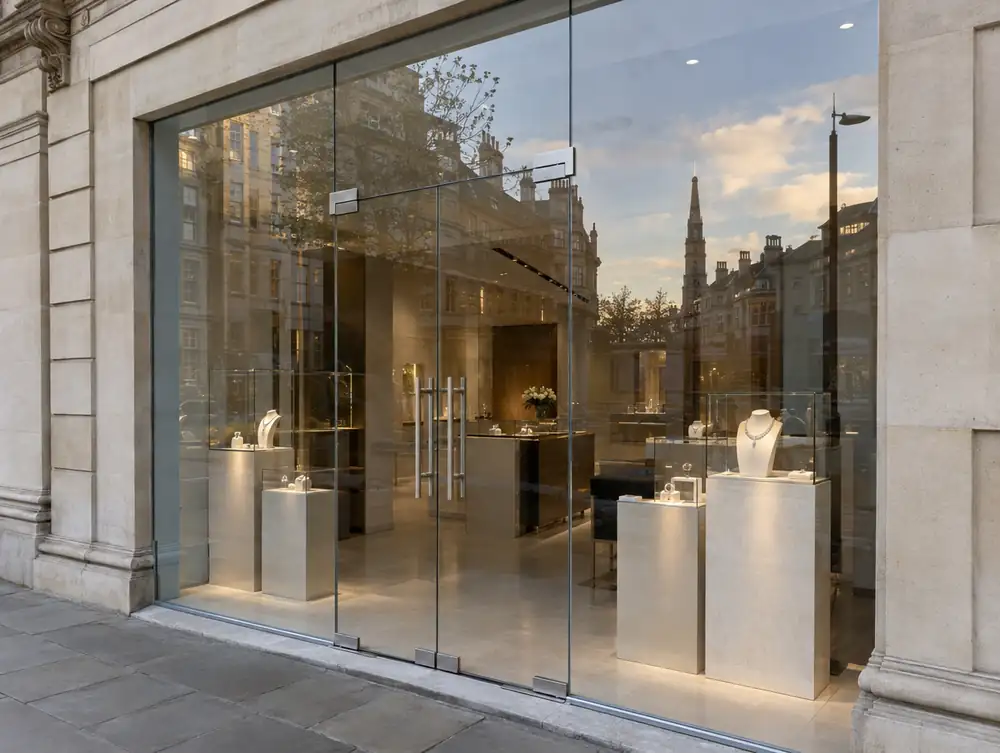
What makes frameless glass shopfronts work well on Birmingham premises?
A corner unit is where frameless glass earns its price, because a glass-to-glass corner dissolves the edge of the building. For a corner plot in Birmingham we'd check the structure above the missing pier first, then mitre the glass so the joint stays as fine as the panes allow.
Between two framed neighbours in a parade in Birmingham, a frameless front can look brilliant or bare. We'd hold the neighbouring fascia line and keep a slim plinth at their stallriser height, so the glass feels deliberate and the row still reads as a row.
A corner unit has two fronts to think about, and the return elevation often does as much selling as the main one. If that is your layout in Birmingham, carry the fascia and glass line round the corner and treat both faces as one composition.
Could frameless glass shopfronts in Birmingham need planning permission?
England has no permitted development route for changing a shopfront. Part 7 Class A of the General Permitted Development Order 2015 excludes creating, altering or replacing one, and it allows no alterations at all on article 2(3) land. That leaves two outcomes for frameless glass shopfronts at premises in the Birmingham area: a planning application, or work that doesn't materially affect the external appearance.
We confirm the position at survey, because a boundary or a special designation can change who handles the file, but applications from Birmingham premises normally go to Birmingham City Council.
How much should you set aside for frameless glass shopfronts in Birmingham?
Our guide band is £4,995 to £15,995 plus VAT for a typical frontage. Scope is the biggest lever, so a tighter brief for frameless glass shopfronts brings the figure down faster than any change of detail.
| Town | Birmingham |
|---|---|
| Area | West Midlands |
| Postcode districts | B1, B2, B3, B4 |
| Planning authority | Birmingham City Council |
| Building approval | Building Regulations (Approved Documents) |
| Distance from Great Barr | About 5 miles |
| Survey | Free for new work |
Does Birmingham City Council publish shopfront guidance?
Yes, Jewellery Quarter Conservation Area Design Guide (Section 9: Signage, Shopfronts and Lighting) (2005). It covers the Jewellery Quarter Conservation Area only, so it doesn't apply across the whole council area. A few of the things it asks for:
- There is a general presumption against security shutters on listed buildings and in the conservation area.
- Security glazing, internal grilles and demountable external grilles are the accepted alternatives to shutters.
- Internally lit signs are not permitted in a conservation area, and shopfronts and fascias should be externally lit.
Questions about frameless glass shopfronts in Birmingham
How much of my Birmingham shop will people see from the pavement?
All of it, which is both the point and the risk. Shelving backs, till positions and ceiling services become part of the front once the frames have gone, so we'd plan that view with you.
Which glass should I choose for premises in the West Midlands?
Clear toughened is the starting point, with low-iron for a whiter look and toughened laminated where you want the pane to stay put after a break. The right one depends on your stock, your street and your insurer.
How much cleaning will a glass front in Birmingham need?
More than a framed front, because glass shows every mark. A regular window cleaner using soft tools can handle it, and a yearly look at the silicone keeps the joints tidy.
What rules apply to a fire exit door through a shopfront in the Birmingham area?
It must open in the direction of escape and can't be locked against immediate use, and a dedicated fire exit can't be a sliding or revolving door. In England that comes from article 14(2) of the Regulatory Reform (Fire Safety) Order 2005, and the duty sits with the responsible person, normally the employer or whoever controls the premises for a business, otherwise the owner. An outward door can clash with section 153 of the Highways Act 1980 where it opens onto the footway, so raise it early.
Do I need planning permission to change a shopfront in the Birmingham area?
Usually yes, if the work materially affects the building's external appearance. England's shop permitted development rights exclude creating, altering or replacing a shopfront, so there is no shortcut. A true like-for-like replacement usually needs no application, and the council confirms the position.