A restaurant, bar or salon in Birmingham needs a sign that works as hard at nine in the evening as it does at noon. We set the colour temperature and output to suit your fascia, your interior and the street.
Surveys for Birmingham are booked with you directly. Tell us your quieter days and we'll work around them.
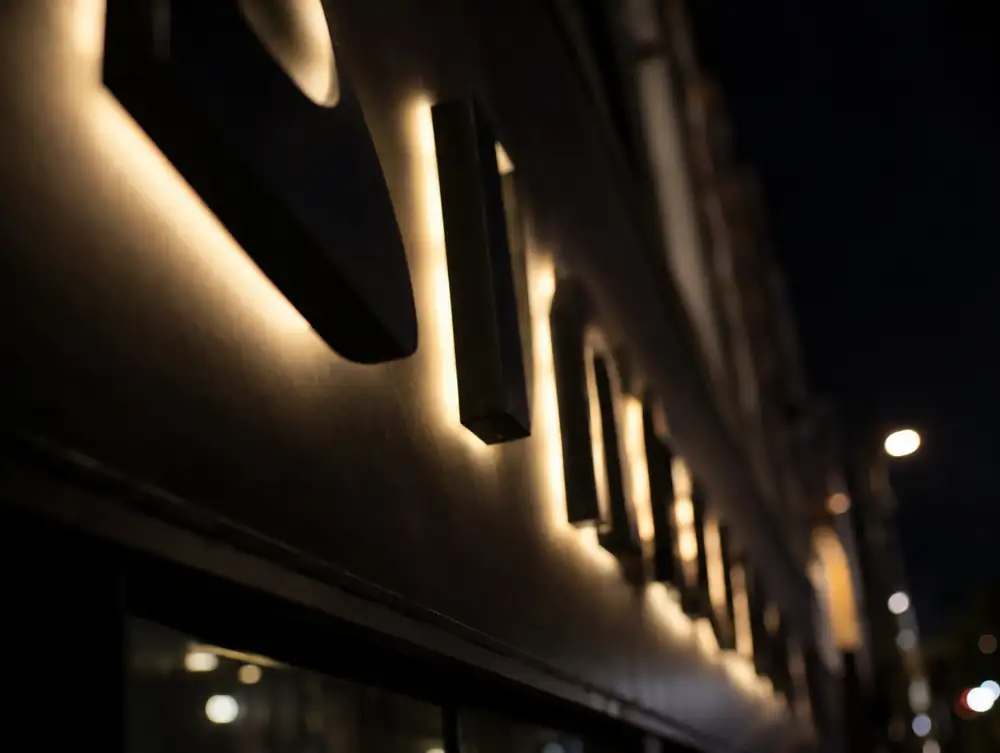
What goes into getting illuminated signage right in Birmingham?
Should your Birmingham premises close early, a photocell and timer can keep the sign on through the evening footfall and off for the rest of the night. It costs very little and helps the frontage look looked-after.
If there are flats above your Birmingham premises, we would keep the output modest and put the sign on a timer. A warm white at lower brightness is kinder to neighbours and still does its job.
If your Birmingham unit is narrow, a central door can split a small window into two weak ones. Moving the door to one side gives you a single confident pane, provided the layout inside still works.
How much could illuminated signage in Birmingham cost you?
The guide for illuminated signage is £895 to £3,995 plus VAT per sign. Expect the lower end for simple work with clear access, and the upper end where detail, finish or awkward conditions add hours.
Which applications might illuminated signage in Birmingham involve?
For illuminated signage at premises in the Birmingham area, the deciding question in England is whether the building work materially affects the external appearance. If it does, planning permission is needed, while a true like-for-like replacement usually needs none. The council confirms the position for each site.
Lighting moves a sign out of Class 5 in England, because that class allows illumination only for medical-type notices. Class 4B then applies at premises in the Birmingham area: halo or character-only lighting, static, with the lowest part at least 2.5m up. Brightness is capped at 600 cd/m² on signs up to 10m² and 300 cd/m² above that, and anything outside these limits needs advertisement consent.
Birmingham applications for planning permission or advertisement consent are normally handled by Birmingham City Council. Our survey includes a check of the position for your address.
| Town | Birmingham |
|---|---|
| Area | West Midlands |
| Postcode districts | B1, B2, B3, B4 |
| Planning authority | Birmingham City Council |
| Building approval | Building Regulations (Approved Documents) |
| Distance from Great Barr | About 5 miles |
| Survey | Free for new work |
Does Birmingham City Council publish shopfront guidance?
Yes, Jewellery Quarter Conservation Area Design Guide (Section 9: Signage, Shopfronts and Lighting) (2005). It covers the Jewellery Quarter Conservation Area only, so it doesn't apply across the whole council area. A few of the things it asks for:
- There is a general presumption against security shutters on listed buildings and in the conservation area.
- Security glazing, internal grilles and demountable external grilles are the accepted alternatives to shutters.
- Internally lit signs are not permitted in a conservation area, and shopfronts and fascias should be externally lit.
Questions about illuminated signage in Birmingham
Will a lit sign in Birmingham cost much to run?
Very little. A typical LED sign uses about the same power as a few domestic lamps, and a timer trims that further. Occasional driver changes are the larger long-term cost.
How will I know what my Birmingham sign looks like at night?
We draw it on your elevation and describe the lighting effect in the specification, and a sample letter can be tested on your fascia where that helps. Colour temperature and output are agreed before manufacture.
What happens if a lit letter fails on my Birmingham sign?
Usually a single LED driver or a damaged connection is to blame, and it can be traced from the access point. That is why drivers are placed where they can be reached without taking the sign down.
Does a new shopfront in the Birmingham area need Building Regulations approval?
Assume yes until building control says otherwise. England has no like-for-like exemption, though registered installers can self-certify replacement windows and doors in non-dwellings. That route doesn't cover structural glass, curtain walling or revolving doors.
Do I need planning permission to change a shopfront in the Birmingham area?
Usually yes, if the work materially affects the building's external appearance. England's shop permitted development rights exclude creating, altering or replacing a shopfront, so there is no shortcut. A true like-for-like replacement usually needs no application, and the council confirms the position.