Every shutter starts with the box, because a box added as an afterthought spoils the frontage. On Nottingham premises we draw its position with the fascia, the glass line and the ceiling.
Surveys for Nottingham are booked with you directly. Tell us your quieter days and we'll work around them.
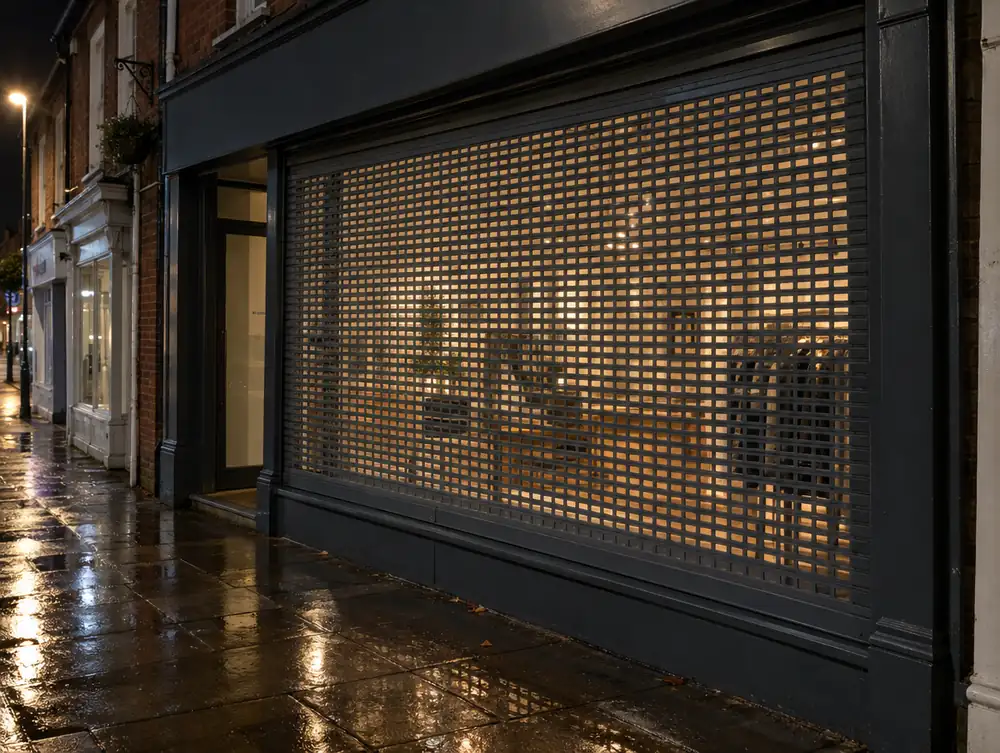
How do you design around the building when planning perforated roller shutters in Nottingham?
Where stock is high in value, a perforated shutter alone may not be enough. We would look at laminated glass in front, a rated curtain, and what your insurer expects, then specify the three together.
If the display goes dark overnight, the shutter will read as plain metal from the street. A low-level timer on the window lighting costs very little and keeps your Nottingham frontage looking open.
If the pavement falls across your frontage, let the stallriser take up the slope and keep the glass line dead level. The eye reads the long horizontal, so Nottingham premises on a slope look settled once that line is true.
What might perforated roller shutters cost in Nottingham?
Until the survey is done, plan on £1,695 to £4,495 plus VAT per shutter. Unusual sizes, fine detail and phased working push the figure up, while a simple brief and clear access keep it toward the lower end.
What permissions should you check for perforated roller shutters in Nottingham?
England has no permitted development route for changing a shopfront. Part 7 Class A of the General Permitted Development Order 2015 excludes creating, altering or replacing one, and it allows no alterations at all on article 2(3) land. That leaves two outcomes for perforated roller shutters at premises in the Nottingham area: a planning application, or work that doesn't materially affect the external appearance.
At survey we check how things stand for your building, although applications for planning permission or advertisement consent here normally go to Nottingham City Council.
| Town | Nottingham |
|---|---|
| Area | Nottinghamshire |
| Postcode districts | NG1, NG2, NG3, NG7 |
| Planning authority | Nottingham City Council |
| Building approval | Building Regulations (Approved Documents) |
| Distance from Great Barr | About 42 miles |
| Survey | Free for new work |
Does Nottingham City Council publish shopfront guidance?
Yes, Shopfront Design - Design Quality Framework. It tells applicants what the council expects from new and altered shopfronts. A few of the things it asks for:
- Fascias and signs should be sized to suit the shopfront and the building above, and oversized fascias are named as a common detractor.
- Historic glass should be kept, and toughened or laminated glass over 10mm is often enough for shop security.
- Internally fitted grilles and security gates are considered case by case, with extra care on listed buildings and in conservation areas.
Questions about perforated roller shutters in Nottingham
Can I keep my window display lit behind a shutter in Nottingham?
Yes, and we recommend it. A low-level light on a timer costs very little and lets the display read through the perforations overnight.
Do you remove old shutters in Nottingham?
Yes. Taking out the old curtain, box and guides, then making good the frontage, is shown as its own line in the itemised quotation.
What happens if the shutter jams at closing time in Nottingham?
Do not force it, because that can damage the curtain and motor. Use the manual override if it is safe, then call us. Repairs are charged call-outs, and the fixed price is shown on our site.
Do I need planning permission to change a shopfront in the Nottingham area?
Usually yes, if the work materially affects the building's external appearance. England's shop permitted development rights exclude creating, altering or replacing a shopfront, so there is no shortcut. A true like-for-like replacement usually needs no application, and the council confirms the position.
Does a new shopfront in the Nottingham area need Building Regulations approval?
Assume yes until building control says otherwise. England has no like-for-like exemption, though registered installers can self-certify replacement windows and doors in non-dwellings. That route doesn't cover structural glass, curtain walling or revolving doors.