Keys, remotes and manual overrides all matter at closing time. We set the controls to suit how your Glasgow staff lock up, then show them how everything works.
Bring whatever you have to the survey in Glasgow: brand guidelines, lease plans, old drawings or a photo of a frontage you admire.
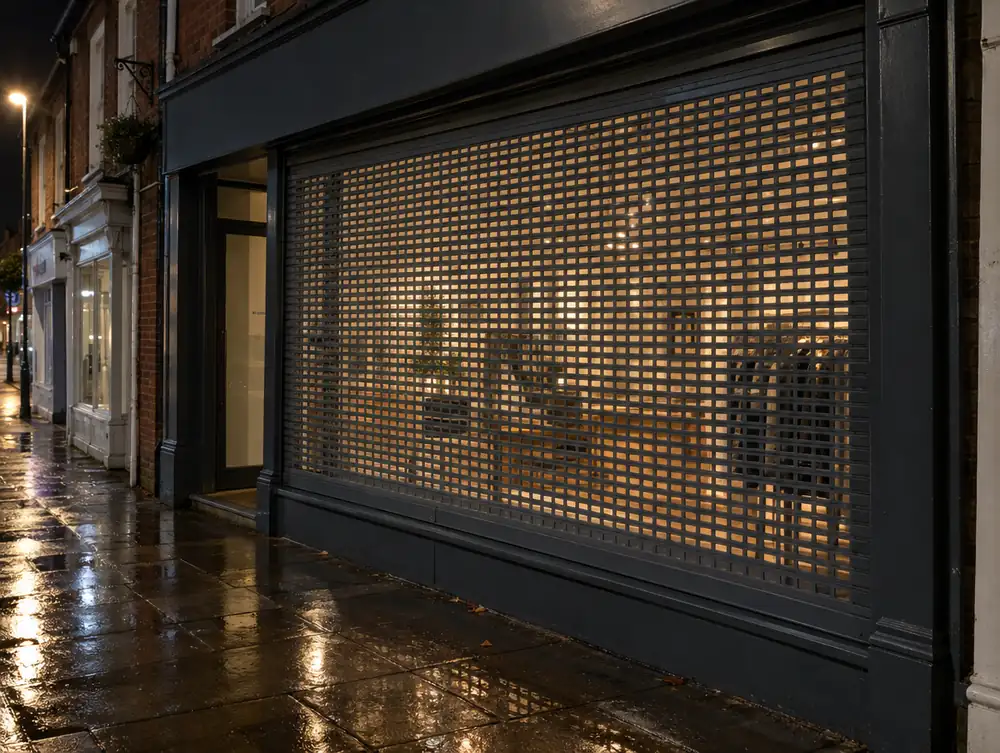
What should you think about before commissioning perforated roller shutters in Glasgow?
If the display goes dark overnight, the shutter will read as plain metal from the street. A low-level timer on the window lighting costs very little and keeps your Glasgow frontage looking open.
If the shutter has to run past a door or a side window, we check how the curtain lands on the threshold. A neat bottom rail and floor lock keep the entrance flush when the shutter is up.
A corner unit has two fronts to think about, and the return elevation often does as much selling as the main one. If that is your layout in Glasgow, carry the fascia and glass line round the corner and treat both faces as one composition.
What is a realistic budget for perforated roller shutters in Glasgow?
Guide price: £1,695 to £4,495 plus VAT per shutter. Materials, finish and the amount of drawing and coordination involved all move it, and your itemised quotation shows where the money goes on perforated roller shutters.
Who approves perforated roller shutters in Glasgow?
Scottish guidance says like-for-like windows need no permission, and a true like-for-like frontage replacement usually follows the same logic. Class 7A covers altering or replacing an existing window, but it doesn't mention shopfronts, so ask before relying on it for a display window. For perforated roller shutters at premises in the Glasgow area, a material effect on the external appearance means planning permission, and the council confirms the position.
At survey we check how things stand for your building, although applications for planning permission or advertisement consent here normally go to Glasgow City Council.
| Town | Glasgow |
|---|---|
| Area | Glasgow and Clyde |
| Postcode districts | G1, G2, G3, G4 |
| Planning authority | Glasgow City Council |
| Building approval | Building warrant (Technical Handbook) |
| Distance from Great Barr | About 248 miles |
| Survey | Free for new work |
Does Glasgow City Council publish shopfront guidance?
Yes, Shawlands Cross Conservation Area Shopfront Design Guide. It covers the Shawlands Cross Conservation Area only, so it doesn't apply across the whole council area. A few of the things it asks for:
- Traditional stallrisers should ideally be retained or restored, and advice should be sought before removing one.
- Fascias on traditional buildings should sit at the original level, wholly within the pilasters, and not extend over residential close entrances.
- Fascia lettering should preferably fill no more than two-thirds of the fascia height.
Questions about perforated roller shutters in Glasgow
Can one person open the shutter at my Glasgow shop?
Yes. Powered shutters run at the turn of a key or a button press, and a manual override is available if the power fails. We show your staff both at handover.
How noisy is a shutter in Glasgow premises?
A modern tubular motor is fairly quiet, and a well-set curtain only makes a low rumble. Heavier steel shutters and worn guides make more noise, which matters if there are flats above.
Can I keep my window display lit behind a shutter in Glasgow?
Yes, and we recommend it. A low-level light on a timer costs very little and lets the display read through the perforations overnight.
Do roller shutters need planning permission in the Glasgow area?
Usually yes, if they materially affect the external appearance. Class 9A doesn't name shutters, so in Scotland treat them as falling to the appearance test rather than assuming a permitted development route. Ask the council before ordering, as this is a reading of the rules and not an official statement.
Does a shop sign in the Glasgow area need advertisement consent?
Not always. Scotland's 1984 Regulations let an unlit sign within Class IV(1) go up without an application, and Class VI does the same for a lit sign with each character lit from within. Class VI isn't available in conservation areas, and one council says lit signs always need express consent, so ask first.