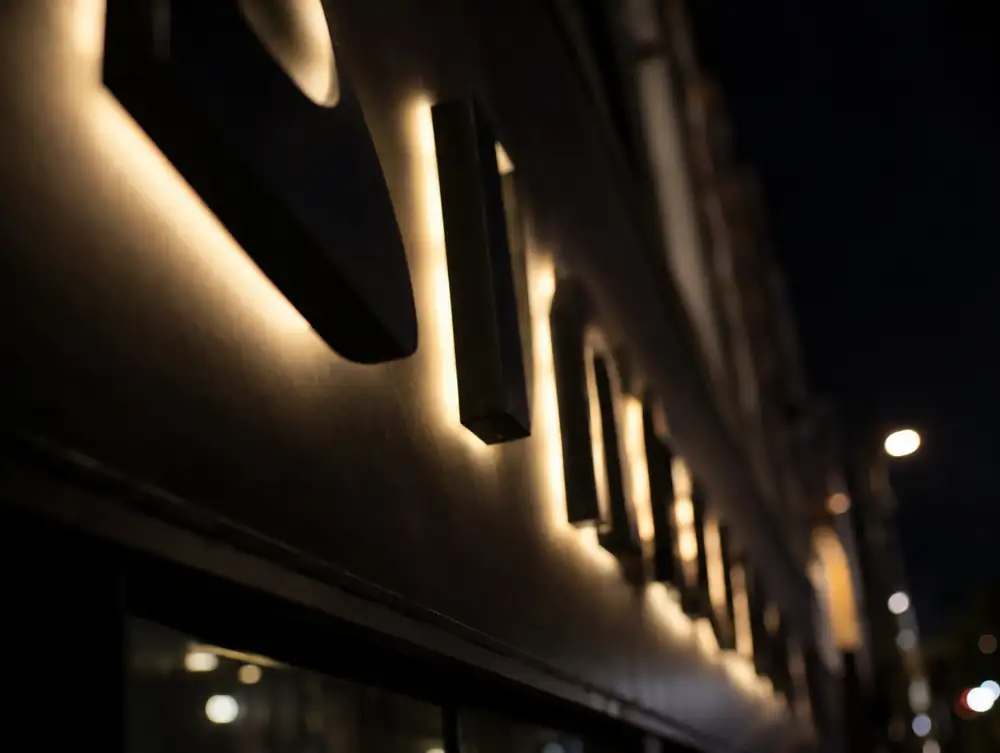
Halo-lit letters give Glasgow premises a soft glow on the panel behind, with the name itself in crisp silhouette. Face-lit and trough options suit other brands and buildings, and we show you the difference on a scale drawing.
Surveys for Glasgow are booked with you directly. Tell us your quieter days and we'll work around them.
How would we approach illuminated signage for your Glasgow premises?
If an old lightbox is coming down, we check the cable position and the wall behind it before designing the new sign. An existing supply can often be reused, which saves work on the inside.
If letters will sit close to a window head or canopy, we check how the light falls across it. A small change in stand-off or letter position can prevent a hard shadow line.
If your Glasgow unit sits in a Victorian parade, the old pilasters usually set the rhythm, so a new front should land on them and not run past them. Keep that line and even a modern frame looks as though it belongs.
What should you budget for illuminated signage in Glasgow?
Guide price: £895 to £3,995 plus VAT per sign. Materials, finish and the amount of drawing and coordination involved all move it, and your itemised quotation shows where the money goes on illuminated signage.
What consents could affect illuminated signage in Glasgow?
Scottish guidance says like-for-like windows need no permission, and a true like-for-like frontage replacement usually follows the same logic. Class 7A covers altering or replacing an existing window, but it doesn't mention shopfronts, so ask before relying on it for a display window. For illuminated signage at premises in the Glasgow area, a material effect on the external appearance means planning permission, and the council confirms the position.
Class VI is the class for lit signs in Scotland, and it is tightly drawn: each character lit from within, the sign at least 2.5m up, no more than 0.25m of projection, and static lighting. One Scottish council says illuminated signs always need express consent, which doesn't match Class VI, so ask the council for the Glasgow area before ordering.
Glasgow applications for planning permission or advertisement consent are normally handled by Glasgow City Council. Our survey includes a check of the position for your address.
| Town | Glasgow |
|---|---|
| Area | Glasgow and Clyde |
| Postcode districts | G1, G2, G3, G4 |
| Planning authority | Glasgow City Council |
| Building approval | Building warrant (Technical Handbook) |
| Distance from Great Barr | About 248 miles |
| Survey | Free for new work |
Does Glasgow City Council publish shopfront guidance?
Yes, Shawlands Cross Conservation Area Shopfront Design Guide. It covers the Shawlands Cross Conservation Area only, so it doesn't apply across the whole council area. A few of the things it asks for:
- Traditional stallrisers should ideally be retained or restored, and advice should be sought before removing one.
- Fascias on traditional buildings should sit at the original level, wholly within the pilasters, and not extend over residential close entrances.
- Fascia lettering should preferably fill no more than two-thirds of the fascia height.
Questions about illuminated signage in Glasgow
Can the sign in Glasgow be switched off at night?
Yes. A timer, photocell or simple switch can be built in, and many premises set the sign to go off shortly after closing or late in the evening.
Do you supply lit signs for premises across Glasgow and Clyde?
Yes. We travel from Great Barr, with vetted teams working under S&K Glazing and one named contact for the job. The same scale drawing and sign-off process applies wherever your premises are.
Will a lit sign in Glasgow cost much to run?
Very little. A typical LED sign uses about the same power as a few domestic lamps, and a timer trims that further. Occasional driver changes are the larger long-term cost.
Which way must a fire exit door open on a shop in the Glasgow area?
In the direction of escape. Regulation 13(2) of the Fire Safety (Scotland) Regulations 2006 also rules out sliding and revolving doors on a dedicated fire exit and says fire exit doors can't be locked against immediate use. Duties sit with dutyholders under Part 3 of the Fire (Scotland) Act 2005, meaning the employer and any person with control of the premises.
Does the Equality Act cover a shop entrance in the Glasgow area?
Yes. The Equality Act 2010 applies in Scotland as part of Great Britain, and its anticipatory duty expects reasonable steps to remove, alter or avoid physical features that disadvantage disabled people generally. BS 8300-2:2018 is the current British Standard for accessible buildings.