If you've admired a painted shopfront and wondered why yours can't look like that, it usually can. Send us the photo, and we'll draw a timber front for your Glasgow premises that captures what you liked.
Measuring the opening is the easy part of a survey in Glasgow. We also look at the beam above, the pavement fall and any meters or drains nearby.
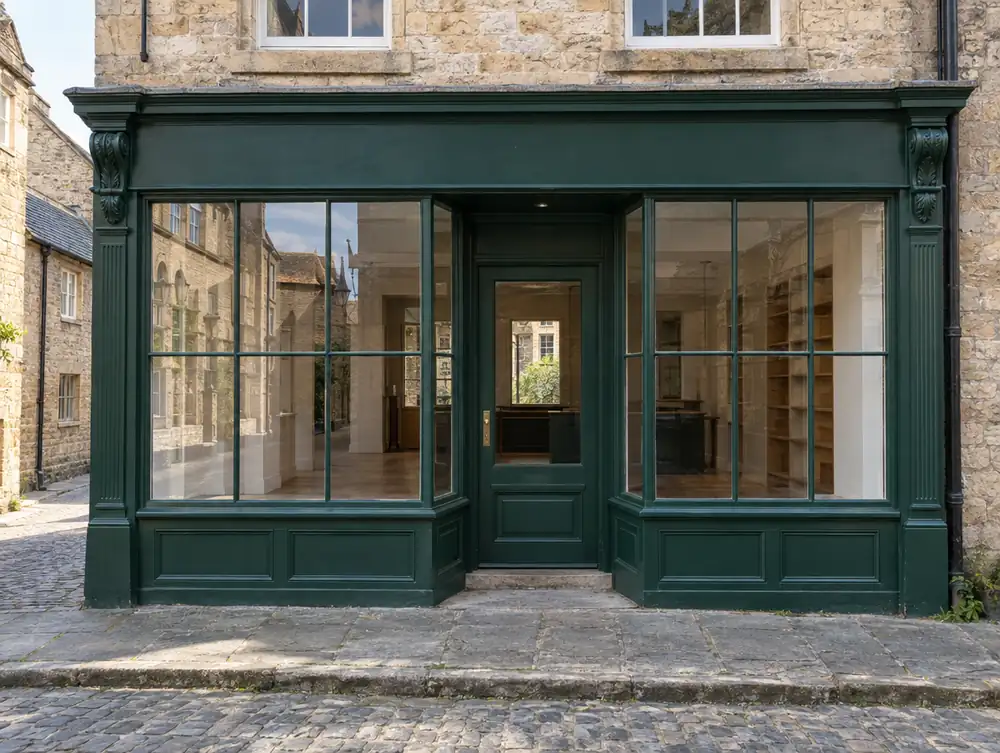
What makes timber shopfronts work well on Glasgow premises?
A brand rollout can include timber, as long as the details repeat. For a branch in Glasgow we'd use the same mouldings, colours and sign panel as your other sites, adjusting only the widths and heights to fit the opening.
In a parade of mixed fronts in Glasgow, painted timber can lift a unit without shouting. We'd take the height of the neighbouring cills and fascias, then let the depth of the mouldings and a considered colour do the talking.
If your Glasgow unit is narrow, a central door can split a small window into two weak ones. Moving the door to one side gives you a single confident pane, provided the layout inside still works.
How much should you set aside for timber shopfronts in Glasgow?
The guide for timber shopfronts is £3,995 to £13,995 plus VAT for a typical frontage. Expect the lower end for simple work with clear access, and the upper end where detail, finish or awkward conditions add hours.
Could timber shopfronts in Glasgow need planning permission?
Shutters aren't named in Class 9A, so in Scotland they usually fall to the appearance test. The same goes for timber shopfronts at premises in the Glasgow area: building work that materially affects the external appearance needs planning permission, and a true like-for-like usually doesn't. Ask the council to confirm the position for your site.
We confirm the position at survey, because a boundary or a special designation can change who handles the file, but applications from Glasgow premises normally go to Glasgow City Council.
| Town | Glasgow |
|---|---|
| Area | Glasgow and Clyde |
| Postcode districts | G1, G2, G3, G4 |
| Planning authority | Glasgow City Council |
| Building approval | Building warrant (Technical Handbook) |
| Distance from Great Barr | About 248 miles |
| Survey | Free for new work |
Does Glasgow City Council publish shopfront guidance?
Yes, Shawlands Cross Conservation Area Shopfront Design Guide. It covers the Shawlands Cross Conservation Area only, so it doesn't apply across the whole council area. A few of the things it asks for:
- Traditional stallrisers should ideally be retained or restored, and advice should be sought before removing one.
- Fascias on traditional buildings should sit at the original level, wholly within the pilasters, and not extend over residential close entrances.
- Fascia lettering should preferably fill no more than two-thirds of the fascia height.
Questions about timber shopfronts in Glasgow
Will timber suffer on my Glasgow frontage if it gets a lot of rain?
Not if the details are right. Sloped cills, sealed end grain and plinth blocks keep water moving, and the paint system then only has to deal with the weather, not trapped damp.
Do you make the joinery for Glasgow shops to order?
Yes. Every length is made to the signed-off drawings for your opening, then brought to Glasgow from Great Barr by vetted teams working under S&K Glazing.
How much disruption will a timber front cause in my Glasgow shop?
Expect more time on site than an aluminium front, typically 3 to 7 days with the painting. Closed-day or out-of-hours fitting can be arranged, and the opening stays boarded and secure between stages.
Do I need a building warrant for a shopfront in the Glasgow area?
Usually yes in Scotland, if the work alters a wall or structure. Schedule 3 of the Building (Scotland) Regulations 2004 lists some work that needs no warrant, such as replacing a door or window with its frame, but the standards still apply. Shopfronts aren't named there, so ask the council before relying on it.
Which way must a fire exit door open on a shop in the Glasgow area?
In the direction of escape. Regulation 13(2) of the Fire Safety (Scotland) Regulations 2006 also rules out sliding and revolving doors on a dedicated fire exit and says fire exit doors can't be locked against immediate use. Duties sit with dutyholders under Part 3 of the Fire (Scotland) Act 2005, meaning the employer and any person with control of the premises.