Perforated roller shutters give Leeds premises out-of-hours protection while light and the display still show through. We look first at whether the shutter should sit inside the glass, since that often gives a better frontage.
Measuring the opening is the easy part of a survey in Leeds. We also look at the beam above, the pavement fall and any meters or drains nearby.
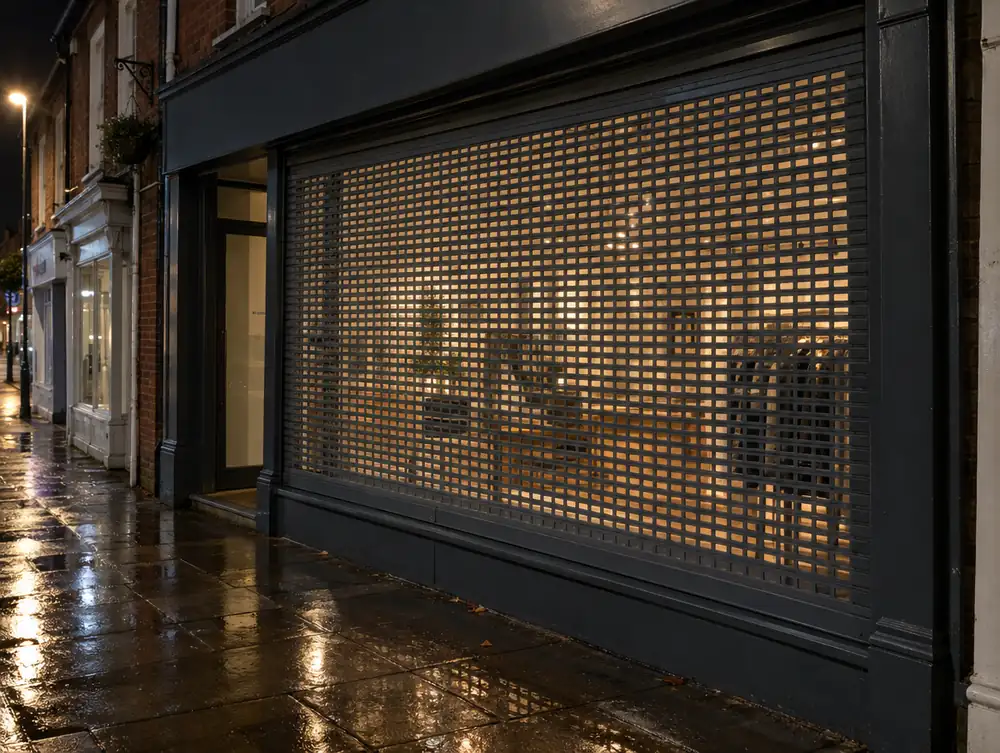
What goes into getting perforated roller shutters right in Leeds?
For premises that open early or trade late, shutter noise can matter to neighbours. A motor with a soft start and well-set guides runs noticeably more quietly.
On premises with a recessed entrance, the shutter line needs careful thought. We usually bring it forward to the building line, or close the recess separately, so the doorway does not become a hiding place.
A corner unit has two fronts to think about, and the return elevation often does as much selling as the main one. If that is your layout in Leeds, carry the fascia and glass line round the corner and treat both faces as one composition.
Which applications might perforated roller shutters in Leeds involve?
For perforated roller shutters at premises in the Leeds area, the deciding question in England is whether the building work materially affects the external appearance. If it does, planning permission is needed, while a true like-for-like replacement usually needs none. The council confirms the position for each site.
At survey we check how things stand for your building, although applications for planning permission or advertisement consent here normally go to Leeds City Council.
How much could perforated roller shutters in Leeds cost you?
The guide for perforated roller shutters is £1,695 to £4,495 plus VAT per shutter. Expect the lower end for simple work with clear access, and the upper end where detail, finish or awkward conditions add hours.
| Town | Leeds |
|---|---|
| Area | West Yorkshire |
| Postcode districts | LS1, LS11, LS2, LS3 |
| Planning authority | Leeds City Council |
| Building approval | Building Regulations (Approved Documents) |
| Distance from Great Barr | About 88 miles |
| Survey | Free for new work |
Does Leeds City Council publish shopfront guidance?
Yes, Morley Shopfront Design & Maintenance Guide (2025). It covers Morley town centre only, so it doesn't apply across the whole council area. A few of the things it asks for:
- Fascias in Morley should typically be no taller than 600mm and should not run unbroken across neighbouring buildings.
- Internal security screens must be lattice or scissor types, as solid or pinhole-perforated versions will be rejected.
- uPVC is very rarely appropriate for any shopfront element, and silver or grey aluminium should be avoided on historic buildings.
Questions about perforated roller shutters in Leeds
How noisy is a shutter in Leeds premises?
A modern tubular motor is fairly quiet, and a well-set curtain only makes a low rumble. Heavier steel shutters and worn guides make more noise, which matters if there are flats above.
What controls can a shutter have?
A key switch, a wall button or a remote are the usual choices, each with a manual override. Many shops use a key switch at the door, so closing up needs someone present.
Can you fit an internal shutter on my Leeds premises?
Usually, yes. We check for ceiling space, a clear path behind the window and a solid fixing for the guides. Where space is tight, a slim box or a smaller display can make it work.
Does a new shopfront in the Leeds area need Building Regulations approval?
Assume yes until building control says otherwise. England has no like-for-like exemption, though registered installers can self-certify replacement windows and doors in non-dwellings. That route doesn't cover structural glass, curtain walling or revolving doors.
Does the Equality Act apply to a shop entrance in the Leeds area?
Yes. The Equality Act 2010 applies in England, as across Great Britain, and it requires reasonable steps to remove, alter or avoid physical features that disadvantage disabled people. The duty is anticipatory, so it looks at disabled people generally, and a new Services Code replaced the 2011 Code on 5 August 2026.