Old tiles, carved brackets and slim glazing bars give a frontage in Leeds a quality new work struggles to match. Where they've survived we keep them, and where they've gone we draw their replacements at full size.
It helps if you can be there when we visit Leeds, since five minutes walking the frontage together answers more than a long email.
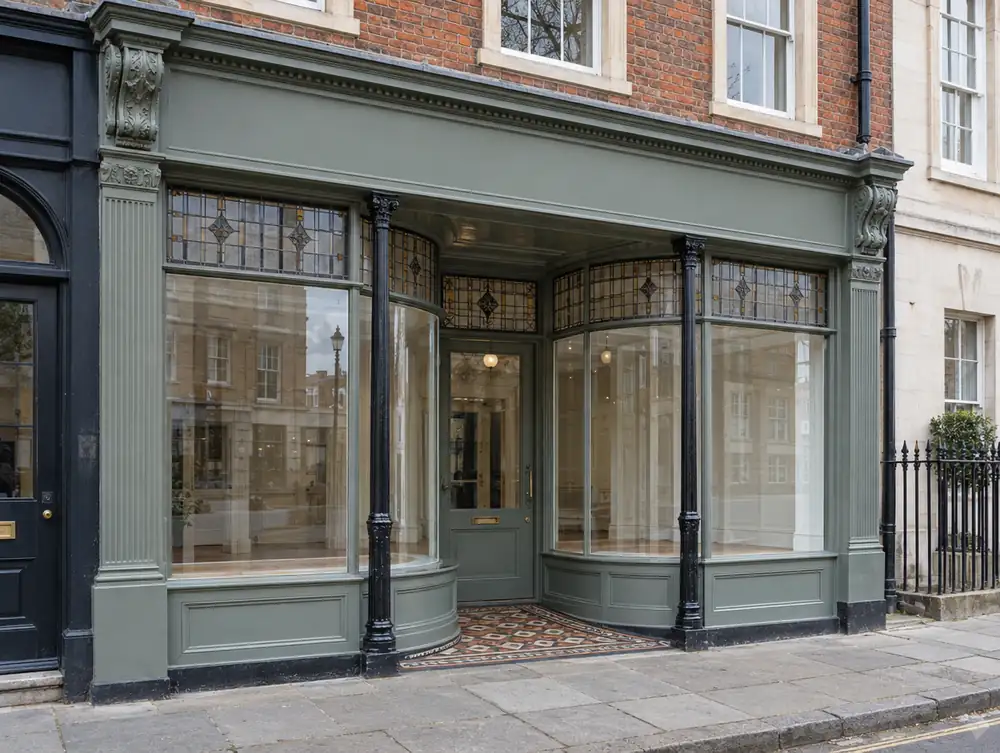
What makes heritage shopfronts work well on Leeds premises?
A landlord may own the building while you hold the lease, and each can see old fabric differently. For Leeds premises we'd prepare a plain record of what's there and what we propose, so both sides can agree before work starts.
Deep recessed lobbies are among the first things to go in a refit. If your Leeds premises still have one, especially with a tiled floor, we'd protect it, repair the floor and reuse the returns as display.
If there are storeys above the shop, the frontage should feel like the base of the building and not a sign stuck on it. Lining up mullions with the windows overhead is a small move that settles the whole elevation at Leeds premises.
How much should you set aside for heritage shopfronts in Leeds?
As a working budget, use £8,495 to £24,995 plus VAT for a typical frontage. Your place inside that range for heritage shopfronts depends mostly on how much of the existing frontage can stay and how much has to be put right first.
Could heritage shopfronts in Leeds need planning permission?
Security grilles and shutters are named in England's rules: installing or replacing one on a shopfront sits outside the shop permitted development rights. The frontage itself is treated the same way, so for heritage shopfronts at premises in the Leeds area, building work that materially affects the appearance needs planning permission. Confirm the position with the council before anything is ordered.
For Leeds, the usual route for planning and advert applications is through Leeds City Council, and we confirm that when we visit.
| Town | Leeds |
|---|---|
| Area | West Yorkshire |
| Postcode districts | LS1, LS11, LS2, LS3 |
| Planning authority | Leeds City Council |
| Building approval | Building Regulations (Approved Documents) |
| Distance from Great Barr | About 88 miles |
| Survey | Free for new work |
Does Leeds City Council publish shopfront guidance?
Yes, Morley Shopfront Design & Maintenance Guide (2025). It covers Morley town centre only, so it doesn't apply across the whole council area. A few of the things it asks for:
- Fascias in Morley should typically be no taller than 600mm and should not run unbroken across neighbouring buildings.
- Internal security screens must be lattice or scissor types, as solid or pinhole-perforated versions will be rejected.
- uPVC is very rarely appropriate for any shopfront element, and silver or grey aluminium should be avoided on historic buildings.
Questions about heritage shopfronts in Leeds
Which old features would you always try to save in West Yorkshire?
Tiled stallrisers, mosaic thresholds, console brackets, ironwork and leaded top lights, wherever they survive. These are the details that are hardest to recreate convincingly.
Can a new sign go on my old Leeds shopfront?
Yes, and traditional sign writing often looks right on a painted fascia. We'd draw the lettering to suit the fascia, then fix anything raised so it does no harm to the original timber.
Can you find the colour my Leeds shopfront used to be?
Often. Scraping back through the paint layers shows earlier colours, and a specialist can analyse them if the detail matters.
Do roller shutters need planning permission in the Leeds area?
Usually yes. Installing or replacing a security grill or shutter on a shopfront is expressly outside England's shop permitted development rights, so the only way to avoid an application is work that doesn't materially affect the appearance. Ask the council before ordering.
Does a new shopfront in the Leeds area need Building Regulations approval?
Assume yes until building control says otherwise. England has no like-for-like exemption, though registered installers can self-certify replacement windows and doors in non-dwellings. That route doesn't cover structural glass, curtain walling or revolving doors.