Good planning and consent support starts with the building, so the first step for any premises in Stirling and Falkirk is a measured visit. Everything we draw or submit after that rests on real dimensions.
Access gets as much attention as appearance at survey. Where a vehicle can stop, how long sections reach the opening and how the pavement stays safe for the public all shape the programme for planning and consent support in Stirling and Falkirk.
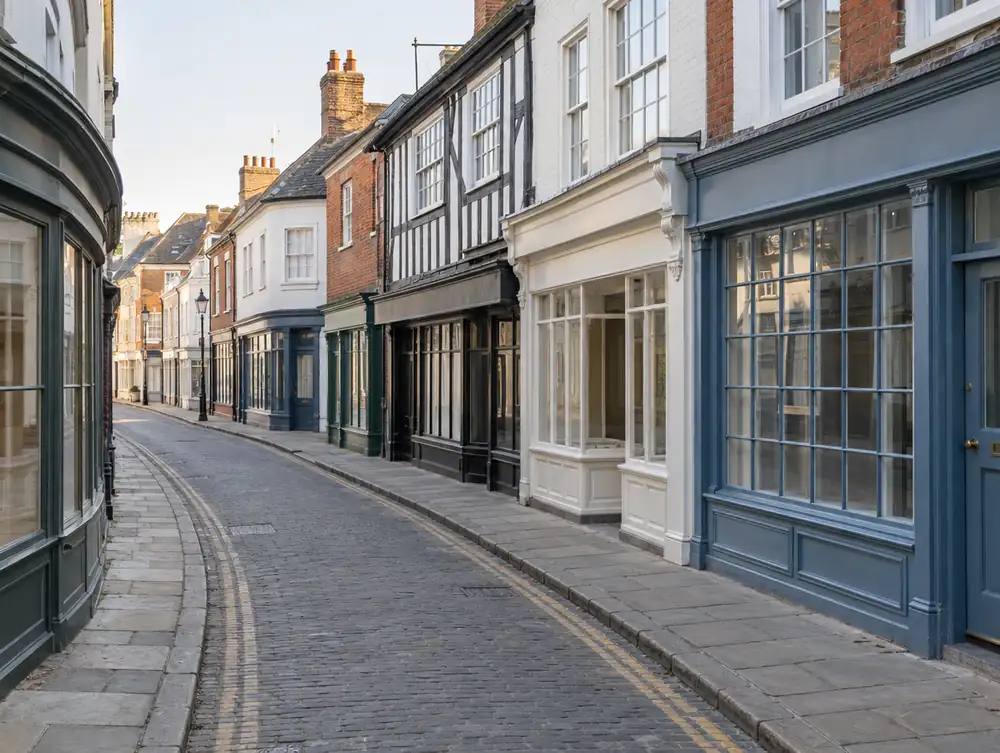
Where do you start with planning and consent support in Stirling and Falkirk?
Good applications start with good photographs. For premises across Stirling and Falkirk we record the frontage, its neighbours and the wider street at survey, so the drawings show your proposal in context.
Older buildings need more evidence. If your premises in Stirling and Falkirk have surviving features, we photograph and draw them before the design is fixed, so the submission shows what will be kept.
What consents apply to shopfront work in Stirling and Falkirk?
Class 9A, Scotland's shop permitted development right, gives no route for a shopfront change. It covers Class 1A premises, but not work that alters or extends beyond the existing front, and it doesn't apply in conservation areas, National Parks or World Heritage Sites. For shopfront work at premises in the Stirling and Falkirk area, that generally means a planning application unless the external appearance isn't materially affected.
How much does planning and consent support cost in Stirling and Falkirk?
The guide for planning and consent support is £395 to £1,295 plus VAT per application, plus the council's fee. Expect the lower end for simple work with clear access, and the upper end where detail, finish or awkward conditions add hours.
| Area | Stirling and Falkirk |
|---|---|
| Nation | Scotland |
| Towns covered | 8 |
| Main town | Stirling |
| Planning regime | Scotland: 1997 Planning Act and the 1984 Advertisement Regulations |
| Building approval | Building warrant (Technical Handbook) |
| Survey | Free for new work, from our Great Barr base |
Does Clackmannanshire Council publish shopfront guidance?
Yes, Shop Fronts, Supplementary Advice Note No. 7. It tells applicants what the council expects from new and altered shopfronts. A few of the things it asks for:
- Stallrisers are preferred over full-depth glazing.
- Box fascias can look clumsy, and new fascia panels should sit flush with the surrounding framework.
- External security shutters are opposed on listed buildings, and where external shutters are essential open mesh covering only the glazing is preferred.
Questions about planning and consent support in Stirling and Falkirk
Can the sign and shopfront be drawn together for premises in Stirling and Falkirk?
Yes, and that is how we prefer to work. One drawing set shows the frontage as it will really look, which helps everyone reviewing it.
How early should I start if I have an opening date in Stirling and Falkirk?
As early as you can, ideally before you commit to the date. Design, drawings and a decision can take months together, so we would map it out with you at the first meeting.
Do you prepare applications for premises across Stirling and Falkirk?
Yes. We measure, draw and prepare the application, then submit it and answer the officer's questions. The decision itself is never ours to make, and we will always be plain about that.
Do I need listed building consent for a shopfront in the Stirling and Falkirk area?
Almost certainly, if the building is listed and windows or doors are changing, according to Historic Environment Scotland. The planning authority decides, and Historic Environment Scotland is consulted on some applications. Scottish Ministers are notified if it objects.
Which way must a fire exit door open on a shop in the Stirling and Falkirk area?
In the direction of escape. Regulation 13(2) of the Fire Safety (Scotland) Regulations 2006 also rules out sliding and revolving doors on a dedicated fire exit and says fire exit doors can't be locked against immediate use. Duties sit with dutyholders under Part 3 of the Fire (Scotland) Act 2005, meaning the employer and any person with control of the premises.