From Stirling to the furthest corner of Stirling and Falkirk, the sequence for curved glass shopfronts stays the same: survey, drawings, written price, then work on site. We travel from Great Barr in Birmingham and use vetted teams working under S&K Glazing.
Daylight is only half the brief for curved glass shopfronts, because a frontage keeps working after dark. Think about how the glass, the sign and the view inside will read to someone walking past at six o'clock on a winter evening.
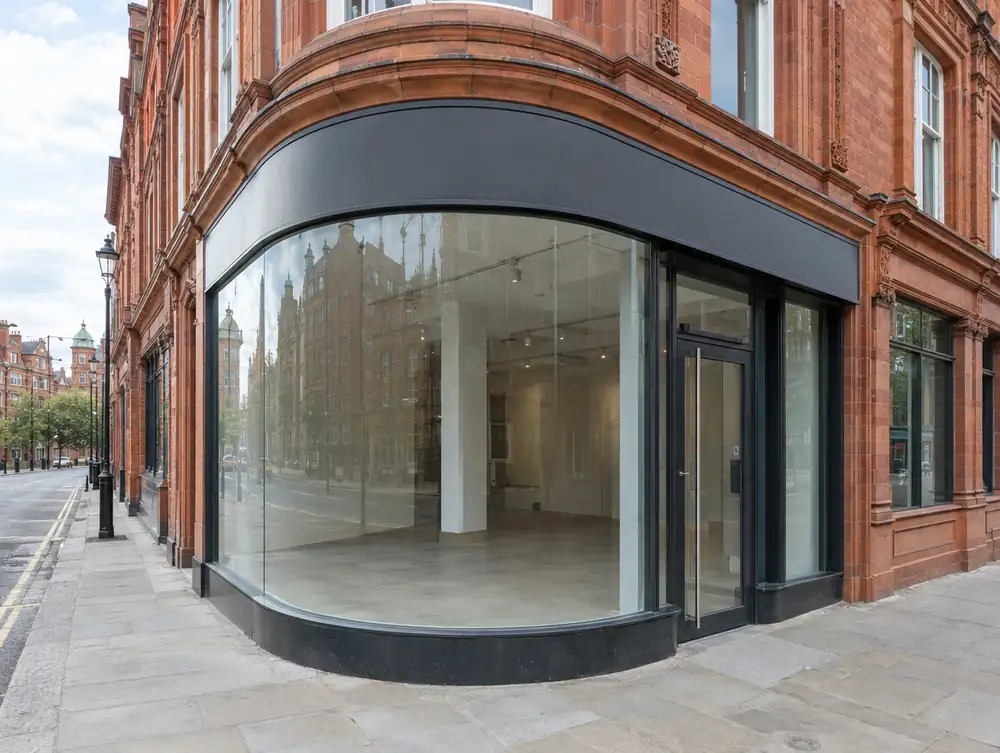
What should you settle before committing to curved glass shopfronts in Stirling and Falkirk?
Corners catch the weather from two directions. If your unit in Stirling and Falkirk stands on an exposed junction, we'd look harder at head fixings, cill drainage and the seal where the curve meets the straight run.
A curved pane follows the building instead of a catalogue. For premises across Stirling and Falkirk we template the real corner at floor, waist and head height, because old brickwork often drifts from one radius to another.
What consents apply to curved glass shopfronts in Stirling and Falkirk?
Scottish guidance says like-for-like windows need no permission, and a true like-for-like frontage replacement usually follows the same logic. Class 7A covers altering or replacing an existing window, but it doesn't mention shopfronts, so ask before relying on it for a display window. For curved glass shopfronts at premises in the Stirling and Falkirk area, a material effect on the external appearance means planning permission, and the council confirms the position.
How much do curved glass shopfronts cost in Stirling and Falkirk?
A sensible starting budget is £6,995 to £19,995 plus VAT for a typical frontage. What shifts the figure is whatever can't be seen yet, such as the condition behind the old frontage or the services running through it.
| Area | Stirling and Falkirk |
|---|---|
| Nation | Scotland |
| Towns covered | 8 |
| Main town | Stirling |
| Planning regime | Scotland: 1997 Planning Act and the 1984 Advertisement Regulations |
| Building approval | Building warrant (Technical Handbook) |
| Survey | Free for new work, from our Great Barr base |
Does Clackmannanshire Council publish shopfront guidance?
Yes, Shop Fronts, Supplementary Advice Note No. 7. It tells applicants what the council expects from new and altered shopfronts. A few of the things it asks for:
- Stallrisers are preferred over full-depth glazing.
- Box fascias can look clumsy, and new fascia panels should sit flush with the surrounding framework.
- External security shutters are opposed on listed buildings, and where external shutters are essential open mesh covering only the glazing is preferred.
Questions about curved glass shopfronts in Stirling and Falkirk
Is a faceted front a sensible alternative in Stirling and Falkirk?
Often, yes, especially on a wide radius. Narrow flat panes give a soft curve from a distance, cost less and are far simpler to replace.
Do you supply curved glass shopfronts across Stirling and Falkirk?
Yes. We travel from Great Barr to template the curve and fit the glass, with the panes made to that template.
What if my corner in Stirling and Falkirk is not a true curve?
Most aren't. We set the glass to the closest arc and absorb the rest in the head and floor channels, or build out the surround where the building drifts too far.
Do I need a building warrant for a shopfront in the Stirling and Falkirk area?
Usually yes in Scotland, if the work alters a wall or structure. Schedule 3 of the Building (Scotland) Regulations 2004 lists some work that needs no warrant, such as replacing a door or window with its frame, but the standards still apply. Shopfronts aren't named there, so ask the council before relying on it.
Which way must a fire exit door open on a shop in the Stirling and Falkirk area?
In the direction of escape. Regulation 13(2) of the Fire Safety (Scotland) Regulations 2006 also rules out sliding and revolving doors on a dedicated fire exit and says fire exit doors can't be locked against immediate use. Duties sit with dutyholders under Part 3 of the Fire (Scotland) Act 2005, meaning the employer and any person with control of the premises.