Few businesses can shut for a week, so any time on site for illuminated signage in Stirling and Falkirk is planned around the hours you trade. Closed-day or out-of-hours installation can be arranged.
Most frontages share something with someone, be that a door to the flats above, a meter cupboard or a pilaster on the boundary. We pick those up early on illuminated signage in Stirling and Falkirk, because they are far easier to design around than to discover on the day.
How should you approach illuminated signage in Stirling and Falkirk?
Flats or hotel rooms nearby change the brief. Where premises in Stirling and Falkirk have neighbours close by at night, a warmer white, lower output and a late timer keep the sign welcome.
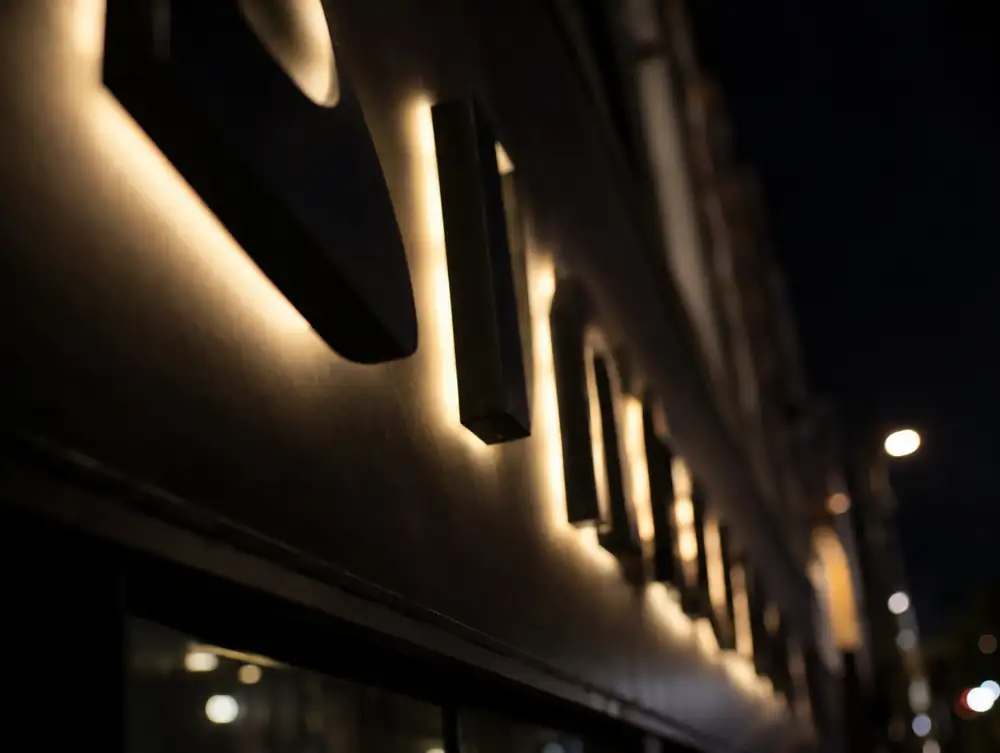
Background decides whether halo lighting works. On premises around Stirling we test the glow against your actual fascia finish, because brick, painted timber and dark composite each throw the light differently.
What consents apply to illuminated signage in Stirling and Falkirk?
Section 26 of the Town and Country Planning (Scotland) Act 1997 sets the test: work that doesn't materially affect the external appearance isn't development. For illuminated signage at premises in the Stirling and Falkirk area, anything that does needs planning permission, and a true like-for-like replacement usually doesn't. The council confirms how that applies to each site.
Class VI is the class for lit signs in Scotland, and it is tightly drawn: each character lit from within, the sign at least 2.5m up, no more than 0.25m of projection, and static lighting. One Scottish council says illuminated signs always need express consent, which doesn't match Class VI, so ask the council for the Stirling and Falkirk area before ordering.
How much does illuminated signage cost in Stirling and Falkirk?
We would budget £895 to £3,995 plus VAT per sign. Scope sets most of the figure, so a clear brief at the start does more for the budget than any later change of detail.
| Area | Stirling and Falkirk |
|---|---|
| Nation | Scotland |
| Towns covered | 8 |
| Main town | Stirling |
| Planning regime | Scotland: 1997 Planning Act and the 1984 Advertisement Regulations |
| Building approval | Building warrant (Technical Handbook) |
| Survey | Free for new work, from our Great Barr base |
Does Clackmannanshire Council publish shopfront guidance?
Yes, Shop Fronts, Supplementary Advice Note No. 7. It tells applicants what the council expects from new and altered shopfronts. A few of the things it asks for:
- Stallrisers are preferred over full-depth glazing.
- Box fascias can look clumsy, and new fascia panels should sit flush with the surrounding framework.
- External security shutters are opposed on listed buildings, and where external shutters are essential open mesh covering only the glazing is preferred.
Questions about illuminated signage in Stirling and Falkirk
Can a lit sign in Stirling and Falkirk be set on a timer?
Yes, and we would recommend it. A timer or photocell switches the sign to suit your trading hours, and it can dim or switch off late in the evening.
Can you test a lit letter on my premises in Stirling and Falkirk before ordering?
Yes, where the job warrants it. A sample letter held against your fascia at dusk tells you more than a visual, particularly for halo lighting on a dark finish.
How disruptive is fitting a lit sign in Stirling and Falkirk?
Very little, as a rule. Fitting usually takes one to two days from a tower or platform, and any cable work inside the shop can be done outside trading hours.
Do roller shutters need planning permission in the Stirling and Falkirk area?
Usually yes, if they materially affect the external appearance. Class 9A doesn't name shutters, so in Scotland treat them as falling to the appearance test rather than assuming a permitted development route. Ask the council before ordering, as this is a reading of the rules and not an official statement.
Do I need planning permission to alter a shopfront in the Stirling and Falkirk area?
Usually yes, if the work materially affects the external appearance. Class 9A, Scotland's shop permitted development right, doesn't cover work that alters or extends beyond the existing front. A true like-for-like replacement usually needs no permission, and the council confirms the position.